Questions + Answers from the Product Manager's POV

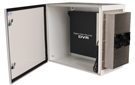
DVRs are often placed in remote, unhospitable environments. An air-conditioned enclosure helps protect the DVR so it’s able to do the job it was built for. We wanted to know more about the enclosure market, so we sat down the Bruce Blackway of EIC Solutions Inc.

Q. What is the DVR enclosure

A. EIC’s air-conditioned enclosure is designed to house and protect a DVR, as well as other 19-inch rack-mount electronics such as servers, routers, modems, switches, amplifiers, power supplies, network gear and communication equipment. The DVR is not included with the purchase of this enclosure. There are many variations and sizes of DVR's available today, but we offer many different enclosures to fit various needs.

Q. Is the enclosure suitable for outdoors

A. The enclosure is constructed to NEMA-4 standards and is suitable for use in indoor or outdoor applications. These units are available in three standard sizes as well as a variety of custom sizes. A typical standard size is 20 inches high by 28 inches wide by 14 inches deep.

Q. What are the NEMA ratings

A. The DVR cooler is usually built to NEMA-4 (powder-coated steel) or NEMA-4X (stainless-steel) construction standards. NEMA-12 units in powder-coated steel are designed for indoor use. The most common color is white, as this minimizes "solar loading" in outdoor applications. The DVR enclosure also is available in other colors--gray, black and desert tan--and the NEMA-4X version is produced from Type 304 stainless steel.

Q. Is the enclosure customizable

A. Yes, we can modify the enclosure in a number of different ways. Also, each unit can be customized to fit additional equipment, if desired. Various modifications are available to meet user’s specific requirements.

The enclosure is equipped with a companion solid-state, all-electronic thermoelectric cooling system. This provides a complete level of protection from the elements--dust, dirt, rain and snow--and from overheating. Your valuable electronis are protected, maximizing the life of your equipment.

Q. What can the enclosure hold

A. The air-conditioned DVR enclosure can accommodate a variety of 19-inch rack-mount electronics such as a DVR, a server, a router, a modem, a switch, an amplifier, a power supply, and network gear and communications equipment. As mentioned, more than one device can be housed in the enclosure, if desired. In general, electronics from 1U to 4U can be protected, though designs also are available for equipment greater than 4U.

Q. What is the goal of the DVR enclosure

A. The DVR cooler integrates one of our unique thermoelectric air conditioners into the enclosure to provide complete protection from harsh environments including dust, dirt, sand, moisture, corrosion and extreme temperatures. The primary goal is to maximize the life of the electronics and prevent downtime of the equipment. The DVR enclosure is perfect for the security industry. This air-conditioned enclosure provides a solution to applications in office buildings, universities, governmental facilities, shopping malls, banks, bridges, toll booths and gated communities.

Q. Are there any limitations

A. If a customer has a large number of rack-mount electronic devices they want to protect, this may require a larger enclosure. If a customer has rack-mount gear that must mount in a traditional horizontal orientation, this will require a different design. If the total heat load (in watts) coming from their electronics is quite high--higher than can be handled via a thermoelectric cooler--we will modify their enclosure to include a traditional, compressor-based air conditioner.

Lastly, if a customer is looking for protection during cold months, we will include supplemental heating capability within their air conditioner. This will provide 24/7 protection during warm and cold seasons.

Featured

  • The Evolution of IP Camera Intelligence

    As the 30th anniversary of the IP camera approaches in 2026, it is worth reflecting on how far we have come. The first network camera, launched in 1996, delivered one frame every 17 seconds—not impressive by today’s standards, but groundbreaking at the time. It did something that no analog system could: transmit video over a standard IP network. Read Now

  • From Surveillance to Intelligence

    Years ago, it would have been significantly more expensive to run an analytic like that — requiring a custom-built solution with burdensome infrastructure demands — but modern edge devices have made it accessible to everyone. It also saves time, which is a critical factor if a missing child is involved. Video compression technology has played a critical role as well. Over the years, significant advancements have been made in video coding standards — including H.263, MPEG formats, and H.264—alongside compression optimization technologies developed by IP video manufacturers to improve efficiency without sacrificing quality. The open-source AV1 codec developed by the Alliance for Open Media—a consortium including Google, Netflix, Microsoft, Amazon and others — is already the preferred decoder for cloud-based applications, and is quickly becoming the standard for video compression of all types. Read Now

  • Cost: Reactive vs. Proactive Security

    Security breaches often happen despite the availability of tools to prevent them. To combat this problem, the industry is shifting from reactive correction to proactive protection. This article will examine why so many security leaders have realized they must “lead before the breach” – not after. Read Now

  • Achieving Clear Audio

    In today’s ever-changing world of security and risk management, effective communication via an intercom and door entry communication system is a critical communication tool to keep a facility’s staff, visitors and vendors safe. Read Now

  • Beyond Apps: Access Control for Today’s Residents

    The modern resident lives in an app-saturated world. From banking to grocery delivery, fitness tracking to ridesharing, nearly every service demands another download. But when it comes to accessing the place you live, most people do not want to clutter their phone with yet another app, especially if its only purpose is to open a door. Read Now

New Products

  • AC Nio

    AC Nio

    Aiphone, a leading international manufacturer of intercom, access control, and emergency communication products, has introduced the AC Nio, its access control management software, an important addition to its new line of access control solutions.

  • ResponderLink

    ResponderLink

    Shooter Detection Systems (SDS), an Alarm.com company and a global leader in gunshot detection solutions, has introduced ResponderLink, a groundbreaking new 911 notification service for gunshot events. ResponderLink completes the circle from detection to 911 notification to first responder awareness, giving law enforcement enhanced situational intelligence they urgently need to save lives. Integrating SDS’s proven gunshot detection system with Noonlight’s SendPolice platform, ResponderLink is the first solution to automatically deliver real-time gunshot detection data to 911 call centers and first responders. When shots are detected, the 911 dispatching center, also known as the Public Safety Answering Point or PSAP, is contacted based on the gunfire location, enabling faster initiation of life-saving emergency protocols.

  • Connect ONE’s powerful cloud-hosted management platform provides the means to tailor lockdowns and emergency mass notifications throughout a facility – while simultaneously alerting occupants to hazards or next steps, like evacuation.

    Connect ONE®

    Connect ONE’s powerful cloud-hosted management platform provides the means to tailor lockdowns and emergency mass notifications throughout a facility – while simultaneously alerting occupants to hazards or next steps, like evacuation.