Lurking in the Shadows
The benefits of using day/night cameras, IR illuminators and thermal cameras
- By Fredrik Nilsson
- Aug 01, 2010
Mal-intended people operate under the cover
of night, knowing that darkness makes it
hard for them to be detected and identified.
While it is difficult for humans to see in darkness, our
eyes compensate by opening the iris. But a wide-open
iris is easily blinded by sudden, direct illumination.
Video cameras work in a similar way. Like human
eyes, cameras also have irises that expand and contract
to adjust for ambient light. In some cameras, built-in
auto-iris control software automatically adjusts the
iris opening. While this feature somewhat improves a
camera’s light sensitivity under certain conditions, the
camera still would not be able to detect everything in
a dark scene. Furthermore, the lens can still be easily
blinded by sudden, direct light.
Beyond poor lighting, haze and smoke present
even greater challenges to visibility. Under these conditions,
the human eye is generally incapable of discerning
much detail. But advances in video surveillance
technology are enabling today’s cameras to see
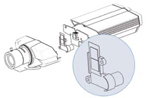
beyond the limits of the human eye. True day/night
cameras, day/night cameras equipped with IR illuminators
and thermal imaging cameras enhance visibility
under trying conditions that would defeat the
abilities of standard imaging cameras.
Boosting Visibility After Sundown
Light comes in different wavelengths. Humans are
able to see wavelengths between 400 and 750 nanometers.
While higher wavelengths are not visible to the
naked eye, most camera sensors can see up to 1,000
nanometers, which is well into the infrared spectrum.
But, to make those images detectable within our visible
spectrum, manufacturers of day/night cameras
employ an IR-cut filter, which filters out infrared light
so it does not distort the color of images. In low light,
the camera automatically retracts the IR-cut filter, allowing
the infrared light to reach the sensor and enabling
the camera’s light sensitivity to reach 0.001 lux.
At the same time, the camera automatically converts
to black-and-white mode since colors would appear
distorted without the IR-cut filter in place.
Day/night camera technology is widely available in
today’s surveillance cameras, which can be mounted
in regular enclosures. While they cost more than cameras
without day/night technology, they are still the
lowest-cost technology for night vision.
Day/night cameras are especially useful in environments
that restrict the use of artificial light, such as
residential areas, or in nighttime traffic surveillance.
Day/night cameras also are optimal for low-light
video surveillance,
such as in a retail store where
lights are dimmed at night, or for city surveillance
where widely spaced street lighting is available.
Seeing in Pitch Black
IR illuminators are designed to enhance the nighttime
performance of day/night cameras. As high-performance
white and infrared LEDs, IR illuminators provide
additional luminosity in the 800 to 1,000 nanometer
range. They give users the unique flexibility to
alter the angle of on-site illumination to suit various
security needs and match a day/night camera’s field of
view. Covert illuminators enhance the camera’s ability
to capture images in the invisible spectrum. Noncovert
illuminators enhance the camera’s sensors to
detect objects in the near-visible infrared spectrum.
Compared to traditional light bulbs, illuminators
are highly energy efficient. With a typical lifecycle of
up to 10 years, illuminators provide huge savings in
long-term operational and maintenance costs.
Day/night cameras enhanced with IR illuminators
also are especially useful in pitch black environments.
More importantly, covert illuminators are impossible
to detect with the naked eye.
But with any surveillance technology, users need to
be aware of their limitations. Non-covert illuminators
generate a red aura that intruders can discern with infrared
detection devices. Plus, illuminators add to the
cost of the surveillance installation and maintenance,
not only in capital investment and labor but also in
power consumption. Another drawback with day/
night cameras with or without IR illuminators is that
they cannot see through smoke or haze.
Detecting Heat Signatures
In contrast to day/night cameras that recognize visible
light up to 750 nanometers, thermal imaging cameras
recognize wavelengths of up to 14,000 nanometers—
well into the far end of the infrared spectrum. Since
all people and objects emit some level of infrared radiation,
thermal cameras can be used to detect objects
and people, not only irrespective of the lighting condition,
but also of smoke, haze and other challenging
weather conditions.
For instance, even if a person is dressed head-totoe
in white clothing in a snowy backdrop or garbed
in black while lurking in a shadowy forest, the camera
can see the heat signature radiating from the human
silhouette. This detection ability also holds true in
difficult weather conditions, which would blind conventional
cameras.
Additionally, for installations where there are
privacy concerns, thermal cameras allow for anonymous
surveillance since the technology does not
depict facial features. It does, however, provide
sufficient information about the scene and helps
eliminate false alarms.
Because thermal cameras can “see” into shadows,
where intruders might hide, the application potential
for this technology is enormous. Thermal cameras
can be deployed in residential neighborhoods without
concern for light pollution. They can protect lengthy
perimeters that lie in complete darkness, such as waterfronts
and prison yards. Their placement in dangerous
areas, such as busy roadways and railway tracks,
can help security staff quickly spot people in danger,
reducing the risk of accidents and death.
Until now, thermal cameras were too costly for average
users. But with the introduction of new sensors
and materials, coupled with economies of scale and
the ease of installation and integration of IP-based
technology, there are more attractive price levels for
a wider deployment of thermal cameras. In addition
to affordability, network thermal cameras can easily
be integrated into existing IP infrastructure
to complement a variety of
video surveillance systems.