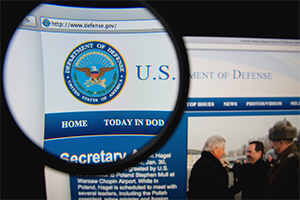
Security at the Department of Defense is Weaker than You Would Think

Security at the Department of Defense is Weaker than You Would Think

Security clearance is given to thousands of people who owe the IRS money.

Security at the Department of Defense is Weaker than You Would Think

A GAO report released on Monday showed that the Department of Defense (DOD) has granted security clearances to over 80,000 employees who collectively owed the IRS over $730 million in back taxes.

In a vacuum this seems bad enough, but when coupled with previous security mishaps at a high level, a disturbing trend starts to appear. It started last June with the scandal involving Edward Snowden, who showed just how capable one employee with access was at revealing a system people think should be most secure of all.

Security clearance became a story once again in September, after Aaron Alexis shot and killed twelve people at the Washington Navy Yard. Alexis was a Navy contractor who had been granted a security clearance even though investigators knew that he falsely reported that he had no prior firearms offenses when he enlisted.

Disclosure of sensitive information has the potential to put national security at risk, which is why government agencies should be taking all possible steps to ensure that security clearances are given only to individuals who pose minimal risk for unauthorized disclosures. The GAO points out in its report that tax debt poses “a potential vulnerability.”

20 percent of employees that were given clearance with tax debt had accrued the debt before they were given access, showing that the DOD does consider this a problem or a potential one. The DOD has simply said that they take someone’s financial status into account with the rest of the specific profile, evaluating based on the whole-person concept.

About the Author

Matt Holden is an Associate Content Editor for 1105 Media, Inc. He received his MFA and BA in journalism from Ball State University in Muncie, Indiana. He currently writes and edits for Occupational Health & Safety magazine, and Security Today.

Featured

  • A Look at AI

    Large language models (LLMs) have taken the world by storm. Within months of OpenAI launching its AI chatbot, ChatGPT, it amassed more than 100 million users, making it the fastest-growing consumer application in history. Read Now

  • First, Do No Harm: Responsibly Applying Artificial Intelligence

    It was 2022 when early LLMs (Large Language Models) brought the term “AI” into mainstream public consciousness and since then, we’ve seen security corporations and integrators attempt to develop their solutions and sales pitches around the biggest tech boom of the 21st century. However, not all “artificial intelligence” is equally suitable for security applications, and it’s essential for end users to remain vigilant in understanding how their solutions are utilizing AI. Read Now

  • Improve Incident Response With Intelligent Cloud Video Surveillance

    Video surveillance is a vital part of business security, helping institutions protect against everyday threats for increased employee, customer, and student safety. However, many outdated surveillance solutions lack the ability to offer immediate insights into critical incidents. This slows down investigations and limits how effectively teams can respond to situations, creating greater risks for the organization. Read Now

  • Security Today Announces 2025 CyberSecured Award Winners

    Security Today is pleased to announce the 2025 CyberSecured Awards winners. Sixteen companies are being recognized this year for their network products and other cybersecurity initiatives that secure our world today. Read Now

  • Empowering and Securing a Mobile Workforce

    What happens when technology lets you work anywhere – but exposes you to security threats everywhere? This is the reality of modern work. No longer tethered to desks, work happens everywhere – in the office, from home, on the road, and in countless locations in between. Read Now

New Products

  • AC Nio

    AC Nio

    Aiphone, a leading international manufacturer of intercom, access control, and emergency communication products, has introduced the AC Nio, its access control management software, an important addition to its new line of access control solutions.

  • HD2055 Modular Barricade

    Delta Scientific’s electric HD2055 modular shallow foundation barricade is tested to ASTM M50/P1 with negative penetration from the vehicle upon impact. With a shallow foundation of only 24 inches, the HD2055 can be installed without worrying about buried power lines and other below grade obstructions. The modular make-up of the barrier also allows you to cover wider roadways by adding additional modules to the system. The HD2055 boasts an Emergency Fast Operation of 1.5 seconds giving the guard ample time to deploy under a high threat situation.

  • Compact IP Video Intercom

    Viking’s X-205 Series of intercoms provide HD IP video and two-way voice communication - all wrapped up in an attractive compact chassis.