Cyber Caliphate Attacks Malaysia Airlines Website

Cyber Caliphate Attacks Malaysia Airlines Website

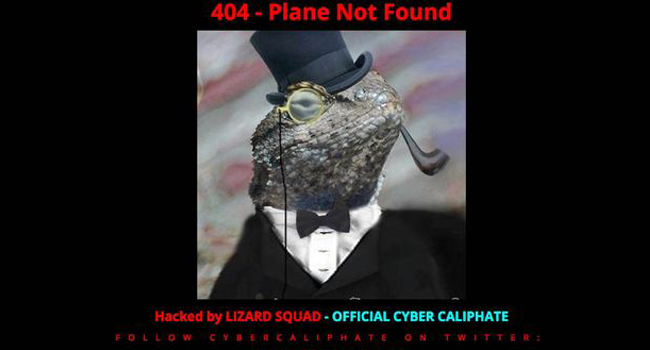
As Malaysia Airlines tries to rebound after Flights 370 and 17 (MH370, MH17), a group calling itself “Cyber Caliphate” had other plans. Hacking into Malaysia Airlines’ website, messages like “ISIS WILL PREVAIL,” “404-Plane Not Found” and “Hacked by Cyber Caliphate” were displayed in strategic areas, such as at the top of the browser’s window, and some were accompanied by graphics, one including a picture of Malaysia Airlines A380.

Later, an image of a tuxedo-wearing, pipe-smoking lizard with a top hat and monocle appeared, with “Hacked by Lizard Squad, Official Cyber Caliphate,” giving the Twitter handle for a group called Lizard Squad. This is the same group who claimed responsibility for the cyberattack on Sony and Microsoft’s videogame servers in December 2014.

In response, Malaysia Airlines replaced the hacked site with a version that allowed users to book flights. The airline immediately reported this incident to CyberSecurity Malaysia, a forensics and analysis agency directed by the Ministry of Science, Technology and Innovation and the Ministry of Transport.

“Our investigation determined that it was a case of domain hijacking,” said CyberSecurity Malaysia Chief Executive Amirudin Abdul.

Malaysia Airlines have since released a statement indicating that their Web servers are intact and customer bookings and data are secure.

Image from the UK's Mirror website.

About the Author

Ginger Hill is Group Social Media Manager.

Featured

  • Empowering and Securing a Mobile Workforce

    What happens when technology lets you work anywhere – but exposes you to security threats everywhere? This is the reality of modern work. No longer tethered to desks, work happens everywhere – in the office, from home, on the road, and in countless locations in between. Read Now

  • TSA Introduces New $45 Fee Option for Travelers Without REAL ID Starting February 1

    The Transportation Security Administration (TSA) announced today that it will refer all passengers who do not present an acceptable form of ID and still want to fly an option to pay a $45 fee to use a modernized alternative identity verification system, TSA Confirm.ID, to establish identity at security checkpoints beginning on February 1, 2026. Read Now

  • The Evolution of IP Camera Intelligence

    As the 30th anniversary of the IP camera approaches in 2026, it is worth reflecting on how far we have come. The first network camera, launched in 1996, delivered one frame every 17 seconds—not impressive by today’s standards, but groundbreaking at the time. It did something that no analog system could: transmit video over a standard IP network. Read Now

  • From Surveillance to Intelligence

    Years ago, it would have been significantly more expensive to run an analytic like that — requiring a custom-built solution with burdensome infrastructure demands — but modern edge devices have made it accessible to everyone. It also saves time, which is a critical factor if a missing child is involved. Video compression technology has played a critical role as well. Over the years, significant advancements have been made in video coding standards — including H.263, MPEG formats, and H.264—alongside compression optimization technologies developed by IP video manufacturers to improve efficiency without sacrificing quality. The open-source AV1 codec developed by the Alliance for Open Media—a consortium including Google, Netflix, Microsoft, Amazon and others — is already the preferred decoder for cloud-based applications, and is quickly becoming the standard for video compression of all types. Read Now

  • Cost: Reactive vs. Proactive Security

    Security breaches often happen despite the availability of tools to prevent them. To combat this problem, the industry is shifting from reactive correction to proactive protection. This article will examine why so many security leaders have realized they must “lead before the breach” – not after. Read Now

New Products

  • AC Nio

    AC Nio

    Aiphone, a leading international manufacturer of intercom, access control, and emergency communication products, has introduced the AC Nio, its access control management software, an important addition to its new line of access control solutions.

  • Unified VMS

    AxxonSoft introduces version 2.0 of the Axxon One VMS. The new release features integrations with various physical security systems, making Axxon One a unified VMS. Other enhancements include new AI video analytics and intelligent search functions, hardened cybersecurity, usability and performance improvements, and expanded cloud capabilities

  • QCS7230 System-on-Chip (SoC)

    QCS7230 System-on-Chip (SoC)

    The latest Qualcomm® Vision Intelligence Platform offers next-generation smart camera IoT solutions to improve safety and security across enterprises, cities and spaces. The Vision Intelligence Platform was expanded in March 2022 with the introduction of the QCS7230 System-on-Chip (SoC), which delivers superior artificial intelligence (AI) inferencing at the edge.