TSA Fails to Find 95 Percent of Weapons in Undercover Tests

TSA Fails to Find 95 Percent of Weapons in Undercover Tests

The tests were conducted by Homeland Security Red Teams

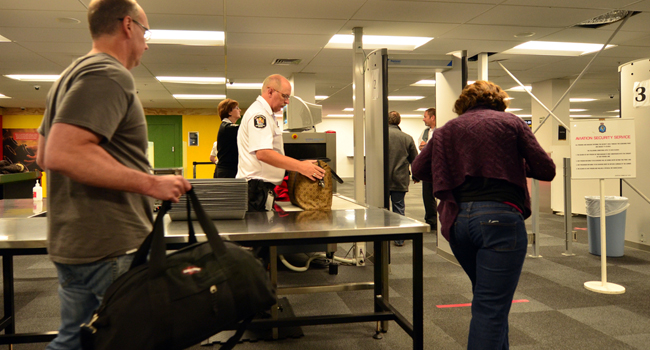
Members of the Transportation Security Administration (TSA) failed to detect weapons and explosives in 67 out of 70 trials, leading to a 95 percent fail rate. The tests were conducted by Homeland Security Red Teams, whose members posed as passengers trying to beat the security system.

According to a report, one case involved an agent setting off a metal detector and TSA agents failing to find a fake explosive taped to his back during a pat-down. The Department of Homeland Security has since reassigned the TSA’s acting administrator, Melvin Carraway, and called for immediate reforms.

About the Author

Matt Holden is an Associate Content Editor for 1105 Media, Inc. He received his MFA and BA in journalism from Ball State University in Muncie, Indiana. He currently writes and edits for Occupational Health & Safety magazine, and Security Today.

Featured

  • The Future of Access Control: Cloud-Based Solutions for Safer Workplaces

    Access controls have revolutionized the way we protect our people, assets and operations. Gone are the days of cumbersome keychains and the security liabilities they introduced, but it’s a mistake to think that their evolution has reached its peak. Read Now

  • A Look at AI

    Large language models (LLMs) have taken the world by storm. Within months of OpenAI launching its AI chatbot, ChatGPT, it amassed more than 100 million users, making it the fastest-growing consumer application in history. Read Now

  • First, Do No Harm: Responsibly Applying Artificial Intelligence

    It was 2022 when early LLMs (Large Language Models) brought the term “AI” into mainstream public consciousness and since then, we’ve seen security corporations and integrators attempt to develop their solutions and sales pitches around the biggest tech boom of the 21st century. However, not all “artificial intelligence” is equally suitable for security applications, and it’s essential for end users to remain vigilant in understanding how their solutions are utilizing AI. Read Now

  • Improve Incident Response With Intelligent Cloud Video Surveillance

    Video surveillance is a vital part of business security, helping institutions protect against everyday threats for increased employee, customer, and student safety. However, many outdated surveillance solutions lack the ability to offer immediate insights into critical incidents. This slows down investigations and limits how effectively teams can respond to situations, creating greater risks for the organization. Read Now

  • Security Today Announces 2025 CyberSecured Award Winners

    Security Today is pleased to announce the 2025 CyberSecured Awards winners. Sixteen companies are being recognized this year for their network products and other cybersecurity initiatives that secure our world today. Read Now

New Products

  • FEP GameChanger

    FEP GameChanger

    Paige Datacom Solutions Introduces Important and Innovative Cabling Products GameChanger Cable, a proven and patented solution that significantly exceeds the reach of traditional category cable will now have a FEP/FEP construction.

  • Automatic Systems V07

    Automatic Systems V07

    Automatic Systems, an industry-leading manufacturer of pedestrian and vehicle secure entrance control access systems, is pleased to announce the release of its groundbreaking V07 software. The V07 software update is designed specifically to address cybersecurity concerns and will ensure the integrity and confidentiality of Automatic Systems applications. With the new V07 software, updates will be delivered by means of an encrypted file.

  • A8V MIND

    A8V MIND

    Hexagon’s Geosystems presents a portable version of its Accur8vision detection system. A rugged all-in-one solution, the A8V MIND (Mobile Intrusion Detection) is designed to provide flexible protection of critical outdoor infrastructure and objects. Hexagon’s Accur8vision is a volumetric detection system that employs LiDAR technology to safeguard entire areas. Whenever it detects movement in a specified zone, it automatically differentiates a threat from a nonthreat, and immediately notifies security staff if necessary. Person detection is carried out within a radius of 80 meters from this device. Connected remotely via a portable computer device, it enables remote surveillance and does not depend on security staff patrolling the area.