Sun, Surf & Surveillance
Compant installs IP video on San Diego's Mission Beach following attacks
 Stretching several miles, Mission
Beach, Calif., is the most popular
beach area in San Diego, and it draws
large crowds during the summer.
Various shops, restaurants and beach rental
outfits line its narrow boardwalk. Mission
Beach offers limitless opportunities for sunbathing,
surfing, bicycling, skateboarding and
other outdoor activities.
Stretching several miles, Mission
Beach, Calif., is the most popular
beach area in San Diego, and it draws
large crowds during the summer.
Various shops, restaurants and beach rental
outfits line its narrow boardwalk. Mission
Beach offers limitless opportunities for sunbathing,
surfing, bicycling, skateboarding and
other outdoor activities.
Despite the beach area’s idyllic landscape,
last year San Diego Public Safety recorded the
largest number of violent crimes ever, including
the sexual assault of two University of San
Diego students in Mission Beach’s historic
Belmont Park area. In response, residents collected
more than $30,000 in private donations
for a video surveillance system. An additional
$80,000 was raised in a bond proposition.
Once funding was established, San Diego
city officials contacted Dotworkz Systems
Inc., a San Diego company that focuses on
network-based video products.
“The city’s chief concerns were to deter
crime on Mission Beach, to create a visual
record of any incidents that may occur for
proper investigation and to improve police
response times,” said William Ferris, CEO of
Dotworkz. “An analog CCTV system could
not deliver what they needed. IP-based video,
however, could achieve those objectives and
more, plus add the capability for expansion
without significant capital costs.”
As with all municipal projects, San Diego
officials were concerned about budgeting.
Dotworkz engineers pointed out that the cost
of ownership for an IP system was comparable
to that of an analog system employing digital
recording, plus it provided more critical
capabilities in applications similar to what
was proposed on Mission Beach.
“While an IP camera is typically 30 to 50
percent more expensive than a similar analog
camera, savings are realized in cabling
infrastructure, recording equipment, labor
and configuration,” Ferris said. “Using a
price-to-performance ratio, IP video is
far more cost-efficient for large-scale
municipal projects, especially when
wireless connectivity can be leveraged for
video distribution.”
A Challenging Environment
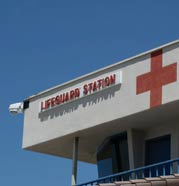
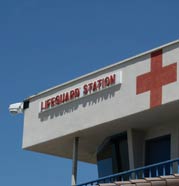
Dotworkz used five network cameras to cover
the relatively small perimeters of Belmont Park,
mounting them on lifeguard houses and light
poles. The cameras were selected for many reasons.
In addition to their impressive pan/tilt capability,
they are equipped with powerful 26x optical
zoom, allowing officers monitoring the cameras
to zoom in on small or distant objects with
clarity. And because the cameras incorporate a
day/night function, they capture images of the
beach and boardwalk at night, when most crimes
are committed.
Like all network cameras, the Sony SNCRZ50
contains sensitive electronics, such as a
processor, a video compression engine and networking,
which could be damaged in the extreme
heat and direct sunlight of a beach. For that reason,
all the cameras are contained within
Dotworkz D2™ marine-ready enclosures
equipped with heater-blower systems. Besides
keeping the cameras cool, this system helps eliminate
fogging of the lower lenses in the earlymorning
mist.
Yet another reason for specifying the D2 was
vandalism. Made of a thermoplastic alloy, the
enclosure is exceptionally shock- and impactresistant.
So much so, in fact, that it is presently in
use by the U.S. military within Iraq’s Green Zone.
Dotworkz was no stranger to the challenges
of mounting cameras in marine environments. It
has been producing ruggedized marine-ready
camera systems for years and has products in use
around the globe in military and commercial
maritime applications.
Going Wireless
Concerned about Wi-Fi interference in Mission
Beach’s residential area, Dotworkz configured
its D2 “city link” mesh option for four of the
five cameras on a powerful 5.8 GHz wireless
spectrum. This provided the means to wirelessly
transmit high-resolution video at up to 20
frames per second with 108 MB throughput
back to the police command center located two
miles away. The fifth camera, stationed on a
light pole across from the historic Belmont
Giant Dipper Roller Coaster and Wave House
water park, is equipped with a Dotworkz 2.4
GHz 802.11 b/g SideKick™.
“Wireless connectivity gives the Mission
Beach system additional flexibility and scalability,
plus saves the municipality the cost of
wiring and installation labor,” Ferris said.
“Right now, the video is sent to the public safety’s
personnel command center, but in the
future, roving police may add camera access on
their laptops, PDAs and smart phones.”
Video archiving is achieved using the
Dotworkz NVR Serverware to optimize the
24/7 video requirement. The NVR Serverware
is engineered for maximum performance and
reliability. It was specified with a Seagate®
security-based hard drive with RAID configuration
to prevent lost data, along with a host of
other reliability features.
Tying together the system is enterpriseclass
NetDVMS™ software from On-Net
Surveillance Systems Inc. This recording and
camera management software suite required
little user training for the officers and no additional
hardware. NetDVMS gives the light-duty
police officers in the command center immediate
and centralized access to all five cameras,
along with schedulable PTZ patrol sequences
when the system is not actively manned.
New Wave Cameras
Residents were worried that surveillance
cameras would leave Belmont Park resembling
a prison on lockdown and take away from the
public’s beach experience. However, once
the enclosures were installed, the residents’
concerns were alleviated. Rounded and
nonthreatening in appearance, the D2 easily
can be mistaken for an outdoor light fixture.
The D2 is a favorite among architects. Not
only is it stylish, but it can be painted virtually
any color to tie in with the client’s design goals.
For example, Dotworkz recently painted several
D2s sky blue with white clouds to blend into
a ceiling. Camouflage also is a popular choice.
“We want to challenge the notion that surveillance
products have to look like Big
Brother props,” said Ferris, who welcomes
the trend toward customizing public safety
cameras. “This industry helps make the public
safer, so why not engineer our cameras
and enclosures to be part of the communities
we protect?”