Twitter Hackers Serving Up Extra Large Combos with Burger King

Twitter Hackers Serving Up Extra Large Combos with Burger King

Wouldn’t it be nice to log into Twitter and see an extra 60,000 followers? That’s exactly what happened to Burger King: people began following their account by the tens of thousands. Were they giving away Whoppers? Nope. Hmmm, something seemed a little fishy…fishier than Burger King’s Premium Alaskan Fish Sandwich. Where did all these new followers come from?

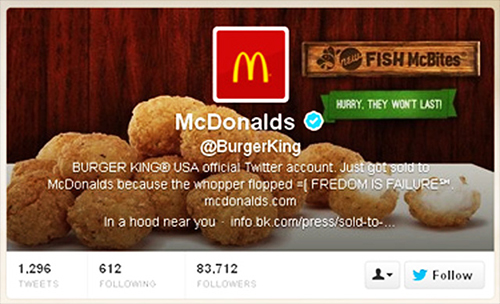
Come to find out, Burger King’s Twitter account had been hacked. Before their account was compromised, Burger King had about 50,000 followers but after being hacked, the followers increased to more than 110,000.

It was unclear who was responsible for the hack, but it did demonstrate how quickly a company’s outreach to their loyal fans can turn into an embarrassing situation. At one point, Burger King’s profile message said that they had been sold to McDonald’s, obviously a direct competitor, because the Whopper, Burger King’s flagship sandwich, had flopped.

At another point during the account hacking, McDonald’s tweeted: “We empathize with our @BurgerKing counterparts. Rest assured, we had nothing to do with the hacking.”

So, how did the hijacking happen? To my knowledge, no official reports have been released; however, remember how Twitter is accessed with a username and password? Well, if a person’s computer is infected with malicious software, it is easy for hackers to hijack accounts. Not saying that this is what happened, but it could be one plausible explanation.

Other social media platforms (Facebook and YouTube) offer two-factor authentication, providing greater security because it requires something in addition to a password, like a code sent by text message to a registered mobile device. If Twitter had this type of authentication, hackers would have been forced to get past two layers of security instead of only one.

We may never know the truth as to how or who actually hacked into Burger King’s Twitter account; however, one truth we do know is social media security is a huge issue that can cause major problems.

(Reference: http://www.cbsnews.com/8301-205_162-57569911/burger-king-twitter-hacked-posting-under-mcdonalds/

About the Author

Ginger Hill is Group Social Media Manager.

Featured

  • The Future of Access Control: Cloud-Based Solutions for Safer Workplaces

    Access controls have revolutionized the way we protect our people, assets and operations. Gone are the days of cumbersome keychains and the security liabilities they introduced, but it’s a mistake to think that their evolution has reached its peak. Read Now

  • A Look at AI

    Large language models (LLMs) have taken the world by storm. Within months of OpenAI launching its AI chatbot, ChatGPT, it amassed more than 100 million users, making it the fastest-growing consumer application in history. Read Now

  • First, Do No Harm: Responsibly Applying Artificial Intelligence

    It was 2022 when early LLMs (Large Language Models) brought the term “AI” into mainstream public consciousness and since then, we’ve seen security corporations and integrators attempt to develop their solutions and sales pitches around the biggest tech boom of the 21st century. However, not all “artificial intelligence” is equally suitable for security applications, and it’s essential for end users to remain vigilant in understanding how their solutions are utilizing AI. Read Now

  • Improve Incident Response With Intelligent Cloud Video Surveillance

    Video surveillance is a vital part of business security, helping institutions protect against everyday threats for increased employee, customer, and student safety. However, many outdated surveillance solutions lack the ability to offer immediate insights into critical incidents. This slows down investigations and limits how effectively teams can respond to situations, creating greater risks for the organization. Read Now

  • Security Today Announces 2025 CyberSecured Award Winners

    Security Today is pleased to announce the 2025 CyberSecured Awards winners. Sixteen companies are being recognized this year for their network products and other cybersecurity initiatives that secure our world today. Read Now

New Products

  • EasyGate SPT and SPD

    EasyGate SPT SPD

    Security solutions do not have to be ordinary, let alone unattractive. Having renewed their best-selling speed gates, Cominfo has once again demonstrated their Art of Security philosophy in practice — and confirmed their position as an industry-leading manufacturers of premium speed gates and turnstiles.

  • Luma x20

    Luma x20

    Snap One has announced its popular Luma x20 family of surveillance products now offers even greater security and privacy for home and business owners across the globe by giving them full control over integrators’ system access to view live and recorded video. According to Snap One Product Manager Derek Webb, the new “customer handoff” feature provides enhanced user control after initial installation, allowing the owners to have total privacy while also making it easy to reinstate integrator access when maintenance or assistance is required. This new feature is now available to all Luma x20 users globally. “The Luma x20 family of surveillance solutions provides excellent image and audio capture, and with the new customer handoff feature, it now offers absolute privacy for camera feeds and recordings,” Webb said. “With notifications and integrator access controlled through the powerful OvrC remote system management platform, it’s easy for integrators to give their clients full control of their footage and then to get temporary access from the client for any troubleshooting needs.”

  • Camden CV-7600 High Security Card Readers

    Camden CV-7600 High Security Card Readers

    Camden Door Controls has relaunched its CV-7600 card readers in response to growing market demand for a more secure alternative to standard proximity credentials that can be easily cloned. CV-7600 readers support MIFARE DESFire EV1 & EV2 encryption technology credentials, making them virtually clone-proof and highly secure.