Radiation Detection to Go
A Sandia National Laboratories team completed acceptance testing on an enormous mobile scanner that makes smuggling radiological materials more difficult, the eighth such unit that Sandia has deployed worldwide.
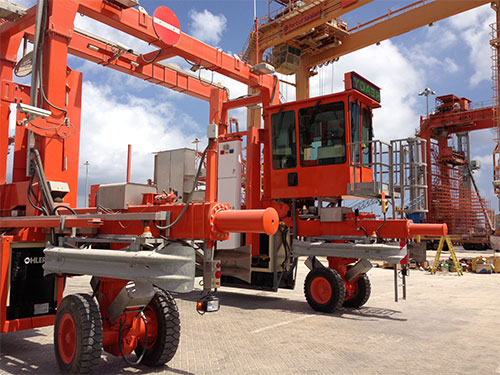 The Mobile Radiation Detection and Identification System (MRDIS) enables the scanning of containers that are in transit from one cargo ship to another.
“Typical radiation detectors are fixed at port entrances and exits, so they aren’t able to scan transshipped containers,” said Greg Stihel of Sandia’s Systems & Mission Assurance Department. “This makes transshipment containers an enticing option for those who might want to smuggle radioactive materials into a country for terrorist activities, such as making dirty bombs. In 2006, National Nuclear Security Administration [NNSA] recognized the need to also scan cargo that is taken off a ship and, in a short period of time, put on a second ship.”
Port security is a major international concern, but port operators and shippers require a balance between security and shipment delays that hurt their bottom line.
“If the system creates time delays that cost shippers and port operators money, the detectors won’t get used,” Stihel said.
Directed by NNSA’s Second Line of Defense (SLD) program, Sandia engineers developed the idea for MRDIS to meet the need for a technology that could scan transshipped containers quickly. Two MRDIS prototypes were developed in 2006 and were field tested in Oman. Engineers analyzed how accurately and quickly MRDIS scanned cargo and worked with port operators to refine the process.
Inspectors can move MRDIS to active quays, so containers can pass through the MRDIS on the way to another vessel in the port.
After the prototypes proved their worth, NNSA ordered 12 MRDIS, which Stihel termed a “tremendous” investment in the idea. Two years later, the first production unit of the second-generation MRDIS was complete.
Engineers then created a detailed set of requirements for subsequent models, allowing the project to move forward quickly.
The work was done in partnership with Pacific Northwest National Laboratory (PNNL) and the Cincinnati firm DRS Technologies.
Not like driving a tractor trailer
To date, eight MRDIS units have been deployed worldwide. The first set of four went to Panama in November 2012. The four in Oman arrived last summer and completed final acceptance testing in late March.
Stihel said that driving MRDIS “feels strange because it’s so big, and because the operator sits sideways, facing the trucks going through the center. The MRDIS is big enough for a truck carrying shipping containers to pass through, so it’s not like driving just a tractor trailer truck.”
Rodney Wilson, who directs Sandia’s Nonproliferation and Cooperative Threat Reduction Center, observed field testing and drove the MRDIS during a visit to Oman in late March.
“It is not as intuitive as you think. Imagine being in the back seat of your car, on the passenger side, facing in, and trying to drive the car using joy sticks to turn and go forward and back, all while staring at a computer screen. Oh, and you are also 15 feet off the ground,” Wilson said.
Use at ‘pinch points’
Stihel said that each MRDIS can work independently or as part of a team, depending on the port’s needs. Each MRDIS can also feed data into a central system or collect data on its own. The ports in Oman and Panama are using three MRDIS units as primary scanners, with a fourth MRDIS that has more sophisticated detection equipment serving as a secondary scanner.
MRDIS will begin scanning cargo at two international airports by next year, and MRDIS-like platforms could be used at any location with “pinch points” through which traffic passes.
The work was funded by NNSA’s International Material Protection & Cooperation Office under SLD, which installs radiation detection equipment at land border crossings, airports, seaports and international checkpoints worldwide.
Nearly 90 percent of imported and exported goods travel the globe in shipping containers. Roughly 500 million containers travel the sea each year.