About 100 Brains Missing from University of Texas

About 100 Brains Missing from University of Texas

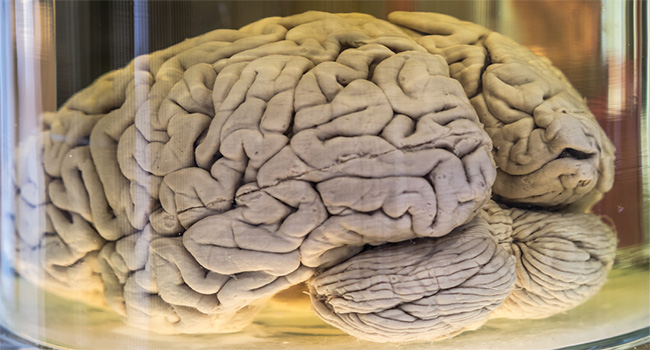
The University of Texas at Austin is missing about 100 brains, and one of them is believed to have belonged to clock tower sniper Charles Whitman.

“We think somebody may have taken the brains, but we don’t know at all for sure,” psychology Professor Tim Schallert, co-curator of the collection, said.

This would make up roughly half of the collection which the university had been preserving in jars of formaldehyde.

It’s entirely possible word got around among undergraduates and people started swiping them for living rooms or Halloween pranks,” said psychology Professor Lawrence Cormack, Schallert’s co-curator.

The university said in a statement that it will investigate "the circumstances surrounding this collection since it came here nearly 30 years ago" and that it's "committed to treating the brain specimens with respect." It says the remaining brain specimens on campus are used "as a teaching tool and carefully curated by faculty."

The 100 remaining brains at the school have been moved to the Norman Hackerman Building, where they are being scanned with high-resolution resonance imaging equipment, Cormack said.

About the Author

Matt Holden is an Associate Content Editor for 1105 Media, Inc. He received his MFA and BA in journalism from Ball State University in Muncie, Indiana. He currently writes and edits for Occupational Health & Safety magazine, and Security Today.

Featured

New Products

  • A8V MIND

    A8V MIND

    Hexagon’s Geosystems presents a portable version of its Accur8vision detection system. A rugged all-in-one solution, the A8V MIND (Mobile Intrusion Detection) is designed to provide flexible protection of critical outdoor infrastructure and objects. Hexagon’s Accur8vision is a volumetric detection system that employs LiDAR technology to safeguard entire areas. Whenever it detects movement in a specified zone, it automatically differentiates a threat from a nonthreat, and immediately notifies security staff if necessary. Person detection is carried out within a radius of 80 meters from this device. Connected remotely via a portable computer device, it enables remote surveillance and does not depend on security staff patrolling the area.

  • PE80 Series

    PE80 Series by SARGENT / ED4000/PED5000 Series by Corbin Russwin

    ASSA ABLOY, a global leader in access solutions, has announced the launch of two next generation exit devices from long-standing leaders in the premium exit device market: the PE80 Series by SARGENT and the PED4000/PED5000 Series by Corbin Russwin. These new exit devices boast industry-first features that are specifically designed to provide enhanced safety, security and convenience, setting new standards for exit solutions. The SARGENT PE80 and Corbin Russwin PED4000/PED5000 Series exit devices are engineered to meet the ever-evolving needs of modern buildings. Featuring the high strength, security and durability that ASSA ABLOY is known for, the new exit devices deliver several innovative, industry-first features in addition to elegant design finishes for every opening.

  • Unified VMS

    AxxonSoft introduces version 2.0 of the Axxon One VMS. The new release features integrations with various physical security systems, making Axxon One a unified VMS. Other enhancements include new AI video analytics and intelligent search functions, hardened cybersecurity, usability and performance improvements, and expanded cloud capabilities