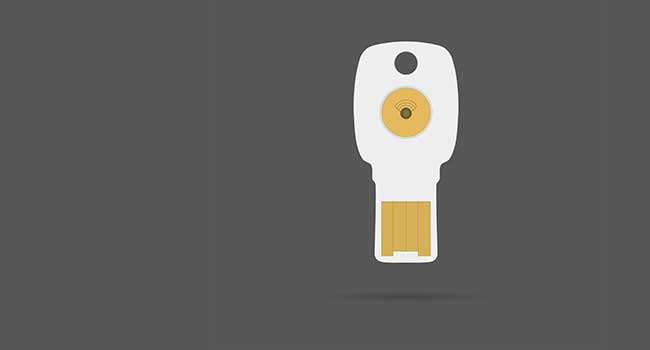
Google Replaces Titan Security Keys Due to Vulnerability

Google Replaces Titan Security Keys Due to Vulnerability

Google announced its Bluetooth security keys could be vulnerable to attack.

Google has discovered a security vulnerability so serious that it is telling users it will replace their Bluetooth Titan Security Keys for free. 

In a press release, the company said that there is a "misconfiguration in the Titan Security Keys' Bluetooth pairing protocols" that could potentially allow an attacker to gain access to your account  or device though some very specific circumstances.

One of the vulnerabilities described by Google allows an attacker within a 30-foot Bluetooth Low Energy range of your key when you press the button to authenticate a login, they could connect heir device to your security key. If they have your password, they could gain access to your account. 

Another way a bad actor could make their way into your account is when you pair your device for the first time. An attacker could "masquerade as your affected security key and connect to your device," and then do the same things on your device that other Bluetooth devices can do, like act as a keyboard or a mouse.

Google has been leading the charge in two-factor authentication (2FA) for a long time now. It has been pushing its Titan Security Keys as a more secure way to enable 2FA than simply an authentication app, or SMS. Google is not wrong about trying to add another layer of security, but there is going to be a higher level of scrutiny on any potential vulnerabilities. 

Google has made it know that if you have a "T1" or "T2" on your Titan Key, you are eligible for a replacement.

About the Author

Sydny Shepard is the Executive Editor of Campus Security & Life Safety.

Featured

New Products

  • A8V MIND

    A8V MIND

    Hexagon’s Geosystems presents a portable version of its Accur8vision detection system. A rugged all-in-one solution, the A8V MIND (Mobile Intrusion Detection) is designed to provide flexible protection of critical outdoor infrastructure and objects. Hexagon’s Accur8vision is a volumetric detection system that employs LiDAR technology to safeguard entire areas. Whenever it detects movement in a specified zone, it automatically differentiates a threat from a nonthreat, and immediately notifies security staff if necessary. Person detection is carried out within a radius of 80 meters from this device. Connected remotely via a portable computer device, it enables remote surveillance and does not depend on security staff patrolling the area.

  • Luma x20

    Luma x20

    Snap One has announced its popular Luma x20 family of surveillance products now offers even greater security and privacy for home and business owners across the globe by giving them full control over integrators’ system access to view live and recorded video. According to Snap One Product Manager Derek Webb, the new “customer handoff” feature provides enhanced user control after initial installation, allowing the owners to have total privacy while also making it easy to reinstate integrator access when maintenance or assistance is required. This new feature is now available to all Luma x20 users globally. “The Luma x20 family of surveillance solutions provides excellent image and audio capture, and with the new customer handoff feature, it now offers absolute privacy for camera feeds and recordings,” Webb said. “With notifications and integrator access controlled through the powerful OvrC remote system management platform, it’s easy for integrators to give their clients full control of their footage and then to get temporary access from the client for any troubleshooting needs.”

  • AC Nio

    AC Nio

    Aiphone, a leading international manufacturer of intercom, access control, and emergency communication products, has introduced the AC Nio, its access control management software, an important addition to its new line of access control solutions.