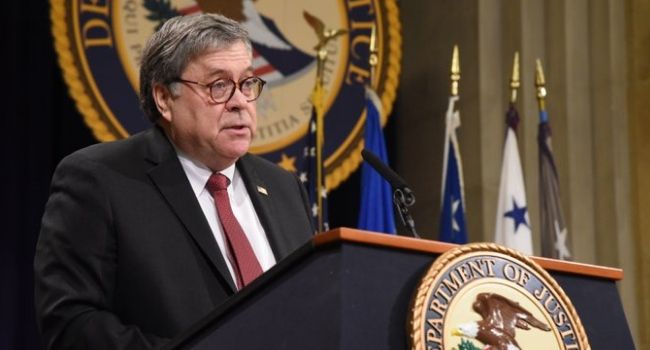
Attorney General Pressures Facebook To Delay End-To-End Encryption, Citing Child Abuse Concerns

Attorney General Pressures Facebook To Delay End-To-End Encryption, Citing Child Abuse Concerns

Law enforcement are increasingly worried about the possibility of end-to-end encryption, which does not provide police with a way to access communications between potential suspects.

In an effort to impede Facebook’s plans to deploy end-to-end encryption for its messaging services, government officials from the United States, the United Kingdom and Australia published an open letter last week pushing CEO Mark Zuckerberg to hold off on implementing encryption. 

BuzzFeed News published a draft of the letter, dated Oct. 4, that was signed by U.S. Attorney General William Barr, Acting Homeland Security Secretary Kevin McAleenan and the top homeland security officials in the UK and Australia, Priti Patel and Peter Dutton. 

While Barr has previously argued that end-to-end encryption would prevent law enforcement officers from properly investigating terrorist threats, the officials have now zoned in on how encryption can make it more difficult to catch and prosecute child sexual exploitation. 

“Companies should not deliberately design their systems to preclude any form of access to content, even for preventing or investigating the most serious crimes,” the letter reads. “Risks to public safety from Facebook’s proposals are exacerbated in the context of a single platform that would combine inaccessible messaging services with open profiles, providing unique routes for prospective offenders to identify and groom our children.”

The letter calls on Facebook and other tech companies to include methods for law enforcement to “obtain lawful access” to content in a readable and usable format; consult with governments about how this ability would influence design decisions; and not implement encryption changes until the company has ensured the “safety” functions are fully tested and operational. 

“As you have recognised, it is critical to get this right for the future of the internet,” the letter concludes. “Children’s safety and law enforcement’s ability to bring criminals to justice must not be the ultimate cost of Facebook taking forward these proposals.”

Tech companies and security experts have consistently argued that building “backdoors,” or ways to decrypt messages from outside of the communication, makes it more difficult to protect the encrypted communication from hackers or foreign governments. 

In its response to criticism from Barr and more recently FBI Director Christopher Wray, a Facebook spokesman said that the company is consulting with child safety experts, governments and companies to make sure encryption is safe. 

“End-to-end encryption already protects the messages of over a billion people every day,” the statement reads. “It is increasingly used across the communications industry and in many other important sectors of the economy.” 

The statement directly countered Barr’s request: “We strongly oppose government attempts to build backdoors because they would undermine the privacy and security of people everywhere.”


About the Author

Haley Samsel is an Associate Content Editor for the Infrastructure Solutions Group at 1105 Media.

Featured

  • Security Today Announces 2025 CyberSecured Award Winners

    Security Today is pleased to announce the 2025 CyberSecured Awards winners. Sixteen companies are being recognized this year for their network products and other cybersecurity initiatives that secure our world today. Read Now

  • Empowering and Securing a Mobile Workforce

    What happens when technology lets you work anywhere – but exposes you to security threats everywhere? This is the reality of modern work. No longer tethered to desks, work happens everywhere – in the office, from home, on the road, and in countless locations in between. Read Now

  • TSA Introduces New $45 Fee Option for Travelers Without REAL ID Starting February 1

    The Transportation Security Administration (TSA) announced today that it will refer all passengers who do not present an acceptable form of ID and still want to fly an option to pay a $45 fee to use a modernized alternative identity verification system, TSA Confirm.ID, to establish identity at security checkpoints beginning on February 1, 2026. Read Now

  • The Evolution of IP Camera Intelligence

    As the 30th anniversary of the IP camera approaches in 2026, it is worth reflecting on how far we have come. The first network camera, launched in 1996, delivered one frame every 17 seconds—not impressive by today’s standards, but groundbreaking at the time. It did something that no analog system could: transmit video over a standard IP network. Read Now

  • From Surveillance to Intelligence

    Years ago, it would have been significantly more expensive to run an analytic like that — requiring a custom-built solution with burdensome infrastructure demands — but modern edge devices have made it accessible to everyone. It also saves time, which is a critical factor if a missing child is involved. Video compression technology has played a critical role as well. Over the years, significant advancements have been made in video coding standards — including H.263, MPEG formats, and H.264—alongside compression optimization technologies developed by IP video manufacturers to improve efficiency without sacrificing quality. The open-source AV1 codec developed by the Alliance for Open Media—a consortium including Google, Netflix, Microsoft, Amazon and others — is already the preferred decoder for cloud-based applications, and is quickly becoming the standard for video compression of all types. Read Now

New Products

  • Mobile Safe Shield

    Mobile Safe Shield

    SafeWood Designs, Inc., a manufacturer of patented bullet resistant products, is excited to announce the launch of the Mobile Safe Shield. The Mobile Safe Shield is a moveable bullet resistant shield that provides protection in the event of an assailant and supplies cover in the event of an active shooter. With a heavy-duty steel frame, quality castor wheels, and bullet resistant core, the Mobile Safe Shield is a perfect addition to any guard station, security desks, courthouses, police stations, schools, office spaces and more. The Mobile Safe Shield is incredibly customizable. Bullet resistant materials are available in UL 752 Levels 1 through 8 and include glass, white board, tack board, veneer, and plastic laminate. Flexibility in bullet resistant materials allows for the Mobile Safe Shield to blend more with current interior décor for a seamless design aesthetic. Optional custom paint colors are also available for the steel frame.

  • A8V MIND

    A8V MIND

    Hexagon’s Geosystems presents a portable version of its Accur8vision detection system. A rugged all-in-one solution, the A8V MIND (Mobile Intrusion Detection) is designed to provide flexible protection of critical outdoor infrastructure and objects. Hexagon’s Accur8vision is a volumetric detection system that employs LiDAR technology to safeguard entire areas. Whenever it detects movement in a specified zone, it automatically differentiates a threat from a nonthreat, and immediately notifies security staff if necessary. Person detection is carried out within a radius of 80 meters from this device. Connected remotely via a portable computer device, it enables remote surveillance and does not depend on security staff patrolling the area.

  • Automatic Systems V07

    Automatic Systems V07

    Automatic Systems, an industry-leading manufacturer of pedestrian and vehicle secure entrance control access systems, is pleased to announce the release of its groundbreaking V07 software. The V07 software update is designed specifically to address cybersecurity concerns and will ensure the integrity and confidentiality of Automatic Systems applications. With the new V07 software, updates will be delivered by means of an encrypted file.