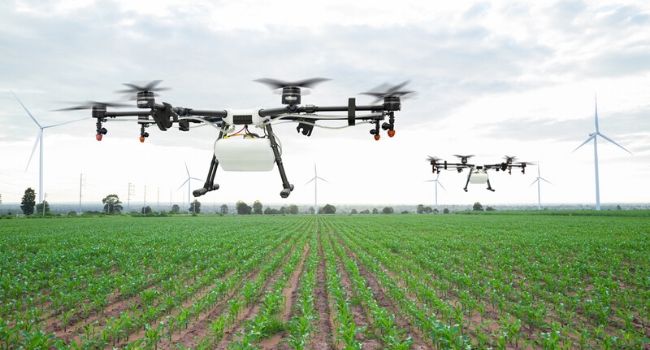
drone in field

Trump Administration Preparing Executive Order to Ban Use of Foreign-Made Drones by Government Agencies

Chinese manufacturer DJI, which accounts for about 70 percent of the global drone market, stands to lose the most from a ban, which is based on national security concerns.

An executive order is being prepared to ban federal agencies from buying or using foreign-made drones, building on previous moves by the Interior Department to ground its entire fleet of drones, all of which had parts manufactured in China.

The draft order, which was reported by TechCrunch, specifically cites national security threats posed by Chinese manufacturers as the reasoning behind the ban. The Trump administration fears that sensitive data collected by drones could be accessed by the Chinese companies, which are required to collaborate and share information with Chinese authorities if asked.

The order will “encourage” domestically built drones and that federal agencies would have one month to comply with the ban, according to TechCrunch. Military and intelligence agencies would be granted widespread exemptions under the terms of the draft order, TechCrunch reported.

China-based drone manufacturer would stand to lose the most from the ban. DJI accounts for 70 percent of the world drone market and formerly supplied many of the parts and drones for federal agencies. Michael Oldenburg, a DJI spokesperson, stated the company’s opposition to any proposed ban on foreign-made drones.

“While we haven’t seen the document, this proposal is another attack on drone technology based on its country of origin, which recent reporting has shown has been criticized within federal agencies including the U.S. Department of Agriculture, Department of the Interior, Fish and Wildlife Service and even the White House Office of Management and Budget,” Oldenburg told TechCrunch.

He added: “When communicating among themselves, these agencies’ officials have explained how such an approach damages American interests and does not solve any cybersecurity issues, and have acknowledged that DJI’s products have been validated as secure for use in government operations.”

Oldenburg was referencing reporting from The New York Times and others showing that top officials in the Department of Agriculture, among other departments, were very concerned about how the law would “severely impact the establishment, development and implementation” of their drone program.

Stephen L. Censky, the deputy secretary for the agriculture department, told the Times in February that he was concerned that “none of our previous comments were considered or integrated” into the revised version of the ban, which they saw in December.

Interior Department officials also previously stated that they were working with DJI to test software to keep sensitive data secure until the grounding in late October.

About the Author

Haley Samsel is an Associate Content Editor for the Infrastructure Solutions Group at 1105 Media.

Featured

  • Empowering and Securing a Mobile Workforce

    What happens when technology lets you work anywhere – but exposes you to security threats everywhere? This is the reality of modern work. No longer tethered to desks, work happens everywhere – in the office, from home, on the road, and in countless locations in between. Read Now

  • TSA Introduces New $45 Fee Option for Travelers Without REAL ID Starting February 1

    The Transportation Security Administration (TSA) announced today that it will refer all passengers who do not present an acceptable form of ID and still want to fly an option to pay a $45 fee to use a modernized alternative identity verification system, TSA Confirm.ID, to establish identity at security checkpoints beginning on February 1, 2026. Read Now

  • The Evolution of IP Camera Intelligence

    As the 30th anniversary of the IP camera approaches in 2026, it is worth reflecting on how far we have come. The first network camera, launched in 1996, delivered one frame every 17 seconds—not impressive by today’s standards, but groundbreaking at the time. It did something that no analog system could: transmit video over a standard IP network. Read Now

  • From Surveillance to Intelligence

    Years ago, it would have been significantly more expensive to run an analytic like that — requiring a custom-built solution with burdensome infrastructure demands — but modern edge devices have made it accessible to everyone. It also saves time, which is a critical factor if a missing child is involved. Video compression technology has played a critical role as well. Over the years, significant advancements have been made in video coding standards — including H.263, MPEG formats, and H.264—alongside compression optimization technologies developed by IP video manufacturers to improve efficiency without sacrificing quality. The open-source AV1 codec developed by the Alliance for Open Media—a consortium including Google, Netflix, Microsoft, Amazon and others — is already the preferred decoder for cloud-based applications, and is quickly becoming the standard for video compression of all types. Read Now

  • Cost: Reactive vs. Proactive Security

    Security breaches often happen despite the availability of tools to prevent them. To combat this problem, the industry is shifting from reactive correction to proactive protection. This article will examine why so many security leaders have realized they must “lead before the breach” – not after. Read Now

New Products

  • Connect ONE’s powerful cloud-hosted management platform provides the means to tailor lockdowns and emergency mass notifications throughout a facility – while simultaneously alerting occupants to hazards or next steps, like evacuation.

    Connect ONE®

    Connect ONE’s powerful cloud-hosted management platform provides the means to tailor lockdowns and emergency mass notifications throughout a facility – while simultaneously alerting occupants to hazards or next steps, like evacuation.

  • A8V MIND

    A8V MIND

    Hexagon’s Geosystems presents a portable version of its Accur8vision detection system. A rugged all-in-one solution, the A8V MIND (Mobile Intrusion Detection) is designed to provide flexible protection of critical outdoor infrastructure and objects. Hexagon’s Accur8vision is a volumetric detection system that employs LiDAR technology to safeguard entire areas. Whenever it detects movement in a specified zone, it automatically differentiates a threat from a nonthreat, and immediately notifies security staff if necessary. Person detection is carried out within a radius of 80 meters from this device. Connected remotely via a portable computer device, it enables remote surveillance and does not depend on security staff patrolling the area.

  • Camden CV-7600 High Security Card Readers

    Camden CV-7600 High Security Card Readers

    Camden Door Controls has relaunched its CV-7600 card readers in response to growing market demand for a more secure alternative to standard proximity credentials that can be easily cloned. CV-7600 readers support MIFARE DESFire EV1 & EV2 encryption technology credentials, making them virtually clone-proof and highly secure.