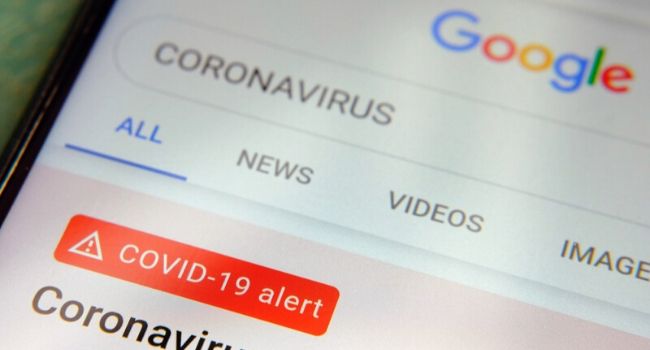
google coronavirus

Apple and Google Team Up For Coronavirus Tracing App, Sparking Privacy Concerns

The app will make it easier for individuals and public health officials to track the spread of COVID-19, but privacy rights groups are pushing for transparency.

In an unprecedented collaboration, Apple and Google are coming together to develop a Bluetooth-based app that would allow individuals (and health officials) to track if they have come into contact with someone who has been diagnosed with COVID-19.

The practice of “contact tracing” is cited by public health officials as crucial in containing the spread of the highly contagious coronavirus so that people who have been in close proximity to an infected person can self-isolate and prevent others from becoming infected.

Now, the two tech companies are creating APIs for Android and iOS, Apple’s operating system, so that public health authorities can release official apps and access the data of people who consent to sharing their short-range Bluetooth communications, allowing the app to detect if they have been close to a person who reported having COVID-19.

“Through close cooperation and collaboration with developers, governments and public health providers, we hope to harness the power of technology to help countries around the world slow the spread of COVID-19 and accelerate the return of everyday life,” the two companies announced last week.

The idea is to release app designs that will operate with apps from public health authorities by mid-May. Users will have the ability to download the app during this period, and the tech giants will work in the meantime to build contact tracing functionality into their operating systems so that it is available to everyone with an Apple or Android device.

While the move has been largely celebrated as a potential way to limit spread of the coronavirus and address the logistical challenges of contact tracing, there have been critiques from tech experts and civil liberties advocates. Many are wondering about the difficulties of getting a majority of Americans to download an app on their own, in addition to concerns about the reliability of Bluetooth signals and the effectiveness of tech contact tracing.

“It does seem like a passive system that works to inform people in those situations about potential exposures could offer at least some level of protection,” Casey Newton, a reporter at The Verge, wrote in his newsletter The Interface. “The question is whether the system ultimately generates more signal than noise — whether Bluetooth finds more true positives than false ones.”

The Electronic Frontier Foundation, a digital privacy rights group, wrote that the apps developed by major tech companies to address the coronavirus crisis should provide and require safeguards for user privacy. Some of those guidelines include requiring consent for all data that is collected, minimizing the data that is collected to only what is necessary for the app to work, implementing stringent information security practices, and ending the app when it is not longer deemed necessary.

Transparency about how the government is using the data gathered from the app and how it will be stored will also go a long way in earning user trust, according to the EFF.

“COVID-19 is a worldwide crisis, one which threatens to kill millions and upend society, but history has shown that exceptions to civil liberties protections made in a time of crisis often persist much longer than the crisis itself,” an EFF blog post reads, adding: “Above all, even as we fight COVID-19, we must ensure that the word ‘crisis’ does not become a magic talisman that can be invoked to build new and ever more clever means of limiting people’s freedoms through surveillance.”

Jennifer Granick, the American Civil Liberties Union’s surveillance and cybersecurity counsel, said in a statement to TechCrunch that no contact tracing app will replace public health services like widespread testing, but Apple and Google have taken steps to address privacy concerns.

“To their credit, Apple and Google have announced an approach that appears to mitigate the worst privacy and centralization risks, but there is still room for improvement,” Granick said. “We will remain vigilant moving forward to make sure any contract tracing app remains voluntary and decentralized, and used only for public health purposes and only for the duration of this pandemic.”

Featured

  • The Future of Access Control: Cloud-Based Solutions for Safer Workplaces

    Access controls have revolutionized the way we protect our people, assets and operations. Gone are the days of cumbersome keychains and the security liabilities they introduced, but it’s a mistake to think that their evolution has reached its peak. Read Now

  • A Look at AI

    Large language models (LLMs) have taken the world by storm. Within months of OpenAI launching its AI chatbot, ChatGPT, it amassed more than 100 million users, making it the fastest-growing consumer application in history. Read Now

  • First, Do No Harm: Responsibly Applying Artificial Intelligence

    It was 2022 when early LLMs (Large Language Models) brought the term “AI” into mainstream public consciousness and since then, we’ve seen security corporations and integrators attempt to develop their solutions and sales pitches around the biggest tech boom of the 21st century. However, not all “artificial intelligence” is equally suitable for security applications, and it’s essential for end users to remain vigilant in understanding how their solutions are utilizing AI. Read Now

  • Improve Incident Response With Intelligent Cloud Video Surveillance

    Video surveillance is a vital part of business security, helping institutions protect against everyday threats for increased employee, customer, and student safety. However, many outdated surveillance solutions lack the ability to offer immediate insights into critical incidents. This slows down investigations and limits how effectively teams can respond to situations, creating greater risks for the organization. Read Now

  • Security Today Announces 2025 CyberSecured Award Winners

    Security Today is pleased to announce the 2025 CyberSecured Awards winners. Sixteen companies are being recognized this year for their network products and other cybersecurity initiatives that secure our world today. Read Now

New Products

  • ResponderLink

    ResponderLink

    Shooter Detection Systems (SDS), an Alarm.com company and a global leader in gunshot detection solutions, has introduced ResponderLink, a groundbreaking new 911 notification service for gunshot events. ResponderLink completes the circle from detection to 911 notification to first responder awareness, giving law enforcement enhanced situational intelligence they urgently need to save lives. Integrating SDS’s proven gunshot detection system with Noonlight’s SendPolice platform, ResponderLink is the first solution to automatically deliver real-time gunshot detection data to 911 call centers and first responders. When shots are detected, the 911 dispatching center, also known as the Public Safety Answering Point or PSAP, is contacted based on the gunfire location, enabling faster initiation of life-saving emergency protocols.

  • PE80 Series

    PE80 Series by SARGENT / ED4000/PED5000 Series by Corbin Russwin

    ASSA ABLOY, a global leader in access solutions, has announced the launch of two next generation exit devices from long-standing leaders in the premium exit device market: the PE80 Series by SARGENT and the PED4000/PED5000 Series by Corbin Russwin. These new exit devices boast industry-first features that are specifically designed to provide enhanced safety, security and convenience, setting new standards for exit solutions. The SARGENT PE80 and Corbin Russwin PED4000/PED5000 Series exit devices are engineered to meet the ever-evolving needs of modern buildings. Featuring the high strength, security and durability that ASSA ABLOY is known for, the new exit devices deliver several innovative, industry-first features in addition to elegant design finishes for every opening.

  • A8V MIND

    A8V MIND

    Hexagon’s Geosystems presents a portable version of its Accur8vision detection system. A rugged all-in-one solution, the A8V MIND (Mobile Intrusion Detection) is designed to provide flexible protection of critical outdoor infrastructure and objects. Hexagon’s Accur8vision is a volumetric detection system that employs LiDAR technology to safeguard entire areas. Whenever it detects movement in a specified zone, it automatically differentiates a threat from a nonthreat, and immediately notifies security staff if necessary. Person detection is carried out within a radius of 80 meters from this device. Connected remotely via a portable computer device, it enables remote surveillance and does not depend on security staff patrolling the area.