TSA thinking About Temperature Checks and Thermal Imaging

TSA thinking About Temperature Checks and Thermal Imaging

New measures may be encourage social distancing to stop spread COVID-19

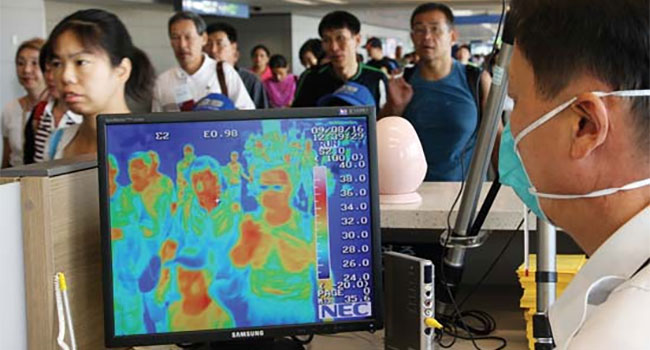
After TSA rolled out a series of new measures May 21, meant to encourage social distancing and stop the spread of COVID-19, the agency also is thinking about checking temperatures and thermal imaging to help screen for the virus.

Acting DHS Secretary Chad Wolf said it is a possible that prior to boarding an aircraft they would be screened for elevated temperatures before they board planes.

“We’re looking at temperature checks, thermal imaging and other technologies to see what we can do to provide some layer of security,” Wolf said Thursday.

Air carrier trade group Airlines 4 America has been pushing federal officials to take on the responsibility of screening passengers for health concerns before they board, however Southwest Airlines Gary Kelly has said the airlines are not equipped to implement such measures.

“In terms of our airport environment, we are recommending that the TSA undertake temperature checks at the screening checkpoint,” Kelly said.

Airline executives say such measures would not be a cure all for stopping the spread of COVID-19. Wolf recently took a tour of Alliance Airport, located in Fort Worth Texas.

“We’re not going to eliminate risk, we can never eliminate risk,” Wolf said. “How do we buy that risk down? And I think that’s what we’re looking at how do we buy that down so that we make sure that folks perhaps with elevated temperatures, perhaps are at the beginning of feeling sick, we can identify those individuals and not have them fly.”

Airlines have recently asked that travelers wear face masks to help stop the spread of COVID-19. Airlines also have been limiting capacity abroad flights. Major carriers have said they will not enforce face mask rules once the plane has pulled back from gates.

TSA’s newest measures don’t include temperature checks but do help put distance between passengers. Rules also ask passengers to put foods in a separate bag so that security screeners don’t have to handle it. Passengers will also be able to scan their own boarding passes. TSA agents are already required to wear face masks.

About the Author

Ralph C. Jensen is the Publisher/Editor in chief of Security Today magazine.

Featured

  • Security Industry Association Announces the 2026 Security Megatrends

    The Security Industry Association (SIA) has identified and forecasted the 2026 Security Megatrends, which form the basis of SIA’s signature annual Security Megatrends report defining the top 10 factors influencing both near- and long-term change in the global security industry. Read Now

  • The Future of Access Control: Cloud-Based Solutions for Safer Workplaces

    Access controls have revolutionized the way we protect our people, assets and operations. Gone are the days of cumbersome keychains and the security liabilities they introduced, but it’s a mistake to think that their evolution has reached its peak. Read Now

  • A Look at AI

    Large language models (LLMs) have taken the world by storm. Within months of OpenAI launching its AI chatbot, ChatGPT, it amassed more than 100 million users, making it the fastest-growing consumer application in history. Read Now

  • First, Do No Harm: Responsibly Applying Artificial Intelligence

    It was 2022 when early LLMs (Large Language Models) brought the term “AI” into mainstream public consciousness and since then, we’ve seen security corporations and integrators attempt to develop their solutions and sales pitches around the biggest tech boom of the 21st century. However, not all “artificial intelligence” is equally suitable for security applications, and it’s essential for end users to remain vigilant in understanding how their solutions are utilizing AI. Read Now

  • Improve Incident Response With Intelligent Cloud Video Surveillance

    Video surveillance is a vital part of business security, helping institutions protect against everyday threats for increased employee, customer, and student safety. However, many outdated surveillance solutions lack the ability to offer immediate insights into critical incidents. This slows down investigations and limits how effectively teams can respond to situations, creating greater risks for the organization. Read Now

New Products

  • Unified VMS

    AxxonSoft introduces version 2.0 of the Axxon One VMS. The new release features integrations with various physical security systems, making Axxon One a unified VMS. Other enhancements include new AI video analytics and intelligent search functions, hardened cybersecurity, usability and performance improvements, and expanded cloud capabilities

  • Camden CV-7600 High Security Card Readers

    Camden CV-7600 High Security Card Readers

    Camden Door Controls has relaunched its CV-7600 card readers in response to growing market demand for a more secure alternative to standard proximity credentials that can be easily cloned. CV-7600 readers support MIFARE DESFire EV1 & EV2 encryption technology credentials, making them virtually clone-proof and highly secure.

  • ResponderLink

    ResponderLink

    Shooter Detection Systems (SDS), an Alarm.com company and a global leader in gunshot detection solutions, has introduced ResponderLink, a groundbreaking new 911 notification service for gunshot events. ResponderLink completes the circle from detection to 911 notification to first responder awareness, giving law enforcement enhanced situational intelligence they urgently need to save lives. Integrating SDS’s proven gunshot detection system with Noonlight’s SendPolice platform, ResponderLink is the first solution to automatically deliver real-time gunshot detection data to 911 call centers and first responders. When shots are detected, the 911 dispatching center, also known as the Public Safety Answering Point or PSAP, is contacted based on the gunfire location, enabling faster initiation of life-saving emergency protocols.