Phone Home
Emergency phone systems play important role in campus communication networks
- By Samuel Shanes
- Dec 01, 2006
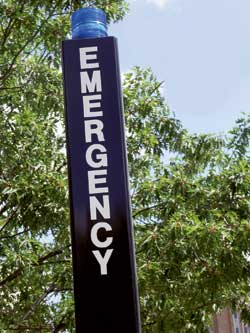 A reliable communication system is the backbone of any school security program. The placement of emergency phones on a college campus has long ceased to be an issue. The question now is how best to plan and deploy a system consistent with the overall communications network, meet statutory and regulatory requirements and enhance integrated service and security needs.
The placement of emergency phones on a college campus has long ceased to be an issue. The question now is how best to plan and deploy a system consistent with the overall communications network, meet statutory and regulatory requirements and enhance integrated service and security needs.
There are several critical factors end users should consider in making the determinations: What is the communications backbone on campus? What functions must the system provide? Are any of the functions affected by legal requirements such as the Americans with Disabilities Act or the A17 Elevator Code?
VoIP Advantages
VoIP is today's most talked about telecommunications development. But the technology also contains its fair share of security issues. The bottom line is that, regardless of what difficulties may exist in conversion from traditional analog systems to VoIP, the technology will continue to spread at an ever-increasing rate. Many college campuses like Fisk University in Nashville, Tenn., have already converted. And many more campuses also have plans in process.
Fisk University's emergency phone towers are now integrated directly into a Talk-A-Phone VoIP interface at the campus' security command center. The school's network already consisted of Talk-A-Phone's emergency phones with VoIP capabilities, so the conversion was simply a matter of adding Ethernet drops at phone locations.
VoIP provides many advantages for emergency phone system installations. Separate, analog home runs are not required back to a head-end frame, but can instead connect Ethernet drops wherever needed. Users also can connect IP CCTV cameras to the same drops, easily installing and integrating two security elements often found together.
Whether users have VoIP capabilities now or are planning for it in the future, be sure the emergency phone equipment selected has VoIP capabilities. Otherwise, supplemental analog lines must be run to support the units or the equipment may be replaced completely when a facility goes VoIP.
System Functions
Traditionally, emergency phones have been seen on open areas of campuses as deterrents to crime and as methods to report incidents. Towers with blue lights or strobes dot walkways to provide a security presence.
Increasingly, universities have come to view parking facilities in much the same way that commercial properties view parking. There have been many lawsuits over crime in parking facilities -- multi-million-dollar judgments are no longer unusual. For that reason alone, it is prudent to provide emergency phones with blue lights or strobes, as well as CCTV, in parking locations.
Campuses have a mission of service to students, faculty and employees, whether that means finding a car, jumping a dead battery or reporting a minor accident. Wall-mounted phones with integrated blue lights or strobes are well-suited for these applications.
There also is an expanding role for emergency/information phones in the area of access control. Whether at a controlled entrance vehicle gate, an entrance to a laboratory or at a late-night entrance to a dormitory, access control systems are an essential part of every campus security plan. These locations usually have card access systems. However, what if the card does not work? Units are now available that integrate card access systems with emergency phones in one pedestal, simplifying system operation.
Prior to the opening of its first residence halls, St. John's University in New York hired two outside servicing companies to complete an assessment of its security program. Both surveys suggested the school institute an emergency phone system throughout the campus and resident villages. As a result, the school deployed a system of emergency phones, including solar-powered emergency phone towers, throughout its buildings, parking garages, playing fields and entry/exit points.
Regulatory Impacts
The Americans with Disabilities Act mandates area-of-rescue systems for facilities around campuses. Section 4.3.11.4 of the ADA Accessibility Guidelines for Buildings and Facilities states "that a method of two-way communication, with both visible and audible signals, shall be provided between each area of rescue assistance and the primary entry. The fire department or appropriate local authority may approve a location other than the primary entry."
An essential element of the system is an ADA-compliant emergency phone in the designated area-of-rescue location -- often a designated stairwell. In many instances, a local command station located at or near the building's fire command center is installed, which can receive and initiate calls from the area-of-rescue stations. The systems can automatically transfer calls from the rescue stations via a phone line to 911 or other emergency services.
Area-of-rescue systems can serve other functions within the facility. If someone trips and falls down the stairs, that person can summon prompt medical attention by pushing the button on the area-of-rescue station. The unit even automatically identifies its location, so emergency workers know exactly where to go. It also can supplement the building's alarm system, allowing the user to quickly contact emergency personnel and provide additional information. Although the fire department must answer every alarm, it's important to collect real-time information while personnel are on their way.
Some schools, such as Hunter College in New York City, have chosen to deploy emergency phones throughout buildings, well beyond the needed requirements of area rescue systems. Hunter College, with several campuses in Manhattan, has installed approximately 1,400 emergency phones in buildings. The units provide students and faculty the ability to report a wide variety of incidents and request appropriate help.
Emergency communication in elevators must comply with numerous codes, including both ADA and A17 Elevator Safety Code. Until 2002, the Elevator Code (ASME A17.1) requirements for emergency communication had remained unchanged since the 1960s. It simply required a way for emergency personnel outside the hoist way to be able to call into the elevator. The updated code significantly expands the role and requirements for emergency phones in elevators.
All campuses should re-examine elevator emergency phones to be certain applicable codes and regulations are met. If a campus has already converted its telephone system to VoIP, installing code-compliant emergency phones will be easier.
Safe Campuses
Some campuses have decided to step up security networks to strengthen homeland security efforts. Many universities conduct government research, which can make the facilities likely terrorist targets. All security directors receive FBI and homeland security bulletins. In the event of an attack on a facility, it will be essential to quickly gain control of the area, deal with the injured and communicate information to those in adjoining areas. These are critical times in which direction must be clearly explained on what actions to take next.
Emergency phone towers can be combined with wide-area broadcasting to enable emergency personnel to broadcast critical information to those in the affected area. Information can be broadcast either remotely or from the tower. The systems also can be used to help people leaving a building in case of a fire or other emergency. Some towers are designed to be fitted with built-in card readers so everyone can check in, providing emergency personnel with a quick count of who may still be in the building.
Planning for the proper configuration of an emergency phone system has quickly become a priority. In response, expanding technology has made more products available for each need, making it easier and more cost effective to deploy the technology.
This article originally appeared in the December 2006 issue of Security Products, pg. 42.