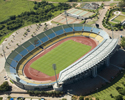
IP Video Technology Keeps Watch Over Soccer World Cup Stadium In South Africa

An IndigoVision IP video surveillance solution has been deployed at the Royal Bafokeng Stadium, near Rustenburg, South Africa as part of a multi-million dollar security upgrade for the recent 2010 Soccer World Cup. The 42,000 capacity stadium was one of the 10 venues used to stage the World Cup finals and was also used to host the Confederations Cup in 2009. With experience of two Olympic Games and the 2006 Soccer Word Cup, IndigoVision’s technology is a field proven solution for the demanding security environment posed by major international sporting events.

The 120 camera system was supplied by IndigoVision’s Partner Norbain SA and installed by Southwest Systems, who also installed Biometric access control alongside the IP Video system. Commenting on the project, Southwest Systems’ Director of Sales, Brian McMahon said, “It’s an unavoidable fact of life that crowded areas are particularly vulnerable to security threats. Environments such as stadiums require complex security solutions that are both scalable and flexible. IndigoVision’s system provides wide-ranging visibility throughout the premises as well as on the periphery, to allow not only for instant incident capture but also incident prevention.”

A mix of IndigoVision’s fixed and vandal-resistant internal and external IP dome cameras were used throughout the stadium.

“These high-end professional IP cameras offer image quality that is as good as, if not better than, their analog counterparts,” said John Loftus, Managing Director of Norbain SA. “The camera range allows for simple, easy deployment of IP-based surveillance systems since they only require a single CAT 5 cable for connection to the network. Because of the cameras’ built-in PoE support they can be powered directly from the network, reducing installation costs.”

Operators located in a central control room overlooking the stadium’s interior use ‘Control Center’, IndigoVision’s Security Management Software to monitor live and recorded video from the cameras.

Video is recorded continuously from all the cameras for 30 days on seven 1TB IndigoVision standalone NVRs. Real-time analytics running in the IP cameras reduce the network bandwidth and storage requirement by streaming lower framerate video during periods of inactivity in the camera scene. The instant motion is detected, video is automatically streamed at the maximum configured framerate.

As well as the stadium near Rustenburg, IndigoVision’s technology was also at the heart of an integrated security system for the Nelson Mandela Bay Metropolitan Municipality located in the Eastern Cape province of South Africa. The metro area is home to more than 1.3 million people, covers an area of 750 square miles and includes the towns of Uitenhage and Despatch, together with Port Elizabeth which was also a host city for the 2010 Soccer World Cup.


Featured

  • Security Today Announces 2025 CyberSecured Award Winners

    Security Today is pleased to announce the 2025 CyberSecured Awards winners. Sixteen companies are being recognized this year for their network products and other cybersecurity initiatives that secure our world today. Read Now

  • Empowering and Securing a Mobile Workforce

    What happens when technology lets you work anywhere – but exposes you to security threats everywhere? This is the reality of modern work. No longer tethered to desks, work happens everywhere – in the office, from home, on the road, and in countless locations in between. Read Now

  • TSA Introduces New $45 Fee Option for Travelers Without REAL ID Starting February 1

    The Transportation Security Administration (TSA) announced today that it will refer all passengers who do not present an acceptable form of ID and still want to fly an option to pay a $45 fee to use a modernized alternative identity verification system, TSA Confirm.ID, to establish identity at security checkpoints beginning on February 1, 2026. Read Now

  • The Evolution of IP Camera Intelligence

    As the 30th anniversary of the IP camera approaches in 2026, it is worth reflecting on how far we have come. The first network camera, launched in 1996, delivered one frame every 17 seconds—not impressive by today’s standards, but groundbreaking at the time. It did something that no analog system could: transmit video over a standard IP network. Read Now

  • From Surveillance to Intelligence

    Years ago, it would have been significantly more expensive to run an analytic like that — requiring a custom-built solution with burdensome infrastructure demands — but modern edge devices have made it accessible to everyone. It also saves time, which is a critical factor if a missing child is involved. Video compression technology has played a critical role as well. Over the years, significant advancements have been made in video coding standards — including H.263, MPEG formats, and H.264—alongside compression optimization technologies developed by IP video manufacturers to improve efficiency without sacrificing quality. The open-source AV1 codec developed by the Alliance for Open Media—a consortium including Google, Netflix, Microsoft, Amazon and others — is already the preferred decoder for cloud-based applications, and is quickly becoming the standard for video compression of all types. Read Now

New Products

  • Camden CV-7600 High Security Card Readers

    Camden CV-7600 High Security Card Readers

    Camden Door Controls has relaunched its CV-7600 card readers in response to growing market demand for a more secure alternative to standard proximity credentials that can be easily cloned. CV-7600 readers support MIFARE DESFire EV1 & EV2 encryption technology credentials, making them virtually clone-proof and highly secure.

  • QCS7230 System-on-Chip (SoC)

    QCS7230 System-on-Chip (SoC)

    The latest Qualcomm® Vision Intelligence Platform offers next-generation smart camera IoT solutions to improve safety and security across enterprises, cities and spaces. The Vision Intelligence Platform was expanded in March 2022 with the introduction of the QCS7230 System-on-Chip (SoC), which delivers superior artificial intelligence (AI) inferencing at the edge.

  • HD2055 Modular Barricade

    Delta Scientific’s electric HD2055 modular shallow foundation barricade is tested to ASTM M50/P1 with negative penetration from the vehicle upon impact. With a shallow foundation of only 24 inches, the HD2055 can be installed without worrying about buried power lines and other below grade obstructions. The modular make-up of the barrier also allows you to cover wider roadways by adding additional modules to the system. The HD2055 boasts an Emergency Fast Operation of 1.5 seconds giving the guard ample time to deploy under a high threat situation.