New Scanner Allows Air Passengers to Carry-on Liquids Again
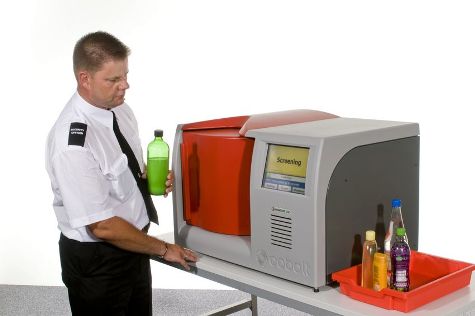
 

Cobalt Light Systems has received European approval for its INSIGHT100 bottle scanner, which enables aircraft passengers to carry liquid items larger than 100-milliliters once more. Airports could now allow passengers to take items, such as water, cosmetics, perfumes and duty-free through airport security channels from as early as 2013. The current ban on items over 100-ml in hand baggage can only be lifted when airports are able to effectively screen quickly and without opening the containers. INSIGHT100 screens individual bottles in less than five seconds to determine whether there is a security threat.

The INSIGHT100 scanner exceeded the European Civil Aviation Conference (ECAC) standard for use at airports with an almost perfect detection capability and negligible false alarm rate in unopened containers, ensuring maximum safety for the travelling public with the minimum delays. What makes INSIGHT100 special is the capability of identifying explosives unambiguously inside opaque bottles such as coloured plastic shampoo containers, or green glass wine bottles. Other systems do not precisely identify the threat reliably and may lead to large numbers of false alarms or to missing genuine threats.  The system is currently in trials at several major European airports.

The INSIGHT100 system uses a proprietary technology called Spatially Offset Raman Spectroscopy (SORS), which was pioneered at the Science & Technology Facilities Council’s (STFC) Central Laser Facility at its Rutherford Appleton Laboratory in Oxfordshire, and led to the creation of Cobalt Light Systems as a spin out of STFC.

“We have worked incredibly hard over the last couple of years to refine the SORS technology and bring the INSIGHT100 to market," said Dr. Paul Loeffen, CEO of Cobalt Light Systems. "It is a great achievement to have exceeded the European standards at this stage so that we are in a prime position to supply this unique bottle screener to European airports”. 

The development of the INSIGHT100 was funded under the Innovative Research Call in Explosives and Weapons Detection (2010) initiative, a cross-government programme sponsored by a number of government departments and agencies under the CONTEST strategy.

"Since STFC made the breakthrough in discovering SORS a few years ago, we have worked closely with the team at Cobalt Light Systems to develop and refine this technology," said Prof. Pavel Matousek, at STFC’s Rutherford Appleton Laboratory, and inventor of the SORS technique. "Particularly exciting to see how this particular scientific development could now go on to make a real difference to the safety and wellbeing of our society.”

The restriction on liquids was introduced following a failed al-Qaeda bomb plot in August 2006 to bring down several airliners departing London for North America – the terrorists aimed to use liquid explosives carried onto aircraft in bottles. Recently, the European Commission agreed to relax the limit on liquids by introducing new screening measures from April 2013. In just over a year from now, passengers will again be allowed to carry on that expensive bottle of champagne as a gift for friends, provided the bottle is screened.

Featured

  • Security Today Announces 2025 CyberSecured Award Winners

    Security Today is pleased to announce the 2025 CyberSecured Awards winners. Sixteen companies are being recognized this year for their network products and other cybersecurity initiatives that secure our world today. Read Now

  • Empowering and Securing a Mobile Workforce

    What happens when technology lets you work anywhere – but exposes you to security threats everywhere? This is the reality of modern work. No longer tethered to desks, work happens everywhere – in the office, from home, on the road, and in countless locations in between. Read Now

  • TSA Introduces New $45 Fee Option for Travelers Without REAL ID Starting February 1

    The Transportation Security Administration (TSA) announced today that it will refer all passengers who do not present an acceptable form of ID and still want to fly an option to pay a $45 fee to use a modernized alternative identity verification system, TSA Confirm.ID, to establish identity at security checkpoints beginning on February 1, 2026. Read Now

  • The Evolution of IP Camera Intelligence

    As the 30th anniversary of the IP camera approaches in 2026, it is worth reflecting on how far we have come. The first network camera, launched in 1996, delivered one frame every 17 seconds—not impressive by today’s standards, but groundbreaking at the time. It did something that no analog system could: transmit video over a standard IP network. Read Now

  • From Surveillance to Intelligence

    Years ago, it would have been significantly more expensive to run an analytic like that — requiring a custom-built solution with burdensome infrastructure demands — but modern edge devices have made it accessible to everyone. It also saves time, which is a critical factor if a missing child is involved. Video compression technology has played a critical role as well. Over the years, significant advancements have been made in video coding standards — including H.263, MPEG formats, and H.264—alongside compression optimization technologies developed by IP video manufacturers to improve efficiency without sacrificing quality. The open-source AV1 codec developed by the Alliance for Open Media—a consortium including Google, Netflix, Microsoft, Amazon and others — is already the preferred decoder for cloud-based applications, and is quickly becoming the standard for video compression of all types. Read Now

New Products

  • Luma x20

    Luma x20

    Snap One has announced its popular Luma x20 family of surveillance products now offers even greater security and privacy for home and business owners across the globe by giving them full control over integrators’ system access to view live and recorded video. According to Snap One Product Manager Derek Webb, the new “customer handoff” feature provides enhanced user control after initial installation, allowing the owners to have total privacy while also making it easy to reinstate integrator access when maintenance or assistance is required. This new feature is now available to all Luma x20 users globally. “The Luma x20 family of surveillance solutions provides excellent image and audio capture, and with the new customer handoff feature, it now offers absolute privacy for camera feeds and recordings,” Webb said. “With notifications and integrator access controlled through the powerful OvrC remote system management platform, it’s easy for integrators to give their clients full control of their footage and then to get temporary access from the client for any troubleshooting needs.”

  • Camden CM-221 Series Switches

    Camden CM-221 Series Switches

    Camden Door Controls is pleased to announce that, in response to soaring customer demand, it has expanded its range of ValueWave™ no-touch switches to include a narrow (slimline) version with manual override. This override button is designed to provide additional assurance that the request to exit switch will open a door, even if the no-touch sensor fails to operate. This new slimline switch also features a heavy gauge stainless steel faceplate, a red/green illuminated light ring, and is IP65 rated, making it ideal for indoor or outdoor use as part of an automatic door or access control system. ValueWave™ no-touch switches are designed for easy installation and trouble-free service in high traffic applications. In addition to this narrow version, the CM-221 & CM-222 Series switches are available in a range of other models with single and double gang heavy-gauge stainless steel faceplates and include illuminated light rings.

  • A8V MIND

    A8V MIND

    Hexagon’s Geosystems presents a portable version of its Accur8vision detection system. A rugged all-in-one solution, the A8V MIND (Mobile Intrusion Detection) is designed to provide flexible protection of critical outdoor infrastructure and objects. Hexagon’s Accur8vision is a volumetric detection system that employs LiDAR technology to safeguard entire areas. Whenever it detects movement in a specified zone, it automatically differentiates a threat from a nonthreat, and immediately notifies security staff if necessary. Person detection is carried out within a radius of 80 meters from this device. Connected remotely via a portable computer device, it enables remote surveillance and does not depend on security staff patrolling the area.