Power to the People
How PoE applications can help future-proof customer networks
- By Steven Olen
- May 01, 2013
What you don’t know about PoE technology could actually be costing you business. Once you understand its broad usefulness and the numerous applications it supports, the more you realize it’s a perfect fit for an incredible number of customers and vertical markets.
Most security system professionals and network designers are already familiar with how PoE technology applies to the world of IP surveillance. They know that using PoE cameras and switches eliminates the need for separate power and data cables, simplifying installation, increasing flexibility for camera locations and saving time and money. By saving money, this strategy also may enable customers to purchase more cameras for more locations, allowing a more comprehensive security solution.
Yet PoE has multiple uses beyond IP surveillance. Today, there are many applications that use PoE in revolutionary ways. The time to future-proof customers’ networks is now.
What Is PoE?
PoE is an IEEE standardized technology that transmits electrical power, along with data, to remote devices over standard Cat-5 or better, unshielded, twisted-pair cable (UTP) in an Ethernet network. With this technology, power sourcing equipment (PSE) devices, such as Ethernet switches or midspan injectors, can power IP cameras, IP telephones and other powered devices that would be inconvenient or infeasible to supply power separately. The original 2003 IEEE PoE standard (802.3af) supports up to 15.4w of power at each port. In 2009, the IEEE ratified a new standard—802.3at (also known as PoE+)—that supports up to 30w of power at each port. Because PoE is standardized, it offers full interoperability, so it works seamlessly with different solutions from a wide range of vendors.
Ten PoE Applications for the Future
When specifying and purchasing PoE switches for your customers’ networks, it always pays to think ahead. Your customers may only need 10 ports today, but sometime in the future they may need more. Here’s a glimpse at future requests:
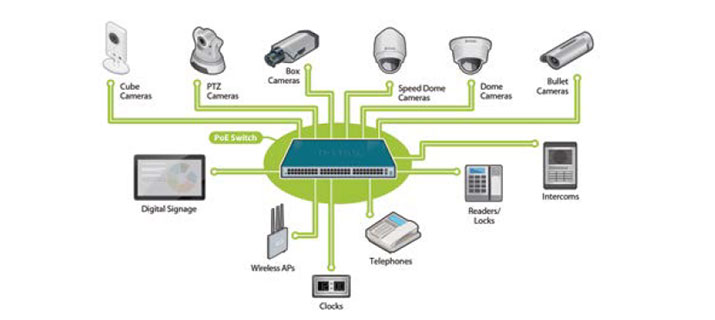
IP surveillance networks. This one you already know. In surveillance networks, IP cameras are replacing analog CCTV cameras at a steady pace. With PoE technology, IP cameras can be powered using the same LAN cable that also carries the IP video data, which may save up to 80 percent over traditional analog installations. PoE also adds a host of other benefits, such as better system management, centralized power, remote resetting of devices, simpler troubleshooting, cable protection and more optimal placement of cameras.
IP telephones. In businesses of all sizes, IP telephones are common PoE applications. IP phones and applications have many features that analog phones don’t support, so even if customers aren’t using IP telephony today, the likelihood that they might tomorrow is high. It’s wise to keep this in mind when designing a PoE network.
Wireless access points and routers. Most business-class wireless access points support PoE on their WAN interface— the uplink to the wired portion of the network. Powering an access point with PoE offers the flexibility to be mounted on walls, ceilings and other hard-to-reach, strategic locations, enabling customers to take full advantage of the benefits of wireless LANs.
PoE-powered “mini-switch” repeaters and splitters. Ethernet is designed to reach 100 meters over UTP cable. For applications that require longer spans, some vendors manufacture PoE-powered Ethernet repeaters, which don’t need local power. Since they’re powered by PoE or PoE+ from an Ethernet switch, they are classified as powered devices and can extend the Ethernet signal another 100 meters. Some of these repeaters can also simultaneously act as PSEs, providing power to a powered device at the far end of the Ethernet span.
PoE splitters are devices at the end of an Ethernet segment that convert 48 VDC PoE power to a lower voltage, typically 5 VDC or 12 VDC. At the same time, the Ethernet signal is transparently passed through the device. Splitters allow PoE switches to power non-PoE cameras and other devices that instead need lower voltages to operate.
IP clocks. How many times have you visited a school or business and noticed each clock on the wall keeping slightly different time? Customers can solve this problem with IP clocks. They require no external AC power or batteries, and they remain synchronized to a central time server.
They can be powered directly by the same PoE switch used for other applications in the network. For these reasons, they’re ideal for facilities such as schools, office buildings and government facilities. For security system integrators and network designers that are already supporting PoE and IP surveillance networks in the education, healthcare and hospitality verticals, IP clocks can be a relatively easy add-on sale.
Door locks and badge/RFID readers. Network-powered door locks, badge readers and RFID readers are another common-sense application. For security conscious businesses and schools already managing IP surveillance systems, it’s not a stretch to see the value of door locks and badge readers that offer big-time security benefits, while also being powered and controlled by the same network.
Intercoms, pagers and public address systems. Many businesses would like company-wide, overhead paging to multiple locations within a facility or across an entire campus—even to remote locations thousands of miles away—without running new cabling and power lines. Thanks to PoE technology, today’s networks can support VoIP speakers, paging systems and public address loudspeakers that easily connect into existing networks with a single cable connection with no external power necessary.
Because these devices traditionally have compact sizes and small footprints, PoE power enables them to be mounted virtually anywhere for greater reach and placement flexibility.
Digital signage and video kiosks. Digital signs, interactive displays and video kiosks have become an increasingly popular way to deliver compelling and creative media to any school campus, store, bank, manufacturing floor or hospital—engaging customers, students and employees in a whole new way. Users gain new opportunities to create a consistent user experience across multiple channels, increase revenue and maximize operational efficiency.
PoE is the technology that easily and cost-effectively powers many of these popular communication devices. Because PoE technology enables a single Ethernet cable to supply both power and data to digital signs, it addresses concerns of both physical concealment and AC proximity for power bricks.
Environmental/industrial sensors. Frequently, businesses use intelligent, online, PoE sensors to measure environmental factors in mission-critical locations such as warehouses, data centers, computer and server rooms, equipment rooms and more. These sensors provide important measurements for temperature, humidity, atmospheric pressure, power failure, airflow and the presence of water. Furthermore, they can automatically generate alerts via email or SNMP traps, so any problems can be resolved quickly, before they escalate.
New (and future) applications. Not surprisingly, there are plenty of new PoE applications on the horizon. For example, a new generation of LED lights will be powered not by an AC power line, but by a basic Ethernet cable from a PoE switch. The UTP cable can carry both power and data to LEDs, which makes these fixtures easier to measure, monitor and control. Because each LED fixture can be an end point on a network, they can each be controlled separately or dimmed automatically with in-line proximity sensors that increase light when someone (perhaps with a smartphone) enters the space.
Some companies also are looking into ways for PoE+ (the 802.3at standard) to “trickle charge” laptops. If successful, this would become an additional benefit of PoE networks, especially in a corporate or business setting.
It is Smart to Plan
As you continue to support your existing IP surveillance customers and gain new ones, consider these applications and realize that installing or enhancing a PoE infrastructure today can help your customers better prepare for the future. Many customers, regardless of their current network sophistication, may choose to add one or more of these applications to their networks down the road, so plan ahead.
What should you look for? Invest in PoE switches with these three things in mind:
Plenty of ports—PoE switches are available from as few as one PoE port to as many as 48 ports. Don’t short change your customers’ networks.
Plenty of power—Don’t forget about your PoE budget (the amount of power available in every switch). A 24-port switch with a 100w budget can support, on average, about 4w per port—many PDs need more than that. On the other hand, a 24-port switch with a 370w budget can support a full 15.4w per port. So, pay attention to power budget, and don’t sell your customers short.
Plenty of bandwidth—Remember, Fast Ethernet (10/100) is good, but Gigabit Ethernet is better. Your customers may not need the full bandwidth today, but if they add any PoE applications in the future, they’ll likely need that extra bandwidth to sustain them.
With all the practical PoE applications available today, you can supply more power to the people—and bring more productivity-enhancing features to their networks.
This article originally appeared in the May 2013 issue of Security Today.