Well, looks like 3D printed guns are making the headlines again. This time, even the Department of Homeland Security seems hopeless when it comes to preventing 3D printed guns from being made, not to mention making it past security checkpoints. The department fears that 3D printed gun control efforts will be useless should their manufacture become more widespread, making it “impossible” to stop or even control.
A couple of days ago, a department-distributed bulletin arrived at state and federal law enforcement agencies, stating that 3D printed guns “poses public safety risks” and are likely beyond the current reach of regulators and regulations.
According to one law enforcement source, “The only security procedure to catch [3D printed guns] is a pat down,” since magnetometers could fail to detect them.
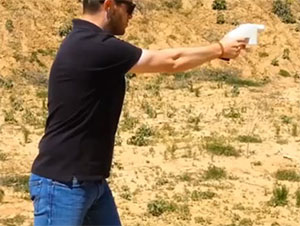 The bulletin specifically honed in on a nonprofit company, Defense Distributed, started by University of Texas law student, Cody Wilson, who has not only successfully printed a 3D gun, which he nicknamed “The Liberator,” but fired it as well. And, of course, Wilson felt the need to share, so plans for how to make “The Liberator” were available for free download, until the U.S. State Department told the organization to stop sharing the file, but only after the plans were downloaded approximately 100,000 times.
Containing phrases like “poses public safety risks” and “limiting access may be impossible,” neither of which sound too confident, the bulletin mentions the following concerns:
- Though prohibited by law, the metal insert may be deliberately omitted;
- Future designs could entirely eliminate metal components;
- 3D guns can be made without serial numbers, which hinders ballistic testing; and
- Improvements in technology leading to cheaper 3D printers could make printed guns easier to acquire.
Plus, even if there is legislation in place that bans 3D printed guns, online distribution of digital files is difficult to control. Think about illegally traded music, movies and software.
So, my fellow Americans, I pose this question: “are we ready for pat downs?”
Source: http://www.foxnews.com/us/2013/05/23/govt-memo-warns-3d-printed-guns-may-be-impossible-to-stop/