
High Profile Shootings Spur Rapid Growth of Market for US School Security System Integration

High Profile Shootings Spur Rapid Growth of Market for US School Security System Integration
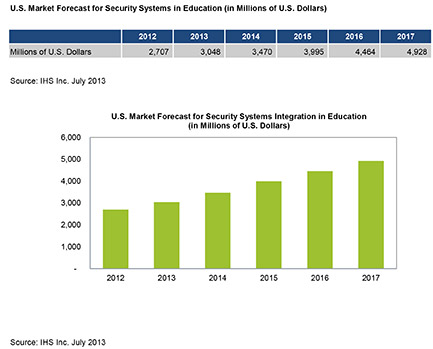
High Profile Shootings Spur Rapid Growth of Market for US School Security System IntegrationIn the wake of shooting tragedies including the Sandy Hook massacre, U.S. educational institutions are adopting systems that allow them to respond to all kinds of emergencies in real time, driving the country’s market for school security system integration to rise by more than 80 percent from 2012 to 2017.

The market for security systems integration in educational institutions is set to expand to $4.9 billion in 2017, up from $2.7 billion in 2012, according to a new report entitled “Vertical Insights: Video Surveillance & Security in Education” from information and analytics provider IHS. Double-digit growth is expected for every year throughout the forecast, with revenue rising by 13 percent to reach $3.0 billion in 2013.

The system-integration business provides complete security solutions including the provision, installation and maintenance of video surveillance, physical access control and intruder alarm systems.

“Following events like Sandy Hook and the Santa Monica shooting, schools have changed their views of how security systems should work,” said Paul Bremner, video surveillance and security services market analyst at IHS. “Instead of serving as forensic tools that provide evidence of events that have already occurred, security systems now are expected to help educational institutions detect and mitigate problems as they happen. Because of this, schools are employing security system-integration providers, which provide technologies and services that combine multiple safety mechanisms into a cohesive solution.”

Video surveillance and security systems that can reduce the possibility, or that provide quicker response times to incidents as they are occurring, have an advantage over those that cannot.

“Video surveillance and security systems in the education sector must be flexible enough to deal with multiple types of threats,” Bremner said. “The types of threats an educational institution may encounter change during the course of a day. During the daytime, the main issue is access control, restricting who comes onto the premise and ensuring any potential threats remain outside. At night, the security system must deal with protection against vandalism.”

School security solutions in the past have centered on a combination of physical access control and emergency notification systems. While this approach is still a strong focus for many schools, there now is much higher demand for video surveillance equipment in educational institutions. The growth rate of the video surveillance equipment market in the education sector is more than double that of the equipment market for physical access control.

“In addition to dealing with threats, video surveillance systems in the education sector have the added advantage that they can be used for a broad range of tasks, including gathering evidence for a criminal investigation; acting as a deterrent for theft, assault and vandalism; or simply by providing greater visibility to the school’s security staff,” Bremner concluded.

Featured

  • Empowering and Securing a Mobile Workforce

    What happens when technology lets you work anywhere – but exposes you to security threats everywhere? This is the reality of modern work. No longer tethered to desks, work happens everywhere – in the office, from home, on the road, and in countless locations in between. Read Now

  • TSA Introduces New $45 Fee Option for Travelers Without REAL ID Starting February 1

    The Transportation Security Administration (TSA) announced today that it will refer all passengers who do not present an acceptable form of ID and still want to fly an option to pay a $45 fee to use a modernized alternative identity verification system, TSA Confirm.ID, to establish identity at security checkpoints beginning on February 1, 2026. Read Now

  • The Evolution of IP Camera Intelligence

    As the 30th anniversary of the IP camera approaches in 2026, it is worth reflecting on how far we have come. The first network camera, launched in 1996, delivered one frame every 17 seconds—not impressive by today’s standards, but groundbreaking at the time. It did something that no analog system could: transmit video over a standard IP network. Read Now

  • From Surveillance to Intelligence

    Years ago, it would have been significantly more expensive to run an analytic like that — requiring a custom-built solution with burdensome infrastructure demands — but modern edge devices have made it accessible to everyone. It also saves time, which is a critical factor if a missing child is involved. Video compression technology has played a critical role as well. Over the years, significant advancements have been made in video coding standards — including H.263, MPEG formats, and H.264—alongside compression optimization technologies developed by IP video manufacturers to improve efficiency without sacrificing quality. The open-source AV1 codec developed by the Alliance for Open Media—a consortium including Google, Netflix, Microsoft, Amazon and others — is already the preferred decoder for cloud-based applications, and is quickly becoming the standard for video compression of all types. Read Now

  • Cost: Reactive vs. Proactive Security

    Security breaches often happen despite the availability of tools to prevent them. To combat this problem, the industry is shifting from reactive correction to proactive protection. This article will examine why so many security leaders have realized they must “lead before the breach” – not after. Read Now

New Products

  • Camden CV-7600 High Security Card Readers

    Camden CV-7600 High Security Card Readers

    Camden Door Controls has relaunched its CV-7600 card readers in response to growing market demand for a more secure alternative to standard proximity credentials that can be easily cloned. CV-7600 readers support MIFARE DESFire EV1 & EV2 encryption technology credentials, making them virtually clone-proof and highly secure.

  • AC Nio

    AC Nio

    Aiphone, a leading international manufacturer of intercom, access control, and emergency communication products, has introduced the AC Nio, its access control management software, an important addition to its new line of access control solutions.

  • Connect ONE’s powerful cloud-hosted management platform provides the means to tailor lockdowns and emergency mass notifications throughout a facility – while simultaneously alerting occupants to hazards or next steps, like evacuation.

    Connect ONE®

    Connect ONE’s powerful cloud-hosted management platform provides the means to tailor lockdowns and emergency mass notifications throughout a facility – while simultaneously alerting occupants to hazards or next steps, like evacuation.