
Bicycle Thieves in San Francisco Could Become Twitter Celebrities

Bicycle Thieves in San Francisco Could Become Twitter Celebrities

In the past few years, cycling in San Francisco has gained in popularity due to community support. The city has embraced this trend by improving paths; however, bicycle theft has also become a popular pastime for criminals. This has prompted police officers to become creative in policing such mischief.

Bait bikes” are being planted all over this city by police officers as a lure for bicycle thieves. These bikes are equipped with GPS technology, enabling them to be tracked in real time and thieves can be arrested on the spot.

I don’t know if you have seen the TV show “Bait Car,” but this seems a bit like that. Yet, officers are taking it just one step further, perhaps attempting to thwart further incidents.
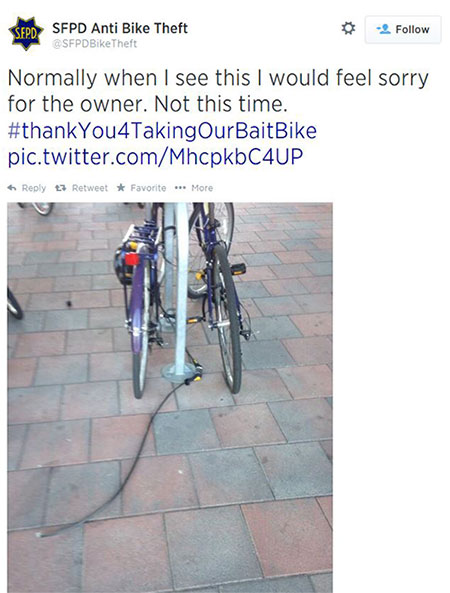
Bicycle Thieves in San Francisco Could Become Twitter CelebritiesOne incident in particular, a thief stole a $1,500 bicycle that was parked outside a train stop and just pedaled off. Thirty minutes later, however, officers were hot on his trail, and Officer Matt Friedman, head of the de facto anti-bike-theft unit in Park Station, caught the criminal in a park with the bike. Armed with his iPhone 5 and a .40-caliber Sig Sauer semiautomatic, Friedman whipped out his smartphone and snapped a picture of the suspect as well as an image of the severed bike lock, tweeting it with a very special hashtag: #ThankYou4TakingOurBaitBike.

While this isn’t a new concept in fighting against bicycle theft, with similar programs on college campuses as well as in cities like Vancouver and Sacramento, I do believe it’s the first program to actually use social media.

Be sure to follow Officer Friedman and the SFPD Anti-bike Theft initiative @SFPDBikeTheft!

About the Author

Ginger Hill is Group Social Media Manager.

Featured

  • Security Today Announces 2025 CyberSecured Award Winners

    Security Today is pleased to announce the 2025 CyberSecured Awards winners. Sixteen companies are being recognized this year for their network products and other cybersecurity initiatives that secure our world today. Read Now

  • Empowering and Securing a Mobile Workforce

    What happens when technology lets you work anywhere – but exposes you to security threats everywhere? This is the reality of modern work. No longer tethered to desks, work happens everywhere – in the office, from home, on the road, and in countless locations in between. Read Now

  • TSA Introduces New $45 Fee Option for Travelers Without REAL ID Starting February 1

    The Transportation Security Administration (TSA) announced today that it will refer all passengers who do not present an acceptable form of ID and still want to fly an option to pay a $45 fee to use a modernized alternative identity verification system, TSA Confirm.ID, to establish identity at security checkpoints beginning on February 1, 2026. Read Now

  • The Evolution of IP Camera Intelligence

    As the 30th anniversary of the IP camera approaches in 2026, it is worth reflecting on how far we have come. The first network camera, launched in 1996, delivered one frame every 17 seconds—not impressive by today’s standards, but groundbreaking at the time. It did something that no analog system could: transmit video over a standard IP network. Read Now

  • From Surveillance to Intelligence

    Years ago, it would have been significantly more expensive to run an analytic like that — requiring a custom-built solution with burdensome infrastructure demands — but modern edge devices have made it accessible to everyone. It also saves time, which is a critical factor if a missing child is involved. Video compression technology has played a critical role as well. Over the years, significant advancements have been made in video coding standards — including H.263, MPEG formats, and H.264—alongside compression optimization technologies developed by IP video manufacturers to improve efficiency without sacrificing quality. The open-source AV1 codec developed by the Alliance for Open Media—a consortium including Google, Netflix, Microsoft, Amazon and others — is already the preferred decoder for cloud-based applications, and is quickly becoming the standard for video compression of all types. Read Now

New Products

  • A8V MIND

    A8V MIND

    Hexagon’s Geosystems presents a portable version of its Accur8vision detection system. A rugged all-in-one solution, the A8V MIND (Mobile Intrusion Detection) is designed to provide flexible protection of critical outdoor infrastructure and objects. Hexagon’s Accur8vision is a volumetric detection system that employs LiDAR technology to safeguard entire areas. Whenever it detects movement in a specified zone, it automatically differentiates a threat from a nonthreat, and immediately notifies security staff if necessary. Person detection is carried out within a radius of 80 meters from this device. Connected remotely via a portable computer device, it enables remote surveillance and does not depend on security staff patrolling the area.

  • Unified VMS

    AxxonSoft introduces version 2.0 of the Axxon One VMS. The new release features integrations with various physical security systems, making Axxon One a unified VMS. Other enhancements include new AI video analytics and intelligent search functions, hardened cybersecurity, usability and performance improvements, and expanded cloud capabilities

  • 4K Video Decoder

    3xLOGIC’s VH-DECODER-4K is perfect for use in organizations of all sizes in diverse vertical sectors such as retail, leisure and hospitality, education and commercial premises.