
fire safety

The Importance of Fire Compartmentation

Whatever the building, compartmentation is fundamental to its safety, creating a series of protected fire zones to ensure that the fire is contained.

First, some statistics.

There were 140 fire deaths in England between April and September last year, a 33 percent reduction on the same period ten years ago.

In the same six months, fire and rescue services attended 102,000 fires, 55percent lower than 2002.  They also attended 115,000 false alarms.

In total, there was a UK reduction in reported fires of 69.5 percent between 1979 and 2007, although the cost of fire remains high.  The Association of British Insurers estimated that in the first half of 2009, insurers paid out £639 million for fire damage - £3.6 million a day.

On a worldwide scale, international fire statistics are collated by the World Fire Statistics Centre (WFSC), which estimates that costs due to fire add up to approximately 1 percent of global GDP – that’s €126 billion in Europe alone.

In the industrialized world, fire deaths per 100,000 of population range from 0.02 in Singapore to 2.03 in Finland.  The UK stands at 0.75.

Across the EU, fire killed over 4,000 people in 2010.  In 2011, in India, fire killed over 26,000 people.

 In other words, fire remains a potent threat, despite advances in building design and construction and the enforcement of strict building regulations

Essentially, fire safety in commercial buildings is down to three things: an alarm system to detect and warn of the danger; a sprinkler system to damp down the fire; and fireproof compartments to contain the fire at source and prevent it spreading.

Taken together, those active and passive elements are designed to allow occupants to escape from the building, and provide safe access for the fire and rescue services.  How those elements are applied depends on the size of the building, its complexity and its function.

For example, an evacuation plan for a hospital or care home will be different to that of an office block, and require a different building safety approach.  In other words, building safety addresses the mobility, or otherwise, of its likely occupants.

Whatever the building, compartmentation is fundamental to its safety, creating a series of protected fire zones to ensure that the fire is contained.  For the glazed elements, the UK’s Glass and Glazing Federation has a specific guide on fire-resistant glazing.

Fire is spread through three methods: convection, conduction and radiation, of which convection is the most dangerous.  This is when smoke from the fire becomes trapped by the roof, spreading in all directions to form a deepening layer.  Smoke, rather than fire, is often the real danger.  Materials such as metal can absorb heat and transmit it to other rooms by conduction, where it can cause new fires to break out.  Radiation transfers heat in the air, until it too sets off secondary fires, spreading the danger away from its original location.

Modern glazing systems can provide complete protection against convection, conduction and radiation – whether as curtain walling, or internal doors or fire screens – for up to two hours, giving more than enough time for a safe evacuation.

But building designers and specifiers must ensure that the glass and its framing systems have proven compatibility.  That means insisting on comprehensive fire test certification that covers both elements.

In a fire, the glass and its frame have to function together to prevent the spread of fire, smoke or toxic gases.  If one fails, both fail, with potentially catastrophic consequences.
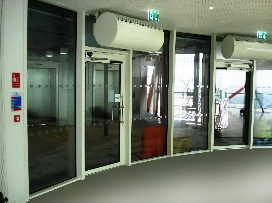
london orbital fire doorsAt Wrightstyle, we’ve invested in fire certification in the UK, USA and Far East – a reflection of our global business, and our confidence in our systems’ performance. 

We can also handle each step – from designing bespoke solutions, to fabrication and installation: an end-to-end service with comprehensive guarantees at each stage.

We can’t prevent fire from happening.  But we can prevent it from spreading, and that’s just as important.

About the Author

Jane Embury has been with Wrightstyle since the company’s formation in 1996. She is now a director of the company responsible for both the marketing and finance departments. She has some 17 years of experience in all aspects of the steel glazing sector and has overseen Wrightstyle’s growth as an international supplier of specialist glazing systems to mitigate against fire, high wind loading, and ballistic or explosive attack. Prior to joining Wrightstyle, Jane worked in the City of London in export finance.

Featured

  • Security Today Announces 2025 CyberSecured Award Winners

    Security Today is pleased to announce the 2025 CyberSecured Awards winners. Sixteen companies are being recognized this year for their network products and other cybersecurity initiatives that secure our world today. Read Now

  • Empowering and Securing a Mobile Workforce

    What happens when technology lets you work anywhere – but exposes you to security threats everywhere? This is the reality of modern work. No longer tethered to desks, work happens everywhere – in the office, from home, on the road, and in countless locations in between. Read Now

  • TSA Introduces New $45 Fee Option for Travelers Without REAL ID Starting February 1

    The Transportation Security Administration (TSA) announced today that it will refer all passengers who do not present an acceptable form of ID and still want to fly an option to pay a $45 fee to use a modernized alternative identity verification system, TSA Confirm.ID, to establish identity at security checkpoints beginning on February 1, 2026. Read Now

  • The Evolution of IP Camera Intelligence

    As the 30th anniversary of the IP camera approaches in 2026, it is worth reflecting on how far we have come. The first network camera, launched in 1996, delivered one frame every 17 seconds—not impressive by today’s standards, but groundbreaking at the time. It did something that no analog system could: transmit video over a standard IP network. Read Now

  • From Surveillance to Intelligence

    Years ago, it would have been significantly more expensive to run an analytic like that — requiring a custom-built solution with burdensome infrastructure demands — but modern edge devices have made it accessible to everyone. It also saves time, which is a critical factor if a missing child is involved. Video compression technology has played a critical role as well. Over the years, significant advancements have been made in video coding standards — including H.263, MPEG formats, and H.264—alongside compression optimization technologies developed by IP video manufacturers to improve efficiency without sacrificing quality. The open-source AV1 codec developed by the Alliance for Open Media—a consortium including Google, Netflix, Microsoft, Amazon and others — is already the preferred decoder for cloud-based applications, and is quickly becoming the standard for video compression of all types. Read Now

New Products

  • ResponderLink

    ResponderLink

    Shooter Detection Systems (SDS), an Alarm.com company and a global leader in gunshot detection solutions, has introduced ResponderLink, a groundbreaking new 911 notification service for gunshot events. ResponderLink completes the circle from detection to 911 notification to first responder awareness, giving law enforcement enhanced situational intelligence they urgently need to save lives. Integrating SDS’s proven gunshot detection system with Noonlight’s SendPolice platform, ResponderLink is the first solution to automatically deliver real-time gunshot detection data to 911 call centers and first responders. When shots are detected, the 911 dispatching center, also known as the Public Safety Answering Point or PSAP, is contacted based on the gunfire location, enabling faster initiation of life-saving emergency protocols.

  • Mobile Safe Shield

    Mobile Safe Shield

    SafeWood Designs, Inc., a manufacturer of patented bullet resistant products, is excited to announce the launch of the Mobile Safe Shield. The Mobile Safe Shield is a moveable bullet resistant shield that provides protection in the event of an assailant and supplies cover in the event of an active shooter. With a heavy-duty steel frame, quality castor wheels, and bullet resistant core, the Mobile Safe Shield is a perfect addition to any guard station, security desks, courthouses, police stations, schools, office spaces and more. The Mobile Safe Shield is incredibly customizable. Bullet resistant materials are available in UL 752 Levels 1 through 8 and include glass, white board, tack board, veneer, and plastic laminate. Flexibility in bullet resistant materials allows for the Mobile Safe Shield to blend more with current interior décor for a seamless design aesthetic. Optional custom paint colors are also available for the steel frame.

  • Luma x20

    Luma x20

    Snap One has announced its popular Luma x20 family of surveillance products now offers even greater security and privacy for home and business owners across the globe by giving them full control over integrators’ system access to view live and recorded video. According to Snap One Product Manager Derek Webb, the new “customer handoff” feature provides enhanced user control after initial installation, allowing the owners to have total privacy while also making it easy to reinstate integrator access when maintenance or assistance is required. This new feature is now available to all Luma x20 users globally. “The Luma x20 family of surveillance solutions provides excellent image and audio capture, and with the new customer handoff feature, it now offers absolute privacy for camera feeds and recordings,” Webb said. “With notifications and integrator access controlled through the powerful OvrC remote system management platform, it’s easy for integrators to give their clients full control of their footage and then to get temporary access from the client for any troubleshooting needs.”