Schools Prepare For Crisis Through Technology Solutions

Schools Prepare For Crisis Through Technology Solutions

Throughout America, schools have made great strides in creating a safety-first culture while federal, state and local governments have also offered expertise to help schools create a more secure environment. Planning and preparedness are vital for success; when it comes to technology investments, funds must be invested with clear safety and security objectives in mind.


Implementing the latest technology solutions, such as emergency alerts, classroom cameras and audio enhancement into schools nationwide gives students and staff the security they’re looking for, while saving lives and minimizing the devastation that can ensue in the wake of a crisis situation.


Prior to the 2015 school year, South Western Communications, an Indiana-based provider of integrated communications solutions for healthcare, educational and commercial clients, worked with Queen of Angels Catholic School in Roswell, Georgia to install two new technology solutions: a crisis lockdown alert status system and a communications console.


The crisis lockdown alert status system gives an overview of the school floor plan with a graphical map used to communicate with first responders and emergency personnel to improve reaction times. The system allows teachers to provide first responders with live updates concerning what’s happening in their classrooms, which then displays on the real-time graphical floor plan map.


In the result of an urgent situation, teachers can switch the status of the classroom between five uniquely identified color conditions from their computer screen, including green for safe/secure; yellow for student unaccounted for; blue for medical emergency; orange for disturbance and red for crisis situation. That information is immediately accessible to resource officers, school administration and anyone else who should be alerted.


If faced with an emergency, the system will initiate a lockdown, activate a pre-recorded message over the PA system and alert first responders, all simultaneously triggered with a single button push. The Queen of Angels Catholic School principal Molly Carlin said the school has a 99 percent check-in rate everyday with the system in order to practice and ensure it’s up and running.


The communications console can be programmed for multiple bell schedules, live announcements, emergency tones, and pre-recorded instructional messages to direct students and staff in case of an emergency. It also has the ability to integrate with all communications and access control systems. Having Principal Carlin’s voice initiate a lockdown has been very effective during drills at Queen of Angels Catholic School because a serene, familiar voice keep students’ calm and no longer triggers unwarranted chaos or panic.


With the push of a silent panic button, the communications console can ensure all doors, including pre-existing fireproof doors, lock automatically in the event of a school lockdown measure.


The school’s new security measures also include a door access control system, which requires school personnel to verify visitors before unlocking outside doors for entry. If the front office personnel are unable to unlock the door, the call would escalate to two further offices where the staff is able to utilize the access control cameras to visually see the visitor, as well as speak with them via the secured entry speaker prior to unlocking the door.


Ideal Technology Solutions For a Prepared School


These are only two of the technology solutions that can prepare schools for crisis. There are several others that would make for a fully scaled school safety solution.  


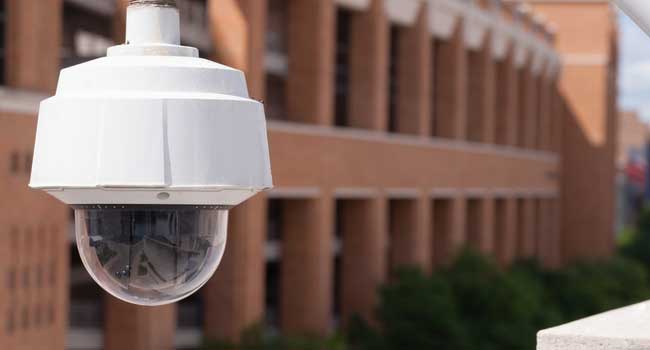
Security cameras: Quickly identify when a visitor is at an entry way and anywhere else on campus by placing cameras in all entrances. Cameras can integrate with emergency systems to be visible from the alert status system graphical map to zoom into a specific location upon notification of an emergency.


Teacher microphones: Seventy-five percent of a typical school day is spent in listening activities; therefore, the success of classroom activities is based on how well students can hear. To keep everyone on the same schedule, wireless clocks throughout the school ensures bell scheduling and protocols are synchronized.


Cameras in the classroom: Improves teacher effectiveness and student learning. Ability to record classroom lessons, which can be used for teacher evaluations and at home student learning.


Panic-call buttons: An easy way to have contact with administrators in the event of an emergency or all clear, check-in situation. Teachers and administrators can also quickly notify the entire school and first responders of a crisis situation and trigger a lockdown via smartphones or tablets.


These solutions are available to empower all educators, especially those in the classroom every day, so they are prepared firsthand to deal with any type of safety situation.

Featured

  • Security Today Announces 2025 CyberSecured Award Winners

    Security Today is pleased to announce the 2025 CyberSecured Awards winners. Sixteen companies are being recognized this year for their network products and other cybersecurity initiatives that secure our world today. Read Now

  • Empowering and Securing a Mobile Workforce

    What happens when technology lets you work anywhere – but exposes you to security threats everywhere? This is the reality of modern work. No longer tethered to desks, work happens everywhere – in the office, from home, on the road, and in countless locations in between. Read Now

  • TSA Introduces New $45 Fee Option for Travelers Without REAL ID Starting February 1

    The Transportation Security Administration (TSA) announced today that it will refer all passengers who do not present an acceptable form of ID and still want to fly an option to pay a $45 fee to use a modernized alternative identity verification system, TSA Confirm.ID, to establish identity at security checkpoints beginning on February 1, 2026. Read Now

  • The Evolution of IP Camera Intelligence

    As the 30th anniversary of the IP camera approaches in 2026, it is worth reflecting on how far we have come. The first network camera, launched in 1996, delivered one frame every 17 seconds—not impressive by today’s standards, but groundbreaking at the time. It did something that no analog system could: transmit video over a standard IP network. Read Now

  • From Surveillance to Intelligence

    Years ago, it would have been significantly more expensive to run an analytic like that — requiring a custom-built solution with burdensome infrastructure demands — but modern edge devices have made it accessible to everyone. It also saves time, which is a critical factor if a missing child is involved. Video compression technology has played a critical role as well. Over the years, significant advancements have been made in video coding standards — including H.263, MPEG formats, and H.264—alongside compression optimization technologies developed by IP video manufacturers to improve efficiency without sacrificing quality. The open-source AV1 codec developed by the Alliance for Open Media—a consortium including Google, Netflix, Microsoft, Amazon and others — is already the preferred decoder for cloud-based applications, and is quickly becoming the standard for video compression of all types. Read Now

New Products

  • ResponderLink

    ResponderLink

    Shooter Detection Systems (SDS), an Alarm.com company and a global leader in gunshot detection solutions, has introduced ResponderLink, a groundbreaking new 911 notification service for gunshot events. ResponderLink completes the circle from detection to 911 notification to first responder awareness, giving law enforcement enhanced situational intelligence they urgently need to save lives. Integrating SDS’s proven gunshot detection system with Noonlight’s SendPolice platform, ResponderLink is the first solution to automatically deliver real-time gunshot detection data to 911 call centers and first responders. When shots are detected, the 911 dispatching center, also known as the Public Safety Answering Point or PSAP, is contacted based on the gunfire location, enabling faster initiation of life-saving emergency protocols.

  • Mobile Safe Shield

    Mobile Safe Shield

    SafeWood Designs, Inc., a manufacturer of patented bullet resistant products, is excited to announce the launch of the Mobile Safe Shield. The Mobile Safe Shield is a moveable bullet resistant shield that provides protection in the event of an assailant and supplies cover in the event of an active shooter. With a heavy-duty steel frame, quality castor wheels, and bullet resistant core, the Mobile Safe Shield is a perfect addition to any guard station, security desks, courthouses, police stations, schools, office spaces and more. The Mobile Safe Shield is incredibly customizable. Bullet resistant materials are available in UL 752 Levels 1 through 8 and include glass, white board, tack board, veneer, and plastic laminate. Flexibility in bullet resistant materials allows for the Mobile Safe Shield to blend more with current interior décor for a seamless design aesthetic. Optional custom paint colors are also available for the steel frame.

  • Luma x20

    Luma x20

    Snap One has announced its popular Luma x20 family of surveillance products now offers even greater security and privacy for home and business owners across the globe by giving them full control over integrators’ system access to view live and recorded video. According to Snap One Product Manager Derek Webb, the new “customer handoff” feature provides enhanced user control after initial installation, allowing the owners to have total privacy while also making it easy to reinstate integrator access when maintenance or assistance is required. This new feature is now available to all Luma x20 users globally. “The Luma x20 family of surveillance solutions provides excellent image and audio capture, and with the new customer handoff feature, it now offers absolute privacy for camera feeds and recordings,” Webb said. “With notifications and integrator access controlled through the powerful OvrC remote system management platform, it’s easy for integrators to give their clients full control of their footage and then to get temporary access from the client for any troubleshooting needs.”