California Casino Recruits Security Robots

California Casino Recruits Security Robots

The West Coast resort has added two ‘bots to the force, with at least one more planned.

Pechanga Resort & Casino is leaping to the bleeding edge of autonomous security, becoming the first casino resort in the United States to deploy robots as part of their security detail.

The resort, located in Temecula, just north of the Pechanga Indian Reservation, sees security robots as a way to enhance the significant safety measures the casino already has, including thousands of cameras and a human security force of over 300 personnel.

Robert Krauss, Pechanga’s vice president for public safety, said robots are the next level, and that to keep team members and patrons safe, staying up to date with the latest technology is a must. The robots’ cameras are at eye level as well, versus peering down from overhead, changing the perspective.

“Humans pick up only so much and after a while, you might miss something,” Krauss said. “Robots don’t miss anything.”

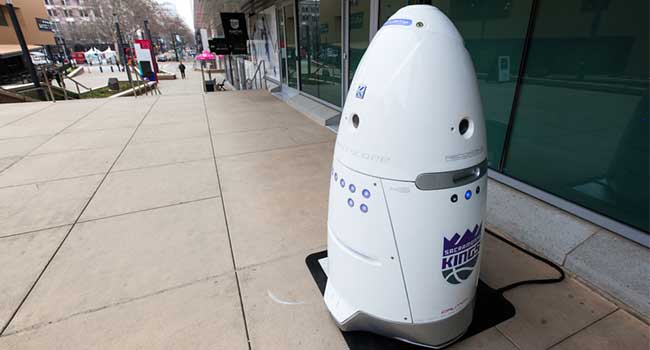
Manufactured by Knightscope in the heart of Silicon Valley, the robots being employed by Pechanga are a tall, stationary machine and a slightly shorter wheeled robot that looks right out of Star Wars, resembling a certain blue-and-white droid. The bots are programmed to continuously capture and transmit video in a 360-degree arc, as well as using thermal imaging to detect possible problems like fires.

The smaller robot, nicknamed “Buddy,” is charged with patrolling the lobby of the casino, while “Rudy,” its stationary colleague, will stand guard outside the main valet entrance. Once the third automaton joins the force, a roving unit like “Buddy” but smaller, “Buddy” itself will be tasked with patrolling the parking garage, using its license plate recognition software to look for stolen vehicles or those wanted by police.

The robots have been leased from Knightscope for about $8 an hour, after Pechanga received a large bump to their security funding in the wake of the Las Vegas shooting in October, 2017.

Customers don’t appear to be put off by the upped security, Krauss said. People especially seem to like “Buddy.”

“People love him, they’re hugging him, high-fiving him,” Krauss said. “There are hundreds of selfies a day with him.”

About the Author

Jordan Lutke is an intern with 1105 Media.

Featured

  • Empowering and Securing a Mobile Workforce

    What happens when technology lets you work anywhere – but exposes you to security threats everywhere? This is the reality of modern work. No longer tethered to desks, work happens everywhere – in the office, from home, on the road, and in countless locations in between. Read Now

  • TSA Introduces New $45 Fee Option for Travelers Without REAL ID Starting February 1

    The Transportation Security Administration (TSA) announced today that it will refer all passengers who do not present an acceptable form of ID and still want to fly an option to pay a $45 fee to use a modernized alternative identity verification system, TSA Confirm.ID, to establish identity at security checkpoints beginning on February 1, 2026. Read Now

  • The Evolution of IP Camera Intelligence

    As the 30th anniversary of the IP camera approaches in 2026, it is worth reflecting on how far we have come. The first network camera, launched in 1996, delivered one frame every 17 seconds—not impressive by today’s standards, but groundbreaking at the time. It did something that no analog system could: transmit video over a standard IP network. Read Now

  • From Surveillance to Intelligence

    Years ago, it would have been significantly more expensive to run an analytic like that — requiring a custom-built solution with burdensome infrastructure demands — but modern edge devices have made it accessible to everyone. It also saves time, which is a critical factor if a missing child is involved. Video compression technology has played a critical role as well. Over the years, significant advancements have been made in video coding standards — including H.263, MPEG formats, and H.264—alongside compression optimization technologies developed by IP video manufacturers to improve efficiency without sacrificing quality. The open-source AV1 codec developed by the Alliance for Open Media—a consortium including Google, Netflix, Microsoft, Amazon and others — is already the preferred decoder for cloud-based applications, and is quickly becoming the standard for video compression of all types. Read Now

  • Cost: Reactive vs. Proactive Security

    Security breaches often happen despite the availability of tools to prevent them. To combat this problem, the industry is shifting from reactive correction to proactive protection. This article will examine why so many security leaders have realized they must “lead before the breach” – not after. Read Now

New Products

  • Camden CV-7600 High Security Card Readers

    Camden CV-7600 High Security Card Readers

    Camden Door Controls has relaunched its CV-7600 card readers in response to growing market demand for a more secure alternative to standard proximity credentials that can be easily cloned. CV-7600 readers support MIFARE DESFire EV1 & EV2 encryption technology credentials, making them virtually clone-proof and highly secure.

  • AC Nio

    AC Nio

    Aiphone, a leading international manufacturer of intercom, access control, and emergency communication products, has introduced the AC Nio, its access control management software, an important addition to its new line of access control solutions.

  • Connect ONE’s powerful cloud-hosted management platform provides the means to tailor lockdowns and emergency mass notifications throughout a facility – while simultaneously alerting occupants to hazards or next steps, like evacuation.

    Connect ONE®

    Connect ONE’s powerful cloud-hosted management platform provides the means to tailor lockdowns and emergency mass notifications throughout a facility – while simultaneously alerting occupants to hazards or next steps, like evacuation.