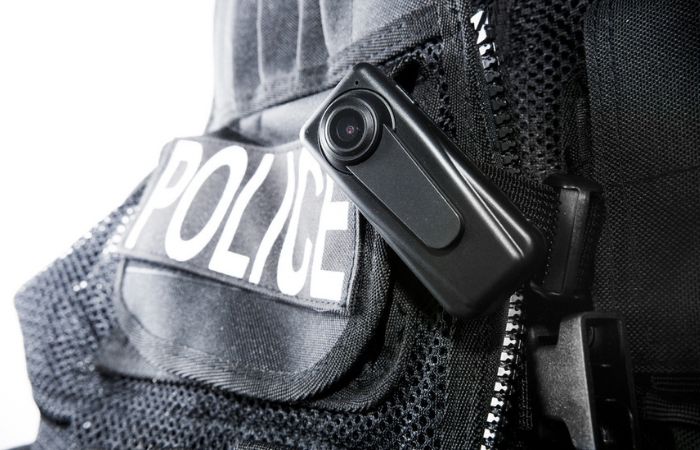
police body camera

Cincinnati Police Become First City To Install Body Cameras With Live-Streaming Capability

Police officials hope that the new software will allow them to better handle crisis situations in real time and speed up the filing of police reports.

With the addition of 1,000 new Axon cameras last week, Cincinnati became the first city in America to roll out police body cameras with live-streaming capabilities.

The system is designed to allow dispatchers or commanders view an emergency situation on police body cameras in real time, or locate an officer who has become lost or hurt during the incident. According to Axon, which is the largest supplier of police body cams in the U.S., the system will be activated when it detects a gun has been drawn, a gunshot is heard or a Taser is turned on.

The cameras will film in 1080p and be equipped with software that allows officers to obtain transcripts of the audio in the footage, Axon officials told The Washington Post. The company is storing the immense amount of footage in a computing cloud maintained by Axon and Microsoft.

Axon has confirmed that the cameras will not have facial recognition capabilities, but will have “face detection” software that will allow officers to skip to parts of the video where people are present. Cincinnati police plan to limit who has access to the live streaming capabilities and where the footage is stored.

“To have the ability to access that camera in real time, and live-stream what the officer is seeing, that’s amazing,” Lt. Stephen Saunders of the Cincinnati police department told the Post. “That will be a tactical advantage in high-stress situations like an active shooter. Or maybe the officer can’t get to their radio. The dispatch center can access it and see what’s going on there. That’s a game-changer.”

Privacy advocates and security researchers say that the addition of live streaming adds more transparency in how police do their jobs as well as opportunities for potential over-surveillance of residents. Barry Friedman, a New York University law professor who serves on Axon’s AI Ethics Board, said that the new technology has “pluses and minuses.”

“On the plus side, it’s possible being able to stream video can make policing more effective and more safe,” Friedman told the Post. “If someone is contemplating use of force, it might help to have a supervisor in his or her ear.”

But he noted that body cameras go into “sensitive places” that could affect not only the officer but the people they are interacting with. That could pose privacy issues for civilians who are not aware they are being filmed.

“There have to be serious limits as to whom the video is streamed,” Friedman said.

Still, the Cincinnati police view the technology as a way to speed up record-keeping and report filing in addition to recording more shootings as they happen. Officers sometimes do not have time to reach for their body camera buttons during an incident, but the live-streaming tech means that it will turn on automatically, according to Axon.

“I think it will bring officers great comfort,” Saunders told the Post. “If they’re out on the beat, they know that someone can find them if they need to. Having that sense of safety is not a no-brainer, it’s a cost, but the cost of not doing it can be even greater.”

About the Author

Haley Samsel is an Associate Content Editor for the Infrastructure Solutions Group at 1105 Media.

Featured

  • Security Today Announces 2025 CyberSecured Award Winners

    Security Today is pleased to announce the 2025 CyberSecured Awards winners. Sixteen companies are being recognized this year for their network products and other cybersecurity initiatives that secure our world today. Read Now

  • Empowering and Securing a Mobile Workforce

    What happens when technology lets you work anywhere – but exposes you to security threats everywhere? This is the reality of modern work. No longer tethered to desks, work happens everywhere – in the office, from home, on the road, and in countless locations in between. Read Now

  • TSA Introduces New $45 Fee Option for Travelers Without REAL ID Starting February 1

    The Transportation Security Administration (TSA) announced today that it will refer all passengers who do not present an acceptable form of ID and still want to fly an option to pay a $45 fee to use a modernized alternative identity verification system, TSA Confirm.ID, to establish identity at security checkpoints beginning on February 1, 2026. Read Now

  • The Evolution of IP Camera Intelligence

    As the 30th anniversary of the IP camera approaches in 2026, it is worth reflecting on how far we have come. The first network camera, launched in 1996, delivered one frame every 17 seconds—not impressive by today’s standards, but groundbreaking at the time. It did something that no analog system could: transmit video over a standard IP network. Read Now

  • From Surveillance to Intelligence

    Years ago, it would have been significantly more expensive to run an analytic like that — requiring a custom-built solution with burdensome infrastructure demands — but modern edge devices have made it accessible to everyone. It also saves time, which is a critical factor if a missing child is involved. Video compression technology has played a critical role as well. Over the years, significant advancements have been made in video coding standards — including H.263, MPEG formats, and H.264—alongside compression optimization technologies developed by IP video manufacturers to improve efficiency without sacrificing quality. The open-source AV1 codec developed by the Alliance for Open Media—a consortium including Google, Netflix, Microsoft, Amazon and others — is already the preferred decoder for cloud-based applications, and is quickly becoming the standard for video compression of all types. Read Now

New Products

  • Mobile Safe Shield

    Mobile Safe Shield

    SafeWood Designs, Inc., a manufacturer of patented bullet resistant products, is excited to announce the launch of the Mobile Safe Shield. The Mobile Safe Shield is a moveable bullet resistant shield that provides protection in the event of an assailant and supplies cover in the event of an active shooter. With a heavy-duty steel frame, quality castor wheels, and bullet resistant core, the Mobile Safe Shield is a perfect addition to any guard station, security desks, courthouses, police stations, schools, office spaces and more. The Mobile Safe Shield is incredibly customizable. Bullet resistant materials are available in UL 752 Levels 1 through 8 and include glass, white board, tack board, veneer, and plastic laminate. Flexibility in bullet resistant materials allows for the Mobile Safe Shield to blend more with current interior décor for a seamless design aesthetic. Optional custom paint colors are also available for the steel frame.

  • A8V MIND

    A8V MIND

    Hexagon’s Geosystems presents a portable version of its Accur8vision detection system. A rugged all-in-one solution, the A8V MIND (Mobile Intrusion Detection) is designed to provide flexible protection of critical outdoor infrastructure and objects. Hexagon’s Accur8vision is a volumetric detection system that employs LiDAR technology to safeguard entire areas. Whenever it detects movement in a specified zone, it automatically differentiates a threat from a nonthreat, and immediately notifies security staff if necessary. Person detection is carried out within a radius of 80 meters from this device. Connected remotely via a portable computer device, it enables remote surveillance and does not depend on security staff patrolling the area.

  • Automatic Systems V07

    Automatic Systems V07

    Automatic Systems, an industry-leading manufacturer of pedestrian and vehicle secure entrance control access systems, is pleased to announce the release of its groundbreaking V07 software. The V07 software update is designed specifically to address cybersecurity concerns and will ensure the integrity and confidentiality of Automatic Systems applications. With the new V07 software, updates will be delivered by means of an encrypted file.