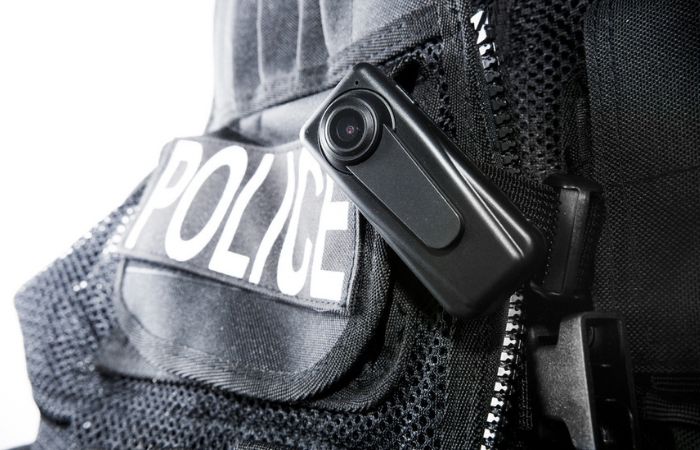
Cincinnati Police Become First City To Install Body Cameras With Live-Streaming Capability
Police officials hope that the new software will allow them to better handle crisis situations in real time and speed up the filing of police reports.
- By Haley Samsel
- Feb 24, 2020
With the addition of 1,000 new Axon cameras last week, Cincinnati became the first city in America to roll out police body cameras with live-streaming capabilities.
The system is designed to allow dispatchers or commanders view an emergency situation on police body cameras in real time, or locate an officer who has become lost or hurt during the incident. According to Axon, which is the largest supplier of police body cams in the U.S., the system will be activated when it detects a gun has been drawn, a gunshot is heard or a Taser is turned on.
The cameras will film in 1080p and be equipped with software that allows officers to obtain transcripts of the audio in the footage, Axon officials told The Washington Post. The company is storing the immense amount of footage in a computing cloud maintained by Axon and Microsoft.
Axon has confirmed that the cameras will not have facial recognition capabilities, but will have “face detection” software that will allow officers to skip to parts of the video where people are present. Cincinnati police plan to limit who has access to the live streaming capabilities and where the footage is stored.
“To have the ability to access that camera in real time, and live-stream what the officer is seeing, that’s amazing,” Lt. Stephen Saunders of the Cincinnati police department told the Post. “That will be a tactical advantage in high-stress situations like an active shooter. Or maybe the officer can’t get to their radio. The dispatch center can access it and see what’s going on there. That’s a game-changer.”
Privacy advocates and security researchers say that the addition of live streaming adds more transparency in how police do their jobs as well as opportunities for potential over-surveillance of residents. Barry Friedman, a New York University law professor who serves on Axon’s AI Ethics Board, said that the new technology has “pluses and minuses.”
“On the plus side, it’s possible being able to stream video can make policing more effective and more safe,” Friedman told the Post. “If someone is contemplating use of force, it might help to have a supervisor in his or her ear.”
But he noted that body cameras go into “sensitive places” that could affect not only the officer but the people they are interacting with. That could pose privacy issues for civilians who are not aware they are being filmed.
“There have to be serious limits as to whom the video is streamed,” Friedman said.
Still, the Cincinnati police view the technology as a way to speed up record-keeping and report filing in addition to recording more shootings as they happen. Officers sometimes do not have time to reach for their body camera buttons during an incident, but the live-streaming tech means that it will turn on automatically, according to Axon.
“I think it will bring officers great comfort,” Saunders told the Post. “If they’re out on the beat, they know that someone can find them if they need to. Having that sense of safety is not a no-brainer, it’s a cost, but the cost of not doing it can be even greater.”
About the Author
Haley Samsel is an Associate Content Editor for the Infrastructure Solutions Group at 1105 Media.