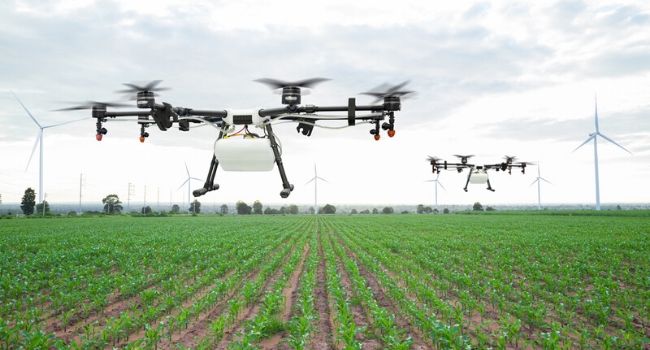
drone in field

Trump Administration Preparing Executive Order to Ban Use of Foreign-Made Drones by Government Agencies

Chinese manufacturer DJI, which accounts for about 70 percent of the global drone market, stands to lose the most from a ban, which is based on national security concerns.

An executive order is being prepared to ban federal agencies from buying or using foreign-made drones, building on previous moves by the Interior Department to ground its entire fleet of drones, all of which had parts manufactured in China.

The draft order, which was reported by TechCrunch, specifically cites national security threats posed by Chinese manufacturers as the reasoning behind the ban. The Trump administration fears that sensitive data collected by drones could be accessed by the Chinese companies, which are required to collaborate and share information with Chinese authorities if asked.

The order will “encourage” domestically built drones and that federal agencies would have one month to comply with the ban, according to TechCrunch. Military and intelligence agencies would be granted widespread exemptions under the terms of the draft order, TechCrunch reported.

China-based drone manufacturer would stand to lose the most from the ban. DJI accounts for 70 percent of the world drone market and formerly supplied many of the parts and drones for federal agencies. Michael Oldenburg, a DJI spokesperson, stated the company’s opposition to any proposed ban on foreign-made drones.

“While we haven’t seen the document, this proposal is another attack on drone technology based on its country of origin, which recent reporting has shown has been criticized within federal agencies including the U.S. Department of Agriculture, Department of the Interior, Fish and Wildlife Service and even the White House Office of Management and Budget,” Oldenburg told TechCrunch.

He added: “When communicating among themselves, these agencies’ officials have explained how such an approach damages American interests and does not solve any cybersecurity issues, and have acknowledged that DJI’s products have been validated as secure for use in government operations.”

Oldenburg was referencing reporting from The New York Times and others showing that top officials in the Department of Agriculture, among other departments, were very concerned about how the law would “severely impact the establishment, development and implementation” of their drone program.

Stephen L. Censky, the deputy secretary for the agriculture department, told the Times in February that he was concerned that “none of our previous comments were considered or integrated” into the revised version of the ban, which they saw in December.

Interior Department officials also previously stated that they were working with DJI to test software to keep sensitive data secure until the grounding in late October.

About the Author

Haley Samsel is an Associate Content Editor for the Infrastructure Solutions Group at 1105 Media.

Featured

  • Security Industry Association Announces the 2026 Security Megatrends

    The Security Industry Association (SIA) has identified and forecasted the 2026 Security Megatrends, which form the basis of SIA’s signature annual Security Megatrends report defining the top 10 factors influencing both near- and long-term change in the global security industry. Read Now

  • The Future of Access Control: Cloud-Based Solutions for Safer Workplaces

    Access controls have revolutionized the way we protect our people, assets and operations. Gone are the days of cumbersome keychains and the security liabilities they introduced, but it’s a mistake to think that their evolution has reached its peak. Read Now

  • A Look at AI

    Large language models (LLMs) have taken the world by storm. Within months of OpenAI launching its AI chatbot, ChatGPT, it amassed more than 100 million users, making it the fastest-growing consumer application in history. Read Now

  • First, Do No Harm: Responsibly Applying Artificial Intelligence

    It was 2022 when early LLMs (Large Language Models) brought the term “AI” into mainstream public consciousness and since then, we’ve seen security corporations and integrators attempt to develop their solutions and sales pitches around the biggest tech boom of the 21st century. However, not all “artificial intelligence” is equally suitable for security applications, and it’s essential for end users to remain vigilant in understanding how their solutions are utilizing AI. Read Now

  • Improve Incident Response With Intelligent Cloud Video Surveillance

    Video surveillance is a vital part of business security, helping institutions protect against everyday threats for increased employee, customer, and student safety. However, many outdated surveillance solutions lack the ability to offer immediate insights into critical incidents. This slows down investigations and limits how effectively teams can respond to situations, creating greater risks for the organization. Read Now

New Products

  • EasyGate SPT and SPD

    EasyGate SPT SPD

    Security solutions do not have to be ordinary, let alone unattractive. Having renewed their best-selling speed gates, Cominfo has once again demonstrated their Art of Security philosophy in practice — and confirmed their position as an industry-leading manufacturers of premium speed gates and turnstiles.

  • HD2055 Modular Barricade

    Delta Scientific’s electric HD2055 modular shallow foundation barricade is tested to ASTM M50/P1 with negative penetration from the vehicle upon impact. With a shallow foundation of only 24 inches, the HD2055 can be installed without worrying about buried power lines and other below grade obstructions. The modular make-up of the barrier also allows you to cover wider roadways by adding additional modules to the system. The HD2055 boasts an Emergency Fast Operation of 1.5 seconds giving the guard ample time to deploy under a high threat situation.

  • Luma x20

    Luma x20

    Snap One has announced its popular Luma x20 family of surveillance products now offers even greater security and privacy for home and business owners across the globe by giving them full control over integrators’ system access to view live and recorded video. According to Snap One Product Manager Derek Webb, the new “customer handoff” feature provides enhanced user control after initial installation, allowing the owners to have total privacy while also making it easy to reinstate integrator access when maintenance or assistance is required. This new feature is now available to all Luma x20 users globally. “The Luma x20 family of surveillance solutions provides excellent image and audio capture, and with the new customer handoff feature, it now offers absolute privacy for camera feeds and recordings,” Webb said. “With notifications and integrator access controlled through the powerful OvrC remote system management platform, it’s easy for integrators to give their clients full control of their footage and then to get temporary access from the client for any troubleshooting needs.”