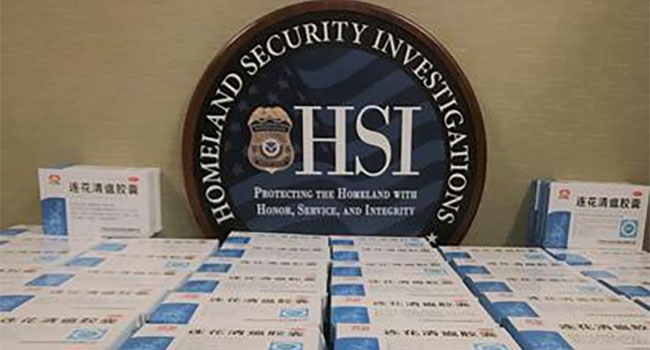
ICE HSI Baltimore seizes over 14,000 unapproved COVID-19 treatment capsules, several unapproved test kits

ICE HSI Baltimore Seizes Over 14,000 Unapproved COVID-19 Treatment Capsules, Several Unapproved Test Kits

Immigration and Customs Enforcement (ICE), Homeland Security Investigations (HSI) Baltimore special agents and Maryland law enforcement partners have seized over 14,000 unapproved COVID-19 treatment capsules and several unapproved COVID-19 test kits as part of ongoing Operation Stolen Promise investigations. Operation Stolen Promise is a national operation aimed at combatting COVID-19 fraud and other related criminal activity. The operation enhances collaboration with multiple federal agencies, along with business and industry representatives. Surging criminal activity surrounding the COVID-19 pandemic requires an equally robust investigative response to protect the American public.

HSI Baltimore has been actively leveraging investigative resources and partnerships to intercept fraudulent products before they can enter our community. In one seizure, HSI Baltimore, Customs and Border Protection and Maryland Natural Resources Police intercepted and seized a shipment that originated in China and contained unapproved COVID-19 test kits. In another case, HSI and the Postal Inspection Service intercepted a package originating in Hong Kong and discovered nearly 500 unapproved COVID-19 treatment capsules.

“In uncertain times, criminals often take advantage of fear and anxiety, hawking fraudulent cures out of greed and disregard for your wellbeing. If it seems too good to be true, it probably is,” said John Eisert, HSI Baltimore Special Agent in Charge. “There are no approved test kits that you can get without going to your doctor and cures being sold online not only delay your trip to the doctor for proper care, but their ingredients can cause more harm. HSI Baltimore stands with our law enforcement partners at Customs and Border Protection, the Postal Inspection Service and local law enforcement to investigate and seize these bogus products and keep the public safe.”

“Panic-stricken consumers and predatory scammers continue to purchase unproven coronavirus pharmaceuticals and counterfeit protective and diagnostic equipment that pose a serious health threat to American consumers,” said Ronald Stanley, CBP’s acting director of field operations in Baltimore. “Customs and Border Protection will continue to work with Homeland Security Investigations and our consumer safety partners to identify and seize these potentially hazardous medical products before they could harm American consumers.”

“The U.S. Postal Inspection Service will not allow the U.S. Mail to be used in furtherance of scams intended to mislead our consumers”, said Peter R. Rendina, Inspector in Charge of the U.S. Postal Inspection Service, Washington Division. “For 245 years the Postal Service has been delivering trust to the American people while Postal Inspectors have been delivering justice to fraudsters. We will continue working with our federal, state and local partners to make sure we stop these greedy scammers from taking advantage of our nation during this pandemic.”

Criminal organizations that have historically engaged in financial scams are pivoting to exploit the coronavirus pandemic and the associated stimulus package for illegal financial gains. These networks are smuggling and selling counterfeit safety equipment and prohibited testing kits, medicines, and hygiene products, as well as running illicit websites to sell their merchandise. In the coming weeks, HSI anticipates that financial fraud scams involving financial relief, COVID-19 stimulus checks, and traditional boiler room criminal operations will increase. All these fraud scams impact and burden government public benefit agencies that are in the process of distributing aid and providing assistance.

As of June 1, HSI special agents nationally have opened over 480 investigations nationwide; seized over $4.9 million dollars in illicit proceeds; made 20 arrests; executed 38 search warrants; analyzed over 36,000 COVID-19 domain names; and worked alongside U.S. Customs and Border Protection to seize 668 shipments of mislabeled, fraudulent, unauthorized or prohibited COVID-19 test kits, treatment kits, homeopathic remedies, purported anti-viral products and personal protective equipment.

Featured

  • Security Today Announces 2025 CyberSecured Award Winners

    Security Today is pleased to announce the 2025 CyberSecured Awards winners. Sixteen companies are being recognized this year for their network products and other cybersecurity initiatives that secure our world today. Read Now

  • Empowering and Securing a Mobile Workforce

    What happens when technology lets you work anywhere – but exposes you to security threats everywhere? This is the reality of modern work. No longer tethered to desks, work happens everywhere – in the office, from home, on the road, and in countless locations in between. Read Now

  • TSA Introduces New $45 Fee Option for Travelers Without REAL ID Starting February 1

    The Transportation Security Administration (TSA) announced today that it will refer all passengers who do not present an acceptable form of ID and still want to fly an option to pay a $45 fee to use a modernized alternative identity verification system, TSA Confirm.ID, to establish identity at security checkpoints beginning on February 1, 2026. Read Now

  • The Evolution of IP Camera Intelligence

    As the 30th anniversary of the IP camera approaches in 2026, it is worth reflecting on how far we have come. The first network camera, launched in 1996, delivered one frame every 17 seconds—not impressive by today’s standards, but groundbreaking at the time. It did something that no analog system could: transmit video over a standard IP network. Read Now

  • From Surveillance to Intelligence

    Years ago, it would have been significantly more expensive to run an analytic like that — requiring a custom-built solution with burdensome infrastructure demands — but modern edge devices have made it accessible to everyone. It also saves time, which is a critical factor if a missing child is involved. Video compression technology has played a critical role as well. Over the years, significant advancements have been made in video coding standards — including H.263, MPEG formats, and H.264—alongside compression optimization technologies developed by IP video manufacturers to improve efficiency without sacrificing quality. The open-source AV1 codec developed by the Alliance for Open Media—a consortium including Google, Netflix, Microsoft, Amazon and others — is already the preferred decoder for cloud-based applications, and is quickly becoming the standard for video compression of all types. Read Now

New Products

  • ResponderLink

    ResponderLink

    Shooter Detection Systems (SDS), an Alarm.com company and a global leader in gunshot detection solutions, has introduced ResponderLink, a groundbreaking new 911 notification service for gunshot events. ResponderLink completes the circle from detection to 911 notification to first responder awareness, giving law enforcement enhanced situational intelligence they urgently need to save lives. Integrating SDS’s proven gunshot detection system with Noonlight’s SendPolice platform, ResponderLink is the first solution to automatically deliver real-time gunshot detection data to 911 call centers and first responders. When shots are detected, the 911 dispatching center, also known as the Public Safety Answering Point or PSAP, is contacted based on the gunfire location, enabling faster initiation of life-saving emergency protocols.

  • A8V MIND

    A8V MIND

    Hexagon’s Geosystems presents a portable version of its Accur8vision detection system. A rugged all-in-one solution, the A8V MIND (Mobile Intrusion Detection) is designed to provide flexible protection of critical outdoor infrastructure and objects. Hexagon’s Accur8vision is a volumetric detection system that employs LiDAR technology to safeguard entire areas. Whenever it detects movement in a specified zone, it automatically differentiates a threat from a nonthreat, and immediately notifies security staff if necessary. Person detection is carried out within a radius of 80 meters from this device. Connected remotely via a portable computer device, it enables remote surveillance and does not depend on security staff patrolling the area.

  • Unified VMS

    AxxonSoft introduces version 2.0 of the Axxon One VMS. The new release features integrations with various physical security systems, making Axxon One a unified VMS. Other enhancements include new AI video analytics and intelligent search functions, hardened cybersecurity, usability and performance improvements, and expanded cloud capabilities