Modernizing Aviation Through Biometric Identity
As global travel volumes soar, airports are ditching siloed manual checks for integrated biometric systems to eliminate identity bottlenecks.
- By Rob Sutton
- Feb 27, 2026
Global passenger volumes may approach eight billion annually within the next two decades, yet most airport security and identity verification workflows were designed for lower volumes and fewer checkpoints.
Adding more staff, more lanes, or more manual checks may provide short-term relief, but those approaches do not fundamentally address the congestion that emerges when millions of travelers must repeatedly prove who they are at every stage of the journey.
Much of the strain in airport security comes down to identity verification.
Passengers are verified multiple times, often using the same documents, by different authorities and systems that operate independently. Each handoff introduces delay, congestion, and the potential for error. To help alleviate these issues, biometrics are increasingly being adopted to establish continuity of identity across the airport environment, allowing for more consistent processing times.
Bottleneck is Identity Verification
Most airports already have the physical infrastructure needed to move passengers through terminals. Movement slows because identity must be re-verified at every stage of the journey. A traveler may present a passport at check-in, again at bag drop, again at security, and again at boarding. Each interaction is treated as a standalone event.
Biometric identity allows the same verification to be reused across multiple checkpoints. By binding a traveler’s identity to a secure biometric reference early in the journey, subsequent verifications can occur more quickly and with greater confidence. When identity becomes portable across systems, airports can maintain rigorous security standards while reducing the operational burden caused by repeated document handling and visual inspection.
An important question for airport operations is whether existing identity processes can realistically scale to meet future demand without biometrics.
No Longer a Limiting Factor
Concerns about passenger readiness once slowed biometric adoption. That hesitation has largely passed. Data from across the aviation sector shows growing comfort with biometric-enabled travel, particularly when systems are positioned as opt-in, transparent, and clearly tied to efficiency and shorter wait times. The number of travelers using digital identity services will increase sharply over the next several years, driven in part by younger travelers who already expect mobile-first interactions in other aspects of daily life.
Travelers are more willing to participate when enrollment is straightforward, when they understand how their data is used, and when biometric checks do not have additional steps. Airports that align biometric rollouts with these expectations are seeing adoption accelerate without requiring a behavioral change from passengers.
Biometrics are Applied Today
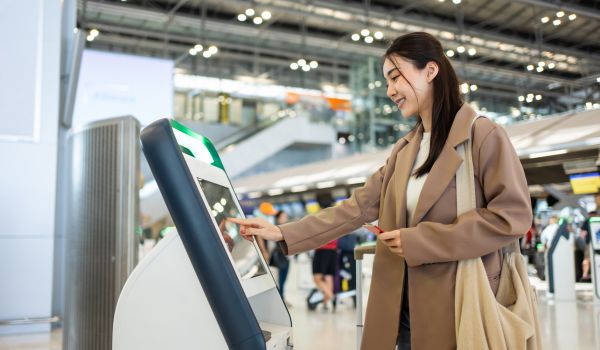
Biometric identity is already being applied across multiple airport touchpoints. Check-in and bag drop are often the first areas of deployment, where facial recognition can link a traveler to their booking and baggage without repeated document presentation. Security screening follows, where biometric matching is used to make processing more consistent during peak periods. Boarding and border control complete the journey, by replacing manual comparisons with faster, automated verification.
International airports that have integrated facial recognition into immigration and border clearance have reported significant reductions in processing time per passenger. Similar gains are being observed at high-volume boarding gates, where biometric verification helps airlines maintain schedules during peak travel periods.
As biometric systems expand, trust remains a prerequisite. This is less about public relations and more about system design. Modern biometric technologies rely on encrypted mathematical templates rather than stored images. These templates are used for matching, then deleted according to defined retention policies. The effectiveness of biometric identity depends not only on algorithm performance, but on how data is managed throughout its lifecycle.
Airports operate across jurisdictions with varying regulatory requirements. Successful biometric programs are built with privacy by design principles that limit data use to specific purposes, minimize retention, and provide clear accountability.
Identity Extends Beyond Passengers
Airports also manage large and dynamic workforces. As airports modernize traveler identity workflows, many are beginning to examine how identity assurance applies across the broader airport system of access control.
Employees, contractors, vendors and service providers require access to restricted areas, often across multiple facilities. Although workforce identity is a separate operational challenge, the underlying principles are similar. In some cases, workforce access systems have not been updated at the same pace as passenger-facing technology.
Identity surrounding access control must be accurate, instantly revocable, and auditable. This requires a focus on hardening readers and credentials against vulnerabilities, as well as ensuring secure communication between readers and controllers.
While it does not require merging systems, it does highlight the value of treating identity consistently across shared infrastructures and not accepting siloed processes.
Sustained Passenger Growth
Biometric identity is now widely used across aviation environments. Identity systems must remain reliable as passenger volumes increase and operational requirements evolve. This requires platforms that integrate well with existing infrastructure, support phased deployment, and allow operators to adapt without disruption. Airports cannot afford wholesale replacement cycles or fragile point solutions.
In practice, biometric deployments are shaped by throughput demands, staffing realities, regulatory oversight, and public accountability.
As passenger volumes continue to rise, biometric identity is becoming part of the underlying infrastructure airports rely on for consistent operations. Identity management across the passenger journey must function under real operating conditions and at a sustained scale.
Operational efficiency depends on identity systems that are reliable, measurable and designed for continuous use.