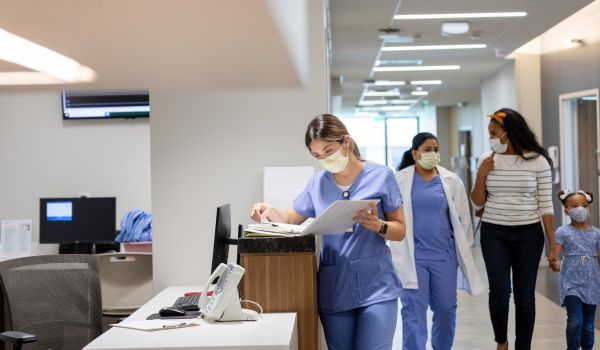
Healthcare staff in hospital setting

HID Showcases Integrated Identity Security Solutions at IAHSS

New cloud-based visitor management and real-time location services aim to modernize fragmented hospital access infrastructure.

HID is demonstrating a layered approach to healthcare security at the IAHSS Annual Conference & Exhibition, focusing on the transition from fragmented access systems to unified identity management.

The company is highlighting how physical access control, visitor management and staff authentication can operate as a single system. Central to this showcase is a cloud-based visitor management solution that integrates with major electronic health record systems, including Epic and Oracle Health, to monitor facility access.

This focus on unified infrastructure comes as healthcare workers demand better safety measures amid rising workplace violence. Recent data indicates that 68% of healthcare staff experienced a violent incident in the past year, leading many to prioritize robust security features and wearable duress technology when evaluating employers.

According to HID’s 2026 State of Security and Identity Report, worker safety and compliance now drive 69% of real-time location system (RTLS) adoption decisions. To address this, the company is exhibiting its healthcare location platform, which provides clinical teams with visibility into the movement of staff, patients and equipment. The technology supports infant security, asset tracking and staff safety protocols.

The integrated suite also includes mobile access capabilities, allowing clinical staff to use smartphones and wearables for credentialing. This shift toward remote issuance and revocation is intended to reduce the administrative burden on IT and security departments while providing more efficient movement through facilities.

To manage the transition from legacy systems, the company is featuring readers that support multiple credential technologies. This allows hospitals to support various card types and mobile devices simultaneously while closing security gaps created by siloed entry points.

About the Author

Jesse Jacobs is assistant editor of SecurityToday.com.

Featured

New Products

  • Unified VMS

    AxxonSoft introduces version 2.0 of the Axxon One VMS. The new release features integrations with various physical security systems, making Axxon One a unified VMS. Other enhancements include new AI video analytics and intelligent search functions, hardened cybersecurity, usability and performance improvements, and expanded cloud capabilities

  • Automatic Systems V07

    Automatic Systems V07

    Automatic Systems, an industry-leading manufacturer of pedestrian and vehicle secure entrance control access systems, is pleased to announce the release of its groundbreaking V07 software. The V07 software update is designed specifically to address cybersecurity concerns and will ensure the integrity and confidentiality of Automatic Systems applications. With the new V07 software, updates will be delivered by means of an encrypted file.

  • Luma x20

    Luma x20

    Snap One has announced its popular Luma x20 family of surveillance products now offers even greater security and privacy for home and business owners across the globe by giving them full control over integrators’ system access to view live and recorded video. According to Snap One Product Manager Derek Webb, the new “customer handoff” feature provides enhanced user control after initial installation, allowing the owners to have total privacy while also making it easy to reinstate integrator access when maintenance or assistance is required. This new feature is now available to all Luma x20 users globally. “The Luma x20 family of surveillance solutions provides excellent image and audio capture, and with the new customer handoff feature, it now offers absolute privacy for camera feeds and recordings,” Webb said. “With notifications and integrator access controlled through the powerful OvrC remote system management platform, it’s easy for integrators to give their clients full control of their footage and then to get temporary access from the client for any troubleshooting needs.”