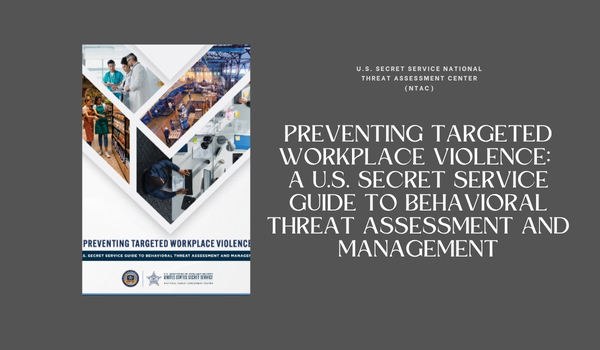
Secret Service Issues First Workplace Violence Prevention Guide
Federal threat assessment methodology has been adapted for private sector security and corporate human resources teams.
- By Jesse Jacobs
- Oct 23, 2026
A federal research center released new operational guidance designed to help private sector organizations and public facilities establish programs to prevent premeditated workplace attacks.
The publication, titled Preventing Targeted Workplace Violence: A U.S. Secret Service Guide to Behavioral Threat Assessment and Management and produced by the U.S. Secret Service National Threat Assessment Center, marks the agency’s first formal adaptation of its threat assessment methodologies specifically for corporate environments, human resources departments and security leadership.
Divided into two main sections, the report pairs empirical research on historical workplace violence with an operational blueprint. The first part analyzes background and behavioral trends among perpetrators of mass workplace attacks, while the second outlines a scalable framework for implementing a Behavioral Threat Assessment and Management program.
According to research findings, perpetrators of workplace violence rarely act without prior warning signs. In most evaluated incidents, attackers demonstrated observable behaviors of concern or communicated troubling intentions to colleagues, family members or third parties before taking action. The findings emphasize that there is no uniform demographic profile for potential attackers, underscoring the need for organizations to evaluate behavioral indicators rather than personal demographics.
The guide details actionable steps for organizations to build multidisciplinary threat management teams. Key steps include securing leadership commitment, developing reporting protocols, establishing internal bystander reporting pathways and gathering cross-system information to evaluate potential risks.
The operational blueprint also addresses post-termination risk management, warning that immediate firing without ongoing threat evaluation or supportive interventions can exacerbate risk levels. The guidance advises security and human resources personnel to maintain continuous coordination with local law enforcement, mental health resources and legal counsel to manage identified concerns effectively.