B.I.G.’s Guard Booths Designed to Withstand Explosions' Blast Waves Protect Against Terror Threats
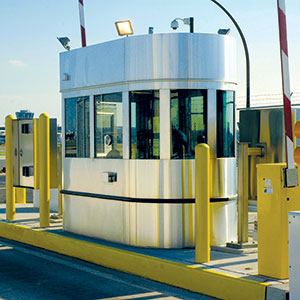
Designed and manufactured by B.I.G. Enterprises (www.bigbooth.com), the allnew “Stainless Bullet” secure guard booth model addresses the challenge ofbullet resistant construction to provide safety for guards as well as awelcoming interface for visitors.

Crash-resistant walls and barriers are vitally important in securing afacility's perimeter, but protecting the personnel inside is even moreessential. “Security guards are viewed by many as both a vital element ofterror deterrence and the first line of response to terrorist attacks,”security expert Paul W. Parfomak wrote in a recent report.

Because blast resistance in guard booth construction is one of the newpost–9/11 security requirements in specific industries, it brings with itspecial manufacturing needs. For any booth to remain intact after exposureto a blast—and for the personnel inside to survive and respond to theattack—it must be designed to withstand the two phenomena of an explosion’sblast wave: the initial blast and the rebound effect. Unlike bulletresistance, blast resistance must deal with these two distinct phases ofpositive and negative pressure waves that are created radiating outward andthen inward.

"In the event of a blast," says ballistics expert Kelley Elmore of LosAngeles-based engineering firm Hopper, Elmore and Associates, “the initialblast wave comes through and pushes the building out, and then the negativeportion of the blast restores the building toward its original position.This is called a rebound effect.” The negative waves last three times aslong as the positive waves. The new materials and technologies used in theguard booths take both the initial blast wave and the rebound into account,preserving the lives of security personnel as well as keeping the structureitself intact.

The booth must also be a self-sufficient unit that can continue to functiontechnologically after an assault, with all security and communicationdevices contained within its protective walls. “360º visual access fromwithin the booth is essential,” says New York City architect Richard Ramsey.“Coordination with outside systems and the complete protection of thosesystems from within the booth are also important. Bullet and blastresistance allows communication even when under attack.”

Towards that end, The Seabees—based in Port Hueneme, CA—recently installedguard booths around several naval bases. The structures have radio andtelephone links and are equipped with bright interior lighting, exteriorfloodlights, loudspeakers and large windows, offering a 360-degree view ofthe perimeter.

Featured

  • Security Today Announces 2025 CyberSecured Award Winners

    Security Today is pleased to announce the 2025 CyberSecured Awards winners. Sixteen companies are being recognized this year for their network products and other cybersecurity initiatives that secure our world today. Read Now

  • Empowering and Securing a Mobile Workforce

    What happens when technology lets you work anywhere – but exposes you to security threats everywhere? This is the reality of modern work. No longer tethered to desks, work happens everywhere – in the office, from home, on the road, and in countless locations in between. Read Now

  • TSA Introduces New $45 Fee Option for Travelers Without REAL ID Starting February 1

    The Transportation Security Administration (TSA) announced today that it will refer all passengers who do not present an acceptable form of ID and still want to fly an option to pay a $45 fee to use a modernized alternative identity verification system, TSA Confirm.ID, to establish identity at security checkpoints beginning on February 1, 2026. Read Now

  • The Evolution of IP Camera Intelligence

    As the 30th anniversary of the IP camera approaches in 2026, it is worth reflecting on how far we have come. The first network camera, launched in 1996, delivered one frame every 17 seconds—not impressive by today’s standards, but groundbreaking at the time. It did something that no analog system could: transmit video over a standard IP network. Read Now

  • From Surveillance to Intelligence

    Years ago, it would have been significantly more expensive to run an analytic like that — requiring a custom-built solution with burdensome infrastructure demands — but modern edge devices have made it accessible to everyone. It also saves time, which is a critical factor if a missing child is involved. Video compression technology has played a critical role as well. Over the years, significant advancements have been made in video coding standards — including H.263, MPEG formats, and H.264—alongside compression optimization technologies developed by IP video manufacturers to improve efficiency without sacrificing quality. The open-source AV1 codec developed by the Alliance for Open Media—a consortium including Google, Netflix, Microsoft, Amazon and others — is already the preferred decoder for cloud-based applications, and is quickly becoming the standard for video compression of all types. Read Now

New Products

  • AC Nio

    AC Nio

    Aiphone, a leading international manufacturer of intercom, access control, and emergency communication products, has introduced the AC Nio, its access control management software, an important addition to its new line of access control solutions.

  • EasyGate SPT and SPD

    EasyGate SPT SPD

    Security solutions do not have to be ordinary, let alone unattractive. Having renewed their best-selling speed gates, Cominfo has once again demonstrated their Art of Security philosophy in practice — and confirmed their position as an industry-leading manufacturers of premium speed gates and turnstiles.

  • Unified VMS

    AxxonSoft introduces version 2.0 of the Axxon One VMS. The new release features integrations with various physical security systems, making Axxon One a unified VMS. Other enhancements include new AI video analytics and intelligent search functions, hardened cybersecurity, usability and performance improvements, and expanded cloud capabilities