Bulletproof Glass Pods Add More Security to Airports

Bulletproof Glass Pods Add More Security to Airports

Bulletproof Glass Pods Add More Security to Airports

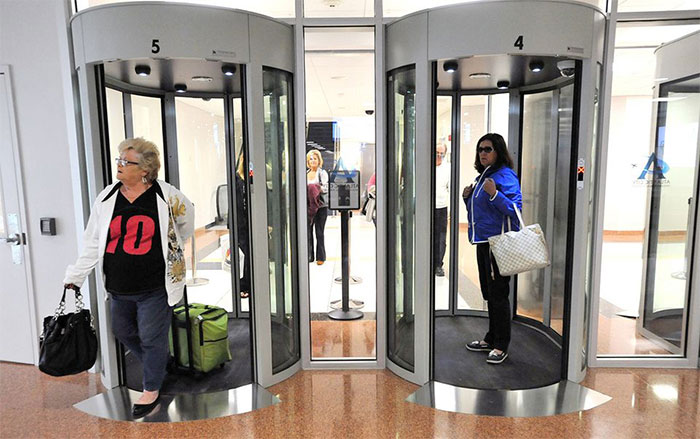
Belts and shoes must be removed; laptops must be taken out of bags and placed into a bin along with carry-on luggage to be shoved through a scanning device to make sure nothing suspicious is hiding within. And, that’s just to get into the airport. Now, after landing, some airports are requiring people to walk through futuristic, bulletproof, glass pods to exit the facility.

Replacing officers at security exits, these unmanned portals act as a barrier to exit for passengers attempting to leave the airport after landing to prevent re-entry into secure areas and to keep others from entering through airport exits. Travelers simply step into one of these elevator-sized cylinders and wait as a door slides closed behind them, fully encasing their body. A couple of seconds later, a different door opens on the front side as a voice instructs people to “please exit.”

(Sounds a little like taking Mario or Luigi through a warp zone in the old Mario Brothers video game to me.)

TSA is preparing to save $88.1 million during 2014 by shifting exit-monitoring duties at airport exit checkpoints, so this technology may be the answer to saving money. However, as with most security, I’m sure it could slow travelers down even though both Syracuse and Atlantic City airports, which are currently using the pods, recently reported that during high-traffic, evening hours there hasn’t been a backup of people. Maybe this is because the whole process, from entering to exiting, takes only approximately 5 seconds or maybe it’s because the pod only acts as a barrier. Whatever the reason, time could become of the essence as it is possible to equip the portals with biometric scanning technology.

I’m not too sure we've done a great job keeping the “bad” people out of airports to begin with, but now we may have to deal with security coming and going!

About the Author

Ginger Hill is Group Social Media Manager.

Featured

  • Security Today Announces 2025 CyberSecured Award Winners

    Security Today is pleased to announce the 2025 CyberSecured Awards winners. Sixteen companies are being recognized this year for their network products and other cybersecurity initiatives that secure our world today. Read Now

  • Empowering and Securing a Mobile Workforce

    What happens when technology lets you work anywhere – but exposes you to security threats everywhere? This is the reality of modern work. No longer tethered to desks, work happens everywhere – in the office, from home, on the road, and in countless locations in between. Read Now

  • TSA Introduces New $45 Fee Option for Travelers Without REAL ID Starting February 1

    The Transportation Security Administration (TSA) announced today that it will refer all passengers who do not present an acceptable form of ID and still want to fly an option to pay a $45 fee to use a modernized alternative identity verification system, TSA Confirm.ID, to establish identity at security checkpoints beginning on February 1, 2026. Read Now

  • The Evolution of IP Camera Intelligence

    As the 30th anniversary of the IP camera approaches in 2026, it is worth reflecting on how far we have come. The first network camera, launched in 1996, delivered one frame every 17 seconds—not impressive by today’s standards, but groundbreaking at the time. It did something that no analog system could: transmit video over a standard IP network. Read Now

  • From Surveillance to Intelligence

    Years ago, it would have been significantly more expensive to run an analytic like that — requiring a custom-built solution with burdensome infrastructure demands — but modern edge devices have made it accessible to everyone. It also saves time, which is a critical factor if a missing child is involved. Video compression technology has played a critical role as well. Over the years, significant advancements have been made in video coding standards — including H.263, MPEG formats, and H.264—alongside compression optimization technologies developed by IP video manufacturers to improve efficiency without sacrificing quality. The open-source AV1 codec developed by the Alliance for Open Media—a consortium including Google, Netflix, Microsoft, Amazon and others — is already the preferred decoder for cloud-based applications, and is quickly becoming the standard for video compression of all types. Read Now

New Products

  • FEP GameChanger

    FEP GameChanger

    Paige Datacom Solutions Introduces Important and Innovative Cabling Products GameChanger Cable, a proven and patented solution that significantly exceeds the reach of traditional category cable will now have a FEP/FEP construction.

  • HD2055 Modular Barricade

    Delta Scientific’s electric HD2055 modular shallow foundation barricade is tested to ASTM M50/P1 with negative penetration from the vehicle upon impact. With a shallow foundation of only 24 inches, the HD2055 can be installed without worrying about buried power lines and other below grade obstructions. The modular make-up of the barrier also allows you to cover wider roadways by adding additional modules to the system. The HD2055 boasts an Emergency Fast Operation of 1.5 seconds giving the guard ample time to deploy under a high threat situation.

  • Compact IP Video Intercom

    Viking’s X-205 Series of intercoms provide HD IP video and two-way voice communication - all wrapped up in an attractive compact chassis.