New Cybersecurity Guidelines Released by White House, Part 1

New Cybersecurity Guidelines Released by White House, Part 1

To assist businesses in managing the growing risk of web-based attacks, the National Institute for Standards and Technology has assembled a 41-page cybersecurity framework as a guide for cybersecurity. Broken into 4 different tiers of protection according to varying risks and resources and introduced by the White House earlier today, President Obama signed the official order for this framework earlier this month.

“We cannot look back years from now and wonder why we did nothing in the fact of real threats to our security and our economy,” said Obama.

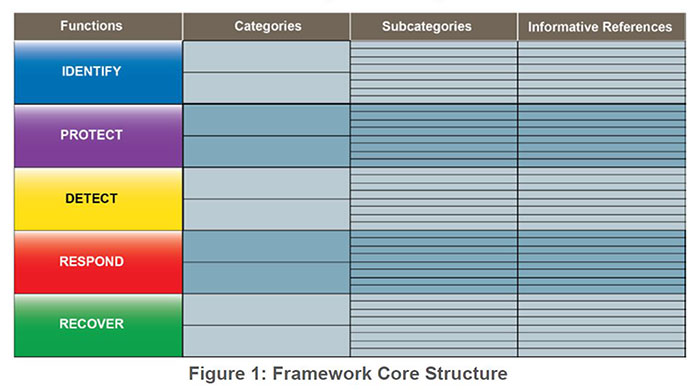
Below is the Framework Core, comprised of 4 elements that present key cybersecurity outcomes identified by specific industries. For the security industry, I think it would be beneficial to complete this core for as many verticals as possible, from education to oil and gas to fire and life safety to access control and beyond.
New Cybersecurity Guidelines Released by White House, Part 1

Functions Column – organizes basic cyber security activities; aids organizations in managing risk; addresses threats; and improves learning from previous activities.

Identify: manage cybersecurity risks by understanding business context, identifying resources used to support the business; creating risk management strategy.

Protect: implement safeguards to limit and/or contain the impact of unwanted cyber events.

Detect: implement activities to ensure a timely discover of unwanted cyber events.

Respond: take action quickly and effectively.

Recover: develop and implement a plan for resiliency and to restore business functions quickly.

Categories Column – groups of cybersecurity outcomes closely tied to particular activities.

Subcategories Column – specific outcomes of management activities.

Informative References Column – standards, guidelines and practices.

Once you have identified your company’s framework, it’s time to discover how your organization views cybersecurity risks and identify the processes in place to manage these risks by choosing the tier in which your business currently identifies with most.

Click here for Part 2 of this article where I introduce the tiers and give tips on how to select the correct tier for your company!

(Image from the official framework's PDF.)

About the Author

Ginger Hill is Group Social Media Manager.

Featured

  • Security Today Announces 2025 CyberSecured Award Winners

    Security Today is pleased to announce the 2025 CyberSecured Awards winners. Sixteen companies are being recognized this year for their network products and other cybersecurity initiatives that secure our world today. Read Now

  • Empowering and Securing a Mobile Workforce

    What happens when technology lets you work anywhere – but exposes you to security threats everywhere? This is the reality of modern work. No longer tethered to desks, work happens everywhere – in the office, from home, on the road, and in countless locations in between. Read Now

  • TSA Introduces New $45 Fee Option for Travelers Without REAL ID Starting February 1

    The Transportation Security Administration (TSA) announced today that it will refer all passengers who do not present an acceptable form of ID and still want to fly an option to pay a $45 fee to use a modernized alternative identity verification system, TSA Confirm.ID, to establish identity at security checkpoints beginning on February 1, 2026. Read Now

  • The Evolution of IP Camera Intelligence

    As the 30th anniversary of the IP camera approaches in 2026, it is worth reflecting on how far we have come. The first network camera, launched in 1996, delivered one frame every 17 seconds—not impressive by today’s standards, but groundbreaking at the time. It did something that no analog system could: transmit video over a standard IP network. Read Now

  • From Surveillance to Intelligence

    Years ago, it would have been significantly more expensive to run an analytic like that — requiring a custom-built solution with burdensome infrastructure demands — but modern edge devices have made it accessible to everyone. It also saves time, which is a critical factor if a missing child is involved. Video compression technology has played a critical role as well. Over the years, significant advancements have been made in video coding standards — including H.263, MPEG formats, and H.264—alongside compression optimization technologies developed by IP video manufacturers to improve efficiency without sacrificing quality. The open-source AV1 codec developed by the Alliance for Open Media—a consortium including Google, Netflix, Microsoft, Amazon and others — is already the preferred decoder for cloud-based applications, and is quickly becoming the standard for video compression of all types. Read Now

New Products

  • AC Nio

    AC Nio

    Aiphone, a leading international manufacturer of intercom, access control, and emergency communication products, has introduced the AC Nio, its access control management software, an important addition to its new line of access control solutions.

  • Automatic Systems V07

    Automatic Systems V07

    Automatic Systems, an industry-leading manufacturer of pedestrian and vehicle secure entrance control access systems, is pleased to announce the release of its groundbreaking V07 software. The V07 software update is designed specifically to address cybersecurity concerns and will ensure the integrity and confidentiality of Automatic Systems applications. With the new V07 software, updates will be delivered by means of an encrypted file.

  • Camden CV-7600 High Security Card Readers

    Camden CV-7600 High Security Card Readers

    Camden Door Controls has relaunched its CV-7600 card readers in response to growing market demand for a more secure alternative to standard proximity credentials that can be easily cloned. CV-7600 readers support MIFARE DESFire EV1 & EV2 encryption technology credentials, making them virtually clone-proof and highly secure.