
Biometrics Market to Hit $50 Billion by 2024

Biometrics Market to Hit $50 Billion by 2024

High acceptance among various verticals including mobile banking and financial services owing to rising security concerns has enhanced biometrics market size.

Biometrics Market size is estimated to surpass USD 50 billion by 2024; according to a new research report by Global Market Insights, Inc. High acceptance among various verticals including mobile banking and financial services owing to rising security concerns has enhanced biometrics market size. Government initiatives for biometrics implementation coupled with high deployment for criminal identification will remain the key factors driving industry demand.

Industry players focus on technological advancements and new product launches to cater to the customer requirements. Benefits offered including provision of precise and accurate validation as compared to traditional validation methods such as PINs and ID cards, are anticipated to increase the industry penetration across the globe till 2024.

Increased smartphone penetration coupled with expansion of consumer electronics will favor the biometrics market share over the forecast timeframe. In addition, rising investment in military & defense due to authentication concerns is anticipated to offer high growth potential. Multimodal biometrics system is an emerging trend in public and private work space for stringent attendance recording purposes. However, high implementation cost and stored data uncertainty may hamper industry growth over the forecast timeframe.
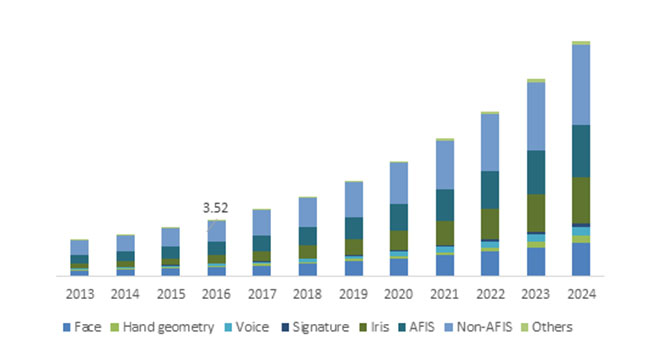
U.S. Biometrics Market Size, By Product, 2013-2024 (USD Billion)

Non-AFIS will account for the highest biometrics market share, surpassing USD 18 billion till 2024. This can be attributed to its high usage in various applications which include cashless vending and workforce management. Moreover, it finds use in various public areas that assure keyless entry and efficient security. Iris recognition will exhibit over 20 percent CAGR owing to wide integration of iris scanners mainly in smartphones.

Benefits such as unauthorized vehicle use detection, reduction of overtime expenses, and identification of billing anomalies will support the transportation & logistics segment growth from 2017 to 2024. Banking & finance applications will benefit from the rising demand from various financial institutions for precise authentication and streamlining of operations.

North America biometrics market is expected to account for more than 30 percent share till 2024. Rising demand from government & security sector in U.S. coupled with the presence of major industry participants will escalate the industry growth. Moreover, favorable regulatory landscape in the U.S will help in fostering the industry demand. Asia Pacific is poised to grow at the highest CAGR owing to various government initiatives in the countries including China and India. National enrollment program (UIDAI Aadhar) in India, and China Resident Identity Card (CRIC) are among the implementation examples across the region.

Global industry share is highly fragmented with various participants across the globe. BIO Key International, David Link, EyeVerfiy, Iris ID, and NEC Corporation are among the prominent players in the biometrics market. Other notable players include Lockheed Martin, Green Bit Biometric Systems, FaceFirst, ZKTeco, and 3M Cogent.

Industry players focus on adoption of strategies including strategic alliances and partnerships to strengthen their position. For instance, in July 2017, Iris ID entered into a strategic partnership with Tongrentang for high revenue generation.

Featured

  • TSA Introduces New $45 Fee Option for Travelers Without REAL ID Starting February 1

    The Transportation Security Administration (TSA) announced today that it will refer all passengers who do not present an acceptable form of ID and still want to fly an option to pay a $45 fee to use a modernized alternative identity verification system, TSA Confirm.ID, to establish identity at security checkpoints beginning on February 1, 2026. Read Now

  • The Evolution of IP Camera Intelligence

    As the 30th anniversary of the IP camera approaches in 2026, it is worth reflecting on how far we have come. The first network camera, launched in 1996, delivered one frame every 17 seconds—not impressive by today’s standards, but groundbreaking at the time. It did something that no analog system could: transmit video over a standard IP network. Read Now

  • From Surveillance to Intelligence

    Years ago, it would have been significantly more expensive to run an analytic like that — requiring a custom-built solution with burdensome infrastructure demands — but modern edge devices have made it accessible to everyone. It also saves time, which is a critical factor if a missing child is involved. Video compression technology has played a critical role as well. Over the years, significant advancements have been made in video coding standards — including H.263, MPEG formats, and H.264—alongside compression optimization technologies developed by IP video manufacturers to improve efficiency without sacrificing quality. The open-source AV1 codec developed by the Alliance for Open Media—a consortium including Google, Netflix, Microsoft, Amazon and others — is already the preferred decoder for cloud-based applications, and is quickly becoming the standard for video compression of all types. Read Now

  • Cost: Reactive vs. Proactive Security

    Security breaches often happen despite the availability of tools to prevent them. To combat this problem, the industry is shifting from reactive correction to proactive protection. This article will examine why so many security leaders have realized they must “lead before the breach” – not after. Read Now

  • Achieving Clear Audio

    In today’s ever-changing world of security and risk management, effective communication via an intercom and door entry communication system is a critical communication tool to keep a facility’s staff, visitors and vendors safe. Read Now

New Products

  • Automatic Systems V07

    Automatic Systems V07

    Automatic Systems, an industry-leading manufacturer of pedestrian and vehicle secure entrance control access systems, is pleased to announce the release of its groundbreaking V07 software. The V07 software update is designed specifically to address cybersecurity concerns and will ensure the integrity and confidentiality of Automatic Systems applications. With the new V07 software, updates will be delivered by means of an encrypted file.

  • A8V MIND

    A8V MIND

    Hexagon’s Geosystems presents a portable version of its Accur8vision detection system. A rugged all-in-one solution, the A8V MIND (Mobile Intrusion Detection) is designed to provide flexible protection of critical outdoor infrastructure and objects. Hexagon’s Accur8vision is a volumetric detection system that employs LiDAR technology to safeguard entire areas. Whenever it detects movement in a specified zone, it automatically differentiates a threat from a nonthreat, and immediately notifies security staff if necessary. Person detection is carried out within a radius of 80 meters from this device. Connected remotely via a portable computer device, it enables remote surveillance and does not depend on security staff patrolling the area.

  • Unified VMS

    AxxonSoft introduces version 2.0 of the Axxon One VMS. The new release features integrations with various physical security systems, making Axxon One a unified VMS. Other enhancements include new AI video analytics and intelligent search functions, hardened cybersecurity, usability and performance improvements, and expanded cloud capabilities