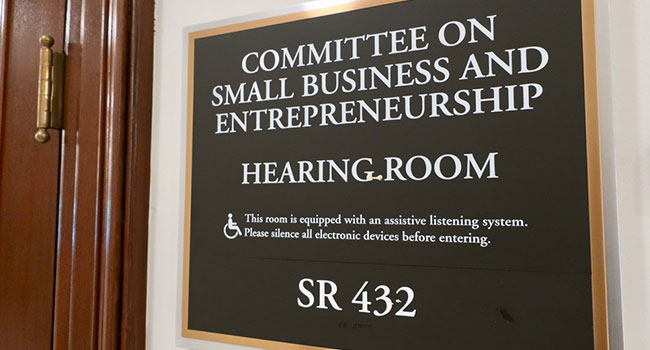
Committee on small business sign

Senators Introduce Bill to Help Small Businesses Improve Cybersecurity Protections

The legislation would require the Department of Homeland Security to develop educational resources for business owners and train counselors on higher-level cybersecurity information.

Sens. Marco Rubio (R-Florida) and Gary Peters (D-Michigan) introduced a bill this week aiming to help small businesses access cybersecurity information and tools more easily through existing government programs.

The Small Business Cybersecurity Assistance Act would direct the U.S. Small Business Administration (SBA) to become a “cybersecurity clearinghouse” by compiling government education materials and offering them as resources at Small Business Development Centers (SBDCs) operated by the federal government.

Most importantly, the bill would require the Department of Homeland Security to train SBDC counselors on higher-level cybersecurity information. DHS officials would also develop online educational materials to disseminate to small business owners.

Rubio, who chairs the Senate Committee on Small Business and Entrepreneurship, said cyber criminals and state-sponsored foreign hackers have targeted small businesses in the past, paralyzing their ability to operate.

“This bipartisan bill ensures that small businesses have greater access to critical resources and training to better protect their networks before a cyber-attack occurs,” Rubio said in a statement.

Security breaches at small businesses can be the “doorway” for breaches of larger companies, making the problem worse, Peters said.

“Yet too many small business owners say they lack the resources they need to safeguard their businesses and customers from hackers, fraudsters, and cybercriminals,” Peters said in a statement. “This commonsense legislation will help ensure small businesses can access much-needed information and training to secure their systems from malicious cyber-attacks.”

The legislation follows recommendations from DHS and SBA’s most recent cyber strategy report, which came out in March. In a study conducted for the report over 85 percent of small business owners said they fear cyberattacks and feel unprepared for one.

Rep. Jason Crow (D-Colorado) introduced a companion bill that has already been added to the House’s version of the annual National Defense Authorization Act, The Hill reported. The House will likely vote on the NDAA this week.

About the Author

Haley Samsel is an Associate Content Editor for the Infrastructure Solutions Group at 1105 Media.

Featured

  • Security Industry Association Announces the 2026 Security Megatrends

    The Security Industry Association (SIA) has identified and forecasted the 2026 Security Megatrends, which form the basis of SIA’s signature annual Security Megatrends report defining the top 10 factors influencing both near- and long-term change in the global security industry. Read Now

  • The Future of Access Control: Cloud-Based Solutions for Safer Workplaces

    Access controls have revolutionized the way we protect our people, assets and operations. Gone are the days of cumbersome keychains and the security liabilities they introduced, but it’s a mistake to think that their evolution has reached its peak. Read Now

  • A Look at AI

    Large language models (LLMs) have taken the world by storm. Within months of OpenAI launching its AI chatbot, ChatGPT, it amassed more than 100 million users, making it the fastest-growing consumer application in history. Read Now

  • First, Do No Harm: Responsibly Applying Artificial Intelligence

    It was 2022 when early LLMs (Large Language Models) brought the term “AI” into mainstream public consciousness and since then, we’ve seen security corporations and integrators attempt to develop their solutions and sales pitches around the biggest tech boom of the 21st century. However, not all “artificial intelligence” is equally suitable for security applications, and it’s essential for end users to remain vigilant in understanding how their solutions are utilizing AI. Read Now

  • Improve Incident Response With Intelligent Cloud Video Surveillance

    Video surveillance is a vital part of business security, helping institutions protect against everyday threats for increased employee, customer, and student safety. However, many outdated surveillance solutions lack the ability to offer immediate insights into critical incidents. This slows down investigations and limits how effectively teams can respond to situations, creating greater risks for the organization. Read Now

New Products

  • FEP GameChanger

    FEP GameChanger

    Paige Datacom Solutions Introduces Important and Innovative Cabling Products GameChanger Cable, a proven and patented solution that significantly exceeds the reach of traditional category cable will now have a FEP/FEP construction.

  • HD2055 Modular Barricade

    Delta Scientific’s electric HD2055 modular shallow foundation barricade is tested to ASTM M50/P1 with negative penetration from the vehicle upon impact. With a shallow foundation of only 24 inches, the HD2055 can be installed without worrying about buried power lines and other below grade obstructions. The modular make-up of the barrier also allows you to cover wider roadways by adding additional modules to the system. The HD2055 boasts an Emergency Fast Operation of 1.5 seconds giving the guard ample time to deploy under a high threat situation.

  • ResponderLink

    ResponderLink

    Shooter Detection Systems (SDS), an Alarm.com company and a global leader in gunshot detection solutions, has introduced ResponderLink, a groundbreaking new 911 notification service for gunshot events. ResponderLink completes the circle from detection to 911 notification to first responder awareness, giving law enforcement enhanced situational intelligence they urgently need to save lives. Integrating SDS’s proven gunshot detection system with Noonlight’s SendPolice platform, ResponderLink is the first solution to automatically deliver real-time gunshot detection data to 911 call centers and first responders. When shots are detected, the 911 dispatching center, also known as the Public Safety Answering Point or PSAP, is contacted based on the gunfire location, enabling faster initiation of life-saving emergency protocols.