According to data presented by the Atlas VPN team, there are 78 new cybersecurity companies founded in 2020 that cumulatively have raised over $31.6 million in funding year-to-date.
Only 15% of cybersecurity startups launched in 2020 secured funding. However, three companies alone collected nearly 96% ($30.3 million) of the total amount of investments.
The startup that scored the most significant investment is Beyond. It secured a total of $21 million in February of 2020, which accounts for more than 66% of total investments into newly launched cybersecurity startups this year.
Beyond is an Israeli cybersecurity startup founded by CEO Assaf Rappaport, who is a former head of R&D at Microsoft Israel. Investors in Beyond include Sequoia Capital Israel and Cyberstars Venture Funds Ltd.
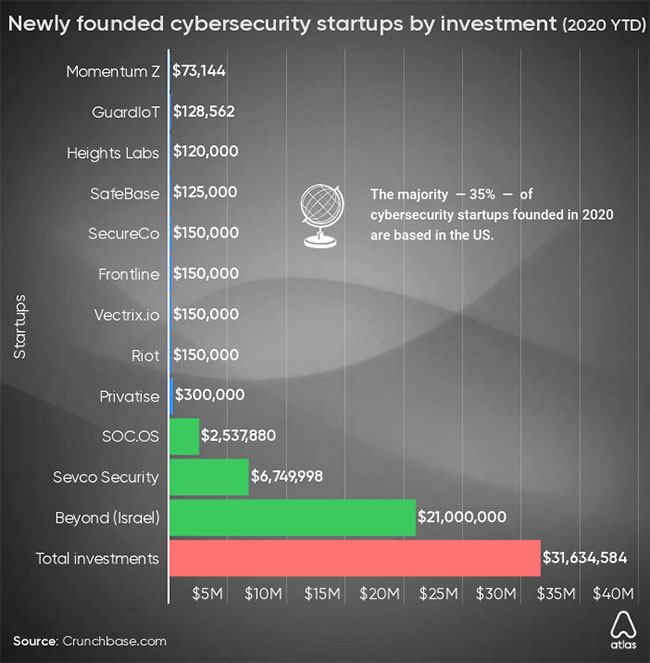
A cybersecurity startup with the second biggest investment is Sevco Security, which raised over $6.7 million in May of 2020. Funds collected by Sevco Security constitute more than 21% of total investments into newly launched cybersecurity startups in 2020.
Sevco Security is a Texas-based company that provides cybersecurity services and products for cyber experts. Among Sevco Security investors is an early-stage venture capital firm 406 Ventures.
Also, in the list of top three cybersecurity startups in terms of funding is Soc.OS. It received more than $2.5 million in investments in July this year. Funding received by Soc.OS makes up 8% of total investments in this year's cybersecurity startups.
Soc.OS is a startup from London, which offers an alert correlation and triage automation tool designed to help internal security teams manage a growing number of alerts produced by threat protection and detection tools. Soc.OS investors include such early-stage venture capital firms as Speedinvest and Hoxton Ventures.
Most of this year's cybersecurity companies are from North America or particularly the United States. They make up almost 35% (27) of all the cybersecurity startups launched in 2020.
The United States is followed by Europe, with nearly a quarter (19) cybersecurity startups coming from the region. Regardless of Brexit, nearly 37% (7) of cybersecurity startups founded in Europe this year are based in the UK.
Other countries where cybersecurity startups come from include Israel (5), Singapore (3), India (2), Brazil (1), Turkey (1), and Australia (1). A total of 24% (19) of startups have not revealed their headquarters.
A Number of New Cybersecurity Startups is Shrinking Each Year
While the amount of cyber incidents is increasing and cyberattacks are becoming more sophisticated, the number of new cybersecurity startups is declining each year.
Historical data shows that in 2015 there were 490 cybersecurity companies launched. Together the startups raised over $3.1 billion in investments.
The year of 2016 saw a slightly smaller number of new cybersecurity companies. The launch of new startups in the cybersecurity field decreased by 0.8%, with 486 startups launched that year. The total amount of funding allocated to those startups, however, dropped in half, from $3.1 billion to $1.6 billion.
In 2017 the number of new cybersecurity startups plummeted again by 0.8%. There were 482 cybersecurity companies founded that year, which raised more than $1.3 billion in total — 17% less than in 2016.
The number of new cybersecurity startups dropped by more than a fifth in 2018 compared to the year before. A total of 382 cybersecurity companies were launched that year, which collected over $847 million in investments. The amount of funds invested in the cybersecurity startups also dropped by 35% compared to 2017.
Last year saw a 46% decrease in the launch of new cybersecurity startups. There were 207 these types of companies founded. Together they raised close to $229.5 million in investments — 73% less than the year before. This year's cybersecurity market has welcomed 78 newcomers — the number has shrunk by 62% compared to last year.