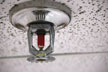
Analysis: Residential Fire Sprinklers Make Economic Sense
Sometimes life-saving technologies seem beyond the reach of the average person. If you put residential fire sprinklers in that category, think again. National Institute of Standards and Technology (NIST) economists ran the numbers. Their benefit-cost analysis found that for new home construction, a multipurpose network sprinkler system that connects to a house’s regular water supply and piping makes good economic sense.
NIST’s Benefit-Cost Analysis of Residential Fire Sprinkler Systems report, released last month, examines data from 2002 to 2005 to value the economic performance of a residential “wet-pipe” fire sprinkler system. The additional economic benefits from installation of a multipurpose network sprinkler system (the least costly wet-pipe system available) are estimated for three types of newly constructed single-family houses that are also equipped with smoke detectors. The study builds on a prior cost analysis developed by NIST’s Building and Fire Research Laboratory and offers a current analysis of the economics of residential fire sprinkler technology.
According to NIST, the cost in 2005 dollars for adding a multipurpose network sprinkler system to a house under construction was approximately $2,075 for a 3,338-square-foot colonial-style house, $1,895 for a 2,257-square-foot townhouse and $829 for a 1,171-square-foot ranch house. However when a house fire occurs, the estimated benefits of a residential fire sprinkler system include a 100 percent reduction in civilian fatalities and a 57 percent reduction in civilian injuries, a 32 percent reduction of both direct property damage (property losses that would not be covered by insurance) and indirect property costs (fire-related expenses such as temporary shelter, missed work, extra food costs, legal expenses, transportation, emotional counseling and childcare). Houses with sprinklers, in addition to smoke alarms, also received an 8 percent reduction in homeowner insurance premiums, compared to houses only equipped with smoke alarms.
After subtracting installation costs and weighting the benefits by the odds that a house would catch on fire, NIST economists concluded that, depending on assumptions, the net gain from installing a sprinkler system (in 2005 dollars) would vary between $704 and $4,801 for the colonial-style house, between $884 and $4,981 for the townhouse, and between $1,950 and $6,048 for the ranch-style house, over the 30-year study period. In all cases examined, the researchers found that the data supported the finding that multipurpose network residential fire sprinkler systems are cost-effective.
The United States Fire Administration, part of the Department of Homeland Security, funded the research. The report can be viewed at http://www.bfrl.nist.gov/oae/publications/nistirs/NISTIR_7451_Oct07.pdf.