Trusted Brands
General Mills installs NOTIFIER intelligent fire alarm network with voice evacuation
- By Jayson Kneen
- May 01, 2009
Whether it's for a new children's cereal or a
comprehensive fire and life safety system,
Lauren Hoen, a building operations manger
for General Mills Inc., understands that the recipe for
success calls for only the finest ingredients.
Hoen is the building operations manager at the James
Ford Bell Technical Center, General Mills' research and
development facility located in Minneapolis. Recently,
Hoen was tasked with finding a fire safety system that
could address the extensive challenges posed by the
large and complex JFB campus.
The JFB Technical Center's 690,000-square-foot
facility is home to numerous research and development
labs and offices, sensory labs and four pilot plants. The
center also houses a cereal science classroom and a comprehensive
research library that contains more than 800
journals, 20,000 books, 500 online databases and 1,400
food industry Internet resources.
Learning From Experience
The existing fire alarm system at JFB was nearly 20
years old and no longer in production, making system
upgrades impossible. Hoen had seen first-hand in his
former job at Pillsbury that a NOTIFIER system could
provide a powerful, effective and flexible fire safety
solution for a large company.
"I installed my first NOTIFIER system at the Pillsbury
R&D center in the early 1980s," Hoen said. "Upgrades
and building expansions over the years have kept the system
current to this day. I've installed fire alarm systems at
four different facilities over the years. From my experience,
I knew that a NOTIFIER system would provide a
seamless and consistent interface for the JFB campus."
In Control
To get the precise NOTIFER system he needed, Hoen
worked with Low Voltage Contractors, a NOTIFIER distributor
that's been serving the Minneapolis-St. Paul area
for 22 years. Dan Westberg, operations manager at Low
Voltage Contractors, said NOTIFIER was a natural fit to
address the projects' complexities.
"The JFB campus, with its size, unique needs and
unusual serpentine configuration, posed many challenges
to maintaining fire safety," Westberg said. "The
building itself is designed with a primary 'spine' with
branches shooting off of it at many different points,
some leading to entirely new and sizable building sections.
The NOTIFIER product had the horsepower, ease
of use and zone control that the application demanded."
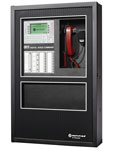
Westberg recommended that a NOTIFIER ONYX
series NFS2-3030 intelligent fire alarm-voice evacuation
control panel be located in the facility's incident
command center, and an ONYXWorks® graphical
workstation and 18 NFS2-640 intelligent fire alarm
control panels be strategically located throughout
the building.
"I find the zoned voice evacuation components to be
highly valuable," Hoen said. "The NOTIFIER system
gives us complete vision of and control over fire safety,
yet it is extremely intuitive to use. I particularly like the
ONYXWorks graphical user interface—because ease of
use is critical."
The primary NFS2-3030 control panel, which can
support up to 10 signaling line circuits and 3,180 intelligent
devices, is paired with the ONYXWorks graphical
workstation and a 40-inch monitor in the JFB Incident
Command Center. The ONYXWorks workstation integrates
all the fire safety components into a single point
of control. In conjunction with the monitor, it provides a
graphical overview of conditions throughout the facility
and allows all key personnel at the Incident Command
Center to supervise and control fire safety throughout
JFB. In addition, the system features an integrated
speaker control panel for communication capabilities
with fire fighting personnel, and all building engineers
and maintenance engineers have voice pagers to receive
updates on alarm status.
The 18 NFS2-640s are linked to the NFS2-3030,
ONYXWorks and to one another via NOTI-FIRE-NET,
NOTIFIER's intelligent fire alarm network. On the network,
each panel operates independently, yet cohesively,
as part of the unified fire and life safety system. NOTI-FIRE-NET's flexibility and expandability aligned perfectly
with the needs of both Hoen and JFB.
"We did not want another proprietary system that
could only be maintained and upgraded by a single
vendor," Hoen said. "We were fairly certain the system
we wanted would be a NOTIFIER, because of its system
architecture and design, as well as the variety of
vendors available to provide any needed service."
Exceeding Expectations
JFB's fire safety system not only had to address all of
Hoen's concerns, but it had to meet a huge array of regulatory
as well as internal standards.
"As a food research facility, we fall under just about
every regulatory agency one can imagine," Hoen said.
"Our designs and installations had to meet USDA, FDA
and Department of Agriculture requirements, among many
others, in addition to IBC, FM Global, UL and a very
tough staff of fire and building professionals in our city."
Hoen said the company has very stringent internal standards,
including safety design, CAD standards, component
wash-down requirements, personal protective equipment,
installation staff requirements, HAZMAT and recycling
requirements of removed equipment, and procedures on
how project purpose, construction impact and testing are
communicated to GM employees.
"The NOTIFIER system and Low Voltage
Contractors have exceeded my expectations while helping
us to meet all these tough standards," he said.
The installation process took about two years, and the
system has been operational for just under a year.
"We now have a sophisticated and user-friendly fire
safety system at JFB, one with a seamless interface and
without the complexities and problems inherent to our
previous system," Hoen said. "The NOTIFIER system
has also saved us substantial dollars, as training costs on
this system are significantly lower."
The work is not yet done for Hoen and Low Voltage
Contractors.
"JFB is always updating and there is constant construction,"
Westberg said. "NOTIFIER is playing a role
in these developments, with system expansions, a new
voice system being added in select
locations, and a plan for exterior
notifications on the building exteriors
and grounds in 2009."
This article originally appeared in the issue of .