FST21 Saferise Solution Raised the Bar on School Security
The recent, profoundly tragic events at Sandy Hook Elementary School in Newtown, Connecticut brought to light very sadly, and all too clearly, the urgent need for heightened access security in our schools. Measures must be put in place to better protect our school children, their teachers and all school staff from random acts of violence.
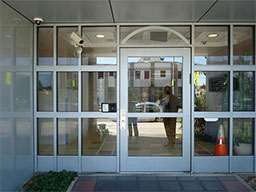 The Bais Yaakov School for Girls (BYLA), a high school in Los Angeles, has long been a proactive leader in this arena and has taken some serious, ongoing steps to harden security at the school. Adam Cohen, a volunteer facilities manager for BYLA, initiated the effort as far back as 2003, when he oversaw the installation of seven doors with access keypads and electric door strikes. Cohen began working with systems integrator OMD, Inc., owned by Barry Belkin and Sam Levari, based in Reseda, Calif. in 2006, when they upgraded security with the installation of additional cameras and DVRs. They also replaced the seven access keypads with more secure fingerprint readers and upgraded electric door strikes.
In the summer of 2009, Cohen hardened school security even further when he had the FST21 SafeRise solution installed.
"When I heard what FST21 was developing," he recalled, "I said 'I want it!' Given what is going on in the world, I saw the need to enhance the security at the school. What prompted the upgrade is that we wanted something better than fingerprints alone," he explained. "Using the fingerprint readers provided us with the needed security, but it was far from convenient. The students didn't like using the fingerprint readers; they complained it was slow and unreliable. Strangely enough, the enrollment process was not reliable for some users, and their fingerprints don't even register. The enrolling system simply says there's nobody there. We needed a better system."
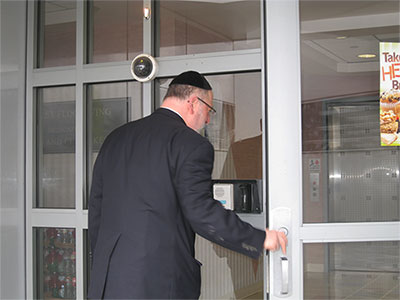 He went with FST21's SafeRise solution, an in motion identification system, that employs quick and highly-secure identification. The system registers users, can identify anyone at the door and allows approved user access through a fusion of biometric recognition, face, behavioral, voice and even license plate recognition. No keys, cards or access codes are needed. The system can verify individuals and make an informed decision whether to allow entrance. (It also earned the coveted Security Industry Association - SIA - Best New Product Award in 2011.)
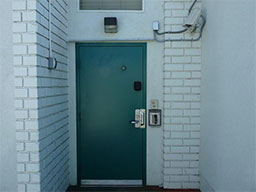
There are currently over 400 students and staff members at the Bais Yaakov School for Girls who are using the system. It spans seven, secured, exterior doors, including the front entrance, three back entrances and three doors between each floor of the building. Lights and canopies were added where needed.
"We learned a lot about cameras, lighting, and all the environmental conditions that effect how the system works," Cohen explained. "If, for instance, someone's face is in the sun, it affects how a camera recognizes them. The canopies provide even lighting on the face, as do exterior lights at night, to ensure accuracy of user recognition."
BYLA upgraded the system a few months ago to add an eighth door – an internal door to an office for the staff members.
Daniel Peled, FST21 VP of sales & marketing, noted, “At BYLA's request, we created specific parameters that include restrictions for each group in the database. For example, students are expected to enter the school before 8:05 a.m. every day. Any student that arrives after that time is diverted to the school receptionist to be listed as ‘late for school.’ We also created the doorman application designed for the receptionist to see all cameras on the same screen and under supervision, open the doors for deliveries and for students who are late and/or the system didn't open the door for them.”
"We've customized who has access and at what times," Cohen added. "Staff, for example, has different access hours than students. Custodial staff has different hours than students, and if, for instance, there are extra-curricular activities going on after school hours, we can remotely update the access parameters for any group."
The staff and students at BYLA adapted quickly and easily to the SafeRise solution, Cohen reported. "It is an ongoing and smooth process. Every year, we enroll new students and staff and take their facial pictures at different angles that go into the computer to create those new templates. We also remove from the system those students who have just graduated."
 "SafeRise is a good and solid system," Cohen attested. "It not only opens and closes doors; it has other levels of preventive sophistication and awareness. It is always alert and active, creating a secure feeling for the students and the staff. It's much more than an access control system, it gives you a feeling it is a system you can actually trust.”
Cohen advised that the first line of defense for any school is to keep the doors locked and the outer perimeter secured.
"You want to have perimeter security, surveillance, and monitoring from different places. Having a security guard is always a great thing. You're always going to have visitors, so it’s good to have a person to monitor any access control system and talk to visitors through an Intercom system. There should be one person dedicated to letting people in."
His decision to install the SafeRise system gives the school added security and peace of mind.
With school security as an uppermost priority in the hearts and minds of so many, especially in the aftermath of the tragically-sad incident at Sandy Hook Elementary School, the SafeRise solution from FST21 represents a strong and significant line of defense, letting the good people in and keeping the bad people out.
"It's a very precise system," Cohen added. "It works very well and is upgradeable. And, FST21 is great about giving us the support and solutions we need to meet our needs."