When Facing an Active Shooter, Get Those Targets Moving

At GovSec West, speaker Shawn Slezak discussed the importance of the ALICE program and how correct training can keep students and faculty safe when an active shooter is on campus.

As part of GovSec West’s Campus Security and Life Safety lineup, Moving Beyond Lockdown: An Overview of the ALICE Response Program to Active Shooter Event was presented by Shawn Slezak, a national trainer to public and private organizations across the nation.

During his speech, Slezak spoke about the difference in a police officer’s training and that of an active shooter. Simply put, law enforcement officers have tactical training, and active shooters do not. Statistics show that only 18-22 percent of all shots fired by officers are fatal, while 80 percent of shots fired by an active shooter end up claiming a life. How is that possible?

According to Slezak, cops have several things to consider before firing their weapon. They think about repercussions, worrying that an innocent bystander will somehow walk into the shot before the bullet makes it to their intended target, and hoping that whatever the outcome of firing their weapon that they will be able to deal with it. In other words, cops are distracted.
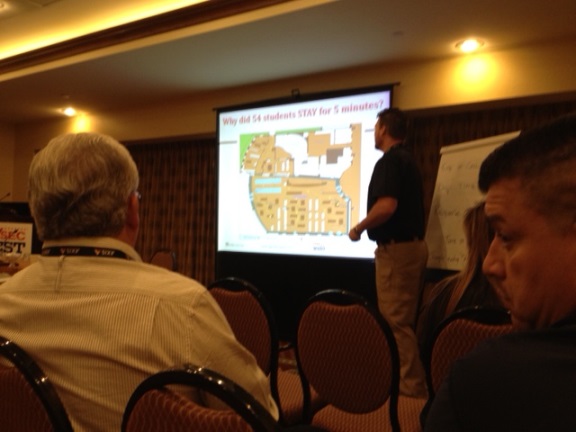
Shawn Slezak discusses ALICE.

Active shooters do not have distractions, and Slezak mentioned that the shooters only have one thing on their mind: to kill. In most cases, campuses lock down their facilities. And during that lockdown, students are told to hide under desks or tables. If the shooter enters a room during this time, the targets are stagnant and the shooter doesn’t even have to take aim in order to fatally shoot someone.

This is where Slezak shows his irritation with the lockdown system. “Why are students told to stay in one place and wait for the shooter to show up?” he asked. “It doesn’t make sense, especially when there are young children on campus. An active shooter hasn’t been trained on shooting a moving object, so get those targets moving.”

According to research during Slezak’s presentation, the majority of students and faculty that didn’t wait for law enforcement to show up survived an active shooting because they took immediate action.

Here is a breakdown of the ALICE program:

ALERT: use plain and specific language when making a 911 call or alerting authorities about an active shooter on campus.

LOCKDOWN: barricade and prepare to evacuate, but do not waste time waiting for law enforcement to arrive.

INFORM: communicate the shooter’s whereabouts to help either officers pinpoint the location or to help students safely escape the facility.

COUNTER: this is a last resort, make noise and throw objects to distract the shooter in order to help others escape.

EVACUATE: break windows from the top corner, move to the rally point as quickly as possible and follow law enforcement commands.

A final point Slezak made was that a violent act can also make the difference between survival and death. Don’t be afraid to act out against the shooter; take a stand and fight for your life and the lives of others. In several past active shooter events, such as Sandy Hook, it took just one person to make a stand that saved several precious lives.

About the Author

Lindsay Page is the editor for Campus Security & Life Safety magazine, and the senior editor for Security Today.

Featured

  • Security Today Announces 2025 CyberSecured Award Winners

    Security Today is pleased to announce the 2025 CyberSecured Awards winners. Sixteen companies are being recognized this year for their network products and other cybersecurity initiatives that secure our world today. Read Now

  • Empowering and Securing a Mobile Workforce

    What happens when technology lets you work anywhere – but exposes you to security threats everywhere? This is the reality of modern work. No longer tethered to desks, work happens everywhere – in the office, from home, on the road, and in countless locations in between. Read Now

  • TSA Introduces New $45 Fee Option for Travelers Without REAL ID Starting February 1

    The Transportation Security Administration (TSA) announced today that it will refer all passengers who do not present an acceptable form of ID and still want to fly an option to pay a $45 fee to use a modernized alternative identity verification system, TSA Confirm.ID, to establish identity at security checkpoints beginning on February 1, 2026. Read Now

  • The Evolution of IP Camera Intelligence

    As the 30th anniversary of the IP camera approaches in 2026, it is worth reflecting on how far we have come. The first network camera, launched in 1996, delivered one frame every 17 seconds—not impressive by today’s standards, but groundbreaking at the time. It did something that no analog system could: transmit video over a standard IP network. Read Now

  • From Surveillance to Intelligence

    Years ago, it would have been significantly more expensive to run an analytic like that — requiring a custom-built solution with burdensome infrastructure demands — but modern edge devices have made it accessible to everyone. It also saves time, which is a critical factor if a missing child is involved. Video compression technology has played a critical role as well. Over the years, significant advancements have been made in video coding standards — including H.263, MPEG formats, and H.264—alongside compression optimization technologies developed by IP video manufacturers to improve efficiency without sacrificing quality. The open-source AV1 codec developed by the Alliance for Open Media—a consortium including Google, Netflix, Microsoft, Amazon and others — is already the preferred decoder for cloud-based applications, and is quickly becoming the standard for video compression of all types. Read Now

New Products

  • A8V MIND

    A8V MIND

    Hexagon’s Geosystems presents a portable version of its Accur8vision detection system. A rugged all-in-one solution, the A8V MIND (Mobile Intrusion Detection) is designed to provide flexible protection of critical outdoor infrastructure and objects. Hexagon’s Accur8vision is a volumetric detection system that employs LiDAR technology to safeguard entire areas. Whenever it detects movement in a specified zone, it automatically differentiates a threat from a nonthreat, and immediately notifies security staff if necessary. Person detection is carried out within a radius of 80 meters from this device. Connected remotely via a portable computer device, it enables remote surveillance and does not depend on security staff patrolling the area.

  • Mobile Safe Shield

    Mobile Safe Shield

    SafeWood Designs, Inc., a manufacturer of patented bullet resistant products, is excited to announce the launch of the Mobile Safe Shield. The Mobile Safe Shield is a moveable bullet resistant shield that provides protection in the event of an assailant and supplies cover in the event of an active shooter. With a heavy-duty steel frame, quality castor wheels, and bullet resistant core, the Mobile Safe Shield is a perfect addition to any guard station, security desks, courthouses, police stations, schools, office spaces and more. The Mobile Safe Shield is incredibly customizable. Bullet resistant materials are available in UL 752 Levels 1 through 8 and include glass, white board, tack board, veneer, and plastic laminate. Flexibility in bullet resistant materials allows for the Mobile Safe Shield to blend more with current interior décor for a seamless design aesthetic. Optional custom paint colors are also available for the steel frame.

  • ResponderLink

    ResponderLink

    Shooter Detection Systems (SDS), an Alarm.com company and a global leader in gunshot detection solutions, has introduced ResponderLink, a groundbreaking new 911 notification service for gunshot events. ResponderLink completes the circle from detection to 911 notification to first responder awareness, giving law enforcement enhanced situational intelligence they urgently need to save lives. Integrating SDS’s proven gunshot detection system with Noonlight’s SendPolice platform, ResponderLink is the first solution to automatically deliver real-time gunshot detection data to 911 call centers and first responders. When shots are detected, the 911 dispatching center, also known as the Public Safety Answering Point or PSAP, is contacted based on the gunfire location, enabling faster initiation of life-saving emergency protocols.