Substation Security Challenges
Applying smart thermal technology to prevent intrusions
- By John Romanowich
- Dec 01, 2014
Electrical substations present a number of unique challenges, ranging
from theft, vandalism and safety concerns to complying with
increasingly enforced regulations from the National Electrical Reliability
Commission’s (NERC) Critical Infrastructure Protection
(CIP) program.
While the threat of terrorist activity to disrupt the nation’s power grid remains
ever-present, other hazards such as theft and vandalism are more common and
represent an immediate challenge. With the price of copper at an all-time high,
and with a large amount of copper wiring present at electrical substations, it’s no
surprise that they have become an attractive target for thieves. Substation owners
have begun taking some precautions, such as painting or marking wiring, to alert
scrap yards that copper has been stolen.
However, that has not stopped thieves from breaking into substations—often
with lethal consequences, along with the associated liability beyond potentially
disrupting electrical services. Even if thieves get away unscathed, the safety of the
substation may have been compromised. Maintenance staff members have been
severely injured or killed in the process of performing regular maintenance due to
the destabilization of certain elements of the power grid caused by copper theft.
In light of these and other concerns, the Federal Energy Regulatory Commission
(FERC) and NERC have worked together to put additional safeguards in
place to ensure greater physical security around these assets and to prevent cascading
consequences. This partnership has led to the strengthening of NERC’s
CIP standards. While these standards have always been considered well-respected
guidelines, as a result of the latest initiatives they are inching closer to being federal
mandates, which can be enforced with fines and other punitive measures for noncompliance.
As CIP standards move toward mandates, utilities will be required to
deploy security equipment to comply with regulations.
In order to assure the physical security of these potentially vulnerable substations,
CIP standards require protection on all six sides of assets: the four surrounding
sides plus above and below. To meet this requirement, the conventional
wisdom has been to use video surveillance cameras to cover all six sides of the
asset. However, there are limitations to what video surveillance can do. Historically,
it has only provided passive recording of events for future use. What is really
needed is a security modality which can detect and stop intruders as soon as they
enter a secured area. When it comes to protecting these critical assets, a real-time
awareness when an intrusion is taking place is critical to ensuring a timely response
and preventing an incident from escalating.
This is where automated detection solutions excel. These smart systems never
tire, can cover large distances, and see what the human eye would miss, all while
delivering immediate, actionable information to enable people to make fast response
decisions. Smart systems can be combined with manpower to manage outdoor
security in a uniquely effective way.
The key for reliability in a smart outdoor security system is to select a solution that
starts with accuracy as a foundation. When alerts are unreliable, there is no accountability—
a responder doesn’t know which of thousands of alerts he should respond
to. Historically, the common approach for detecting intrusions over large perimeters
has been to use a blind sensor, such as coax or fiber on the fence, acting as an activity
detector, augmented by a camera to help security guards determine the cause of
the alert. The drawback to such an approach is that these sensors can generate many
nuisance alerts, diminishing reliability, while the costs for deploying and maintaining
two separate systems—a sensor and a video system—can quickly escalate.
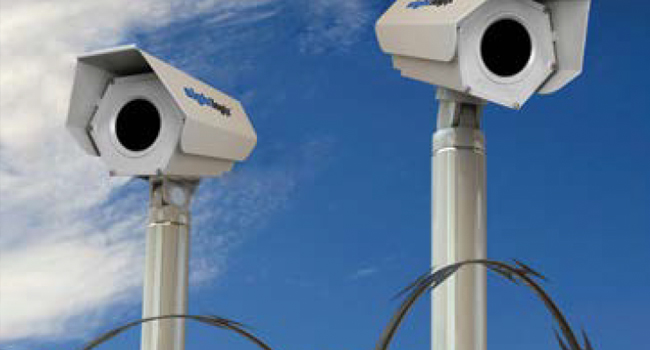
Thermal cameras with video analytics—also known as “smart” thermal cameras—
provide substantial advantages over these alternatives, increasing the probability
of intruder detection while greatly reducing the nuisance alarms that have
plagued automated perimeter systems in the past. One advantage is speed, which is
paramount when thwarting an intruder. Smart thermal cameras combine accurate
detection with visual detail to determine the “what and where” of an alert without
additional verification systems.
For this reason, smart thermal video cameras are being used at electrical utilities
to provide reliable detection of intruders and deliver accurate alarms in even
the most challenging conditions. Some smart thermal cameras now benefit from
the same processing advancements that make all of our computing devices so powerful,
and can amplify small differences between the temperature of a person and
the background, accurately detecting intruders even in less than ideal conditions.
They will ignore headlights, reflections off water or other lighting issues that cause
false detections with visible light cameras.
Because they can detect in complete dark, bright sunlight or poor weather, smart
thermal cameras can be counted on to secure outdoor areas 24/7. The alerts smart thermal cameras generate are accurate
and will drive focused attention when
an intrusion occurs. With the right
combination of manpower and automation,
smart thermal systems provide
the reliable, real-time security necessary
to protect substations and meet federal
physical security mandates.
By sending alerts when an intrusion
occurs, or even when someone approaches
a fence line, officials are alerted
and can view video in real time to determine
if there is activity to be stopped.
With this level of detection, you would
know when someone has entered a site
before they had an opportunity to steal,
vandalize or disrupt substation operations
or the power grid as a whole. Some
smart thermal cameras can also automatically
control PTZ cameras to the
exact location of an alarm and to zoom
and follow a detected target. Knowing
this information enables accurate,
real-time response directly to where the
threat resides, while ensuring good forensic
evidence after the fact. If multiple
events unfold simultaneously, the system
can track them all, and keep operators
from becoming confused by a distraction
or decoy.
The predominant methodology for
securing critical assets such as substations
has historically focused on perimeter
security. However, there are
numerous advantages to using thermal
cameras for outdoor security beyond
their typical use along a fence line to
protect a defined perimeter. They also
can create virtual barriers along open
areas that surround a building or an asset
to prevent insider theft where physical
or man-made boundaries are unlikely
to exist. Adding infrastructure around
internal assets would be costly and likely
impede the flow of business operations.
Smart video can be used to create a security
buffer zone around areas of special
concern to control access based on time
of day or other criteria, mitigating possible
sabotage or theft from insiders.
Additional technologies are available
with smart cameras that are proving
beneficial in a substation environment.
For instance, some systems now
incorporate audible communications so
an intruder who has triggered an alarm
can be requested to identify themselves.
All those authorized to have access can
be given a unique access code to enter
on their phones, which can also be
supplemented by an audio password.
The access accountability of codes and/
or passwords generates a complete log
of who enters and exits the area—satisfying
the physical security aspects of
NERC’s CIP requirements.
True security means stopping an
event by detecting intruders as soon
as they enter a secured area. When it
comes to protecting these critical assets,
this real-time awareness when an intrusion
is taking place is critical to ensuring
a timely response and preventing
theft, vandalism, accidents and other
potentially dangerous activities or
events that could disrupt the stability of
the power grid—while
also meeting increasingly
enforced security
regulations.
This article originally appeared in the December 2014 issue of Security Today.