
Online Exclusive: Wind Loading and Glass Technologies
National and regional governments and the insurance industry stepped in to drastically improve building codes, recognizing both the scale of human and financial loss. One important addition to the code was a requirement for missile-impact resisting glass.
- By Jane Embury
- Apr 22, 2015
Over the past few months, extreme weather events have battered countries in the Caribbean and Asia, testing the resilience of both local communities and the infrastructure on which they rely. The ferocity of those typhoons and hurricanes are in stark contrast to the innocence of their names. In the Western Pacific, recent names have included Ruth, Betty, Peggy and Dot. In the Eastern Pacific, Celia, Marie and Odile; and in the North Atlantic, Janet, Opal, Isabel and Katrina.
In the Pacific, the responsibility for naming tropical storms is coordinated through the World Meteorology Organization (WMO). Fourteen regional governments submit 10 names each, and the WMO Regional Specialized Meteorological Center (RSMC) in Tokyo is then responsible for naming each storm.
It’s a little different in the Atlantic. Tropical storms that reach a wind speed of 39mph are given a name while, if it reaches 74mph, it is redefined as a hurricane – while keeping its original name. Still all innocence, names for Atlantic storms later this year or for 2016 include Ana, Danny, Grace and Odette.
Normally, names can be reused after six years – except when reuse of a particular name would be considered insensitive. Katrina, for example, has been deleted from reuse: that 2005 hurricane brought massive destruction to Louisiana, Mississippi and Alabama, killed nearly 2,000 people and caused more than $100 billion in damage.
But if Katrina is the bad sheep whose name has been officially deleted, it was a different member of the hurricane family that was of greater significance for the glass and building trades.
Andrew, in 1992, was the second costliest hurricane in US history, after Katrina. Dozens were killed and, in parts of Florida, for example, between 90 and 100 percent of all mobile homes were destroyed. At the time, it was the costliest natural disaster for insured losses in global history.
National and regional governments and the insurance industry stepped in to drastically improve building codes, recognizing both the scale of human and financial loss. One important addition to the code was a requirement for missile-impact resisting glass.
Many of the technological advances made to glass and its framing systems stem from Hurricane Andrew and, in many countries or regions at risk from tropical storms, advanced glazing systems are now a requirement of building regulations – certainly for commercial buildings.
One primary advance has been in understanding wind loading – the amount of wind that architectural glass is able to withstand. That, of course, depends on a large number of variables such as the building’s height, its relationship to surrounding buildings, and the size of the glass spans.
Simplistically, in high winds, the exposed side of the glass is subjected to compressive stresses, while the opposing side is subjected to tensile stresses. Glass has a high resistance to the former, and a lower resistance to the latter. Its breaking point depends on how it reacts to each stress.
The standards used to measure wind load in the USA are ASTM E1300 and ASCE/SEI 7-05, which determine glass resistance to uniform lateral loads.
However, any calculation is complicated by the final glass type and thickness and will depend on a range of other factors such as windborne debris, safety glazing requirements – such as fire protection – and other site-specific concerns.
In the UK, BS 6399 and BS 6262 apply, with further guidance supplied by the Centre for Window and Cladding Technology (CWCT), although the American standard is also often used in the Middle East and parts of Asia, usually when American architects are involved in building design, or when US corporations are designing office buildings to US domestic standards.
These standards allow for a calculation of the uniform load resistance that a glazing system is able to sustain without breaking, taking into consideration glass dimensions, its type and thickness, and centre of glass deflection.
They are standards that Wrightstyle use when advising customers on glass types and framing systems, both in the UK and internationally. For example, we recently supplied roof glazing to a major banking group in Hong Kong, for a corporate-critical project of immense importance. The glass and framing systems had to provide fire resistance, bomb resistance – and, in a typhoon zone, have high wind load characteristics.
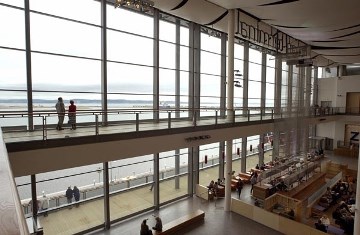
Nearer to home, we supplied to Ocean Terminal in Edinburgh. While Scotland is not in a tropical storm zone, the glass spans used in the retail and leisure complex were so large – and therefore so heavy – that wind loading became a significant factor in Wrightstyle systems being chosen. We were able to combine wind loading with other critical safety factors in a non-intrusive steel frame.
One current debate in meteorological circles is how climate change is likely to impact on the strength and frequency of tropical storms. In general, wind is caused by the movement of air masses, and the main influence on wind movement is temperature difference between the earth’s equator and poles.
Using those calculations, a recent study from the University of Texas-Austin suggested a continuing fall in average wind speed of up to 12 percent in some northern latitudes. That’s on top of the 5-15 percent that wind speed is estimated to have fallen within the past 30 years – notwithstanding Andrew, Katrina and all the other tropical storms.
However, a similar study at the University of California-Santa Cruz found that climate change might actually cause coastal wind speed to increase. But for those who live in tropical storm regions the argument may seem academic – the only certainty is that, every storm season, there will be storms.
Over the past few years, the glass and glazing industry has invested significantly to understand the dynamics of high wind loading and blast pressures, developing glass and framing systems to keep the glazed element intact and in its frame.
Understanding those dynamics has pushed the boundaries of what is now possible with glass. At Wrightstyle, for example, we have independently and successfully tested one of our advanced glass and framing systems against the blast from a lorry bomb.
Although bomb blast and wind load cannot be equated – the former is an explosive dynamic shock, while the latter is a static load – it demonstrates how glass, an intrinsically fragile material, can be made immensely strong and resistant to blast or wind pressures.
Later this year, Danny, Grace, or Odette may well be in the news, for all the wrong reasons. But for those buildings served by new building codes and incorporating the latest glazing systems, their impact is likely to be greatly reduced.