Robots Protect and Serve the Public

Robots Protect and Serve the Public

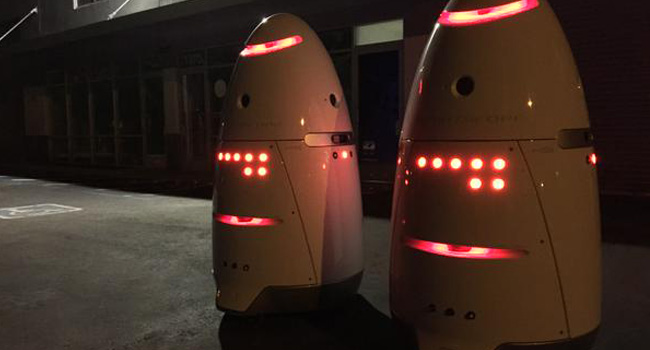
While all the Star Wars fans are waiting for Episode VII – The Force Awakens to be released in December 2015, a shopping center is embracing security with the use of sci-fi-like, crime-fighting robots. Standing at 5 feet tall and weighing in at 300 pounds, the Knightscope K5s, a product of the company Mountain View, act as roaming security guards at Palo Alto’s Stanford Shopping Center and all across Silicon Valley for that matter as part of a pilot program.

The shiny white, bullet-shaped machines gather real-time data using sensors and public data from businesses, government and social media feeds. The data is processed through a predictive analytics engine and if the robot senses a concern or threat in their patrolling area, a real-time alert is sent to authorities.

These unarmed machines operate within a predefined area, but just their size and appearance is enough to make people think twice about doing harm or malice, or committing a crime.

Each robot operates on lithium ion batteries and is equipped with the following features:

  • Built-in emergency intercom;
  • Proximity sensors;
  • GPS locator,
  • LPR sensors;
  • Thermal imaging;
  • Night-vision cameras;
  • 360-degree video;
  • Audio-recording capabilities; and
  • Broadcast capabilities.

When the robot senses its battery getting low, it will return itself to a charging station to recharge.

These humanoids are not meant to replace human security guards, but to enhance security by assisting offers and improving response times.

People have taken to these futuristic machines offering protection, safety and security. Perhaps it’s because they look similar to R2-D2, but whatever the reason, people find them approachable and friendly-looking, not afraid to interact with them or even give them a hug!

About the Author

Ginger Hill is Group Social Media Manager.

Featured

  • Security Today Announces 2025 CyberSecured Award Winners

    Security Today is pleased to announce the 2025 CyberSecured Awards winners. Sixteen companies are being recognized this year for their network products and other cybersecurity initiatives that secure our world today. Read Now

  • Empowering and Securing a Mobile Workforce

    What happens when technology lets you work anywhere – but exposes you to security threats everywhere? This is the reality of modern work. No longer tethered to desks, work happens everywhere – in the office, from home, on the road, and in countless locations in between. Read Now

  • TSA Introduces New $45 Fee Option for Travelers Without REAL ID Starting February 1

    The Transportation Security Administration (TSA) announced today that it will refer all passengers who do not present an acceptable form of ID and still want to fly an option to pay a $45 fee to use a modernized alternative identity verification system, TSA Confirm.ID, to establish identity at security checkpoints beginning on February 1, 2026. Read Now

  • The Evolution of IP Camera Intelligence

    As the 30th anniversary of the IP camera approaches in 2026, it is worth reflecting on how far we have come. The first network camera, launched in 1996, delivered one frame every 17 seconds—not impressive by today’s standards, but groundbreaking at the time. It did something that no analog system could: transmit video over a standard IP network. Read Now

  • From Surveillance to Intelligence

    Years ago, it would have been significantly more expensive to run an analytic like that — requiring a custom-built solution with burdensome infrastructure demands — but modern edge devices have made it accessible to everyone. It also saves time, which is a critical factor if a missing child is involved. Video compression technology has played a critical role as well. Over the years, significant advancements have been made in video coding standards — including H.263, MPEG formats, and H.264—alongside compression optimization technologies developed by IP video manufacturers to improve efficiency without sacrificing quality. The open-source AV1 codec developed by the Alliance for Open Media—a consortium including Google, Netflix, Microsoft, Amazon and others — is already the preferred decoder for cloud-based applications, and is quickly becoming the standard for video compression of all types. Read Now

New Products

  • AC Nio

    AC Nio

    Aiphone, a leading international manufacturer of intercom, access control, and emergency communication products, has introduced the AC Nio, its access control management software, an important addition to its new line of access control solutions.

  • Automatic Systems V07

    Automatic Systems V07

    Automatic Systems, an industry-leading manufacturer of pedestrian and vehicle secure entrance control access systems, is pleased to announce the release of its groundbreaking V07 software. The V07 software update is designed specifically to address cybersecurity concerns and will ensure the integrity and confidentiality of Automatic Systems applications. With the new V07 software, updates will be delivered by means of an encrypted file.

  • Camden CV-7600 High Security Card Readers

    Camden CV-7600 High Security Card Readers

    Camden Door Controls has relaunched its CV-7600 card readers in response to growing market demand for a more secure alternative to standard proximity credentials that can be easily cloned. CV-7600 readers support MIFARE DESFire EV1 & EV2 encryption technology credentials, making them virtually clone-proof and highly secure.