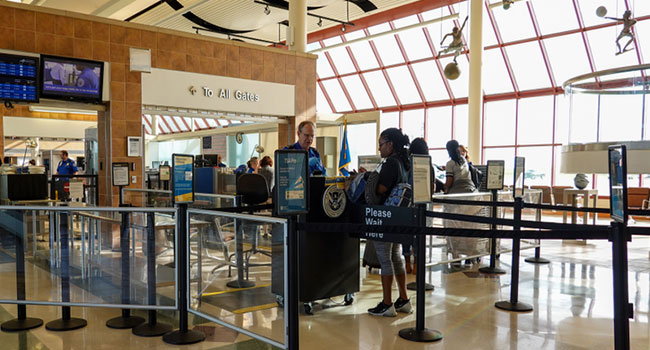
TSA ID checkpoint

TSA Requires Security Officers to Wear Masks in Screening Areas to Prevent Coronavirus Spread

The agency plans to receive millions of masks in the next few weeks to distribute to employees, but most agents will wear surgical masks rather than the more expensive N95 respirators.

Airport security agents will now be required to wear masks in screening areas to prevent further spreading of the coronavirus, the Transportation Security Administration confirmed on Thursday.

Employees were informed of the policy during a virtual town hall with Administrator David Pekoske on Wednesday. On Thursday, the agency officially announced mandatory mask policies for security officers, federal air marshals and baggage employees.

Already, more than 500 TSA employees have been diagnosed with COVID-19 and at least six have died, according to The Washington Post.

“TSA is making this change to protect our employees and travelers as social distancing cannot always be maintained in the screening process,” Pekoske said in a statement.

Previously, masks had been optional for employees, many of whom had advocated for better provisions of surgical masks and N95 respirators, which provide stronger protection against airborne disease. According to Reuters, Pekoske said during the town hall that TSA will receive millions of masks in the next few weeks, but most would be surgical masks rather than the more costly N95s.

Read More: TSA Faces Record-Low Numbers of Travelers, Coronavirus Outbreak Among Employees

Pekoske added that the airport screening process will never become “completely touchless,'' though the TSA will allow passengers to go through machines twice in order to reduce pat downs and close contact. Other steps have been taken at airports across the country: Floor markers have been installed to help travelers maintain social distancing, and some clear barriers have been put in place to stagger lines so that passengers are more spaced out.

“We can reduce the number of times we get in close proximity to a passenger to a significant degree and then mitigate a good portion of the rest of the risk with personal protective equipment,” Pekoske said.

No decision has been made about required temperature checks of passengers, noting that questions were still unanswered about where those checks would take place and which government agency would perform them, Reuters reported.

The TSA announcement also did not address if travelers will be required to wear face coverings, though they are already encouraged to do so. Individual airports, including Los Angeles International Airport, are making masks mandatory for travelers, and airlines such as Delta and United are implementing similar policies.

Airlines for America, a major trade group representing North American airlines, applauded TSA’s move on Thursday but called for further action on passenger requirements.

“While requiring facial coverings for TSA officers is an important and necessary step, we encourage the TSA and U.S. airports to similarly require facial protection for all travelers, in keeping with CDC recommendations,” A4A said in a press release. “This would ensure needed consistency for the duration of the passenger journey and instill greater confidence for the traveling public that the airlines, airports and federal government are prioritizing their health and safety.”

About the Author

Haley Samsel is an Associate Content Editor for the Infrastructure Solutions Group at 1105 Media.

Featured

  • Security Today Announces 2025 CyberSecured Award Winners

    Security Today is pleased to announce the 2025 CyberSecured Awards winners. Sixteen companies are being recognized this year for their network products and other cybersecurity initiatives that secure our world today. Read Now

  • Empowering and Securing a Mobile Workforce

    What happens when technology lets you work anywhere – but exposes you to security threats everywhere? This is the reality of modern work. No longer tethered to desks, work happens everywhere – in the office, from home, on the road, and in countless locations in between. Read Now

  • TSA Introduces New $45 Fee Option for Travelers Without REAL ID Starting February 1

    The Transportation Security Administration (TSA) announced today that it will refer all passengers who do not present an acceptable form of ID and still want to fly an option to pay a $45 fee to use a modernized alternative identity verification system, TSA Confirm.ID, to establish identity at security checkpoints beginning on February 1, 2026. Read Now

  • The Evolution of IP Camera Intelligence

    As the 30th anniversary of the IP camera approaches in 2026, it is worth reflecting on how far we have come. The first network camera, launched in 1996, delivered one frame every 17 seconds—not impressive by today’s standards, but groundbreaking at the time. It did something that no analog system could: transmit video over a standard IP network. Read Now

  • From Surveillance to Intelligence

    Years ago, it would have been significantly more expensive to run an analytic like that — requiring a custom-built solution with burdensome infrastructure demands — but modern edge devices have made it accessible to everyone. It also saves time, which is a critical factor if a missing child is involved. Video compression technology has played a critical role as well. Over the years, significant advancements have been made in video coding standards — including H.263, MPEG formats, and H.264—alongside compression optimization technologies developed by IP video manufacturers to improve efficiency without sacrificing quality. The open-source AV1 codec developed by the Alliance for Open Media—a consortium including Google, Netflix, Microsoft, Amazon and others — is already the preferred decoder for cloud-based applications, and is quickly becoming the standard for video compression of all types. Read Now

New Products

  • Luma x20

    Luma x20

    Snap One has announced its popular Luma x20 family of surveillance products now offers even greater security and privacy for home and business owners across the globe by giving them full control over integrators’ system access to view live and recorded video. According to Snap One Product Manager Derek Webb, the new “customer handoff” feature provides enhanced user control after initial installation, allowing the owners to have total privacy while also making it easy to reinstate integrator access when maintenance or assistance is required. This new feature is now available to all Luma x20 users globally. “The Luma x20 family of surveillance solutions provides excellent image and audio capture, and with the new customer handoff feature, it now offers absolute privacy for camera feeds and recordings,” Webb said. “With notifications and integrator access controlled through the powerful OvrC remote system management platform, it’s easy for integrators to give their clients full control of their footage and then to get temporary access from the client for any troubleshooting needs.”

  • ResponderLink

    ResponderLink

    Shooter Detection Systems (SDS), an Alarm.com company and a global leader in gunshot detection solutions, has introduced ResponderLink, a groundbreaking new 911 notification service for gunshot events. ResponderLink completes the circle from detection to 911 notification to first responder awareness, giving law enforcement enhanced situational intelligence they urgently need to save lives. Integrating SDS’s proven gunshot detection system with Noonlight’s SendPolice platform, ResponderLink is the first solution to automatically deliver real-time gunshot detection data to 911 call centers and first responders. When shots are detected, the 911 dispatching center, also known as the Public Safety Answering Point or PSAP, is contacted based on the gunfire location, enabling faster initiation of life-saving emergency protocols.

  • QCS7230 System-on-Chip (SoC)

    QCS7230 System-on-Chip (SoC)

    The latest Qualcomm® Vision Intelligence Platform offers next-generation smart camera IoT solutions to improve safety and security across enterprises, cities and spaces. The Vision Intelligence Platform was expanded in March 2022 with the introduction of the QCS7230 System-on-Chip (SoC), which delivers superior artificial intelligence (AI) inferencing at the edge.