TSA at JFK and LaGuardia Airports are Using New Credential Authentication Technology to Improve Checkpoint Screening Capabilities

TSA at JFK and LaGuardia Airports are Using New Credential Authentication Technology to Improve Checkpoint Screening Capabilities

Transportation Security Administration officers at John F. Kennedy International and LaGuardia Airports are using new technology at checkpoints that validates a traveler’s identification and confirms their flight information in near real time.

TSA at JFK International Airport has 22 credential authentication technology (CAT) units in use and LaGuardia Airport has 18 of them in operation.

“The credential authentication technology units improve upon TSA’s capabilities to detect and identify fraudulent identification documents such as driver’s licenses and passports at checkpoints and increases efficiency by automatically verifying passenger identification,” said John Bambury, TSA’s Federal Security Director for JFK International Airport.

“In addition to enhancing detection capabilities for identifying fake IDs, the credential system is able to confirm a passenger’s flight status in near real time through a secured connection,” said Robert Duffy, TSA’s Federal Security Director for LaGuardia Airport.

CAT Screen with Passport
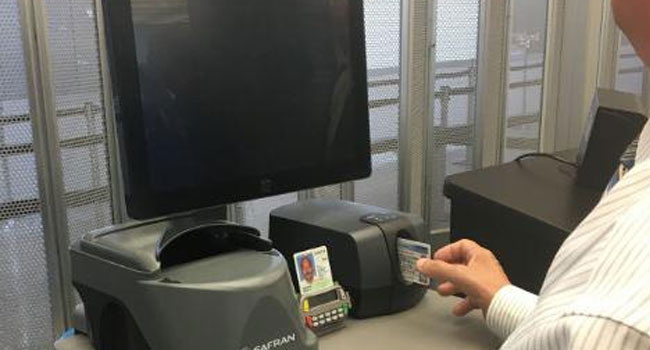
When a traveler hands the TSA officer their ID, the officer places it in the CAT unit, which scans the ID and informs the TSA officer whether the ID is valid. In some locations, the units are positioned to allow passengers to insert their ID into the units.

In most cases, travelers who approach the TSA travel document checking podium do not have to show their boarding pass because the CAT unit verifies that the traveler is prescreened to travel out of the airport for a flight that day; however, one may be requested for travelers under the age of 18 and/or those with ID issues. Even with TSA’s use of CAT, travelers still need to check-in with their airline in advance and bring their boarding pass to their gate agent to show the airline representative before boarding their flight.

CAT units authenticate several thousand types of IDs including passports, military common access cards, retired military ID cards, Department of Homeland Security Trusted Traveler ID cards, uniformed services ID cards, permanent resident cards, U.S. visas and driver licenses and photo IDs issued by state motor vehicle departments.

A CAT unit consists of the passport reader, an ID card reader, a Federal personal identity verification ID card reader, a monitor, a stand and a UV light. Each unit costs less than $30,000.

In addition, it is critical that travelers have their REAL ID-compliant driver licenses or other acceptable form of identification by the Oct. 1, 2021, deadline. The CAT units will not accept a driver’s license after Oct. 1, 2021, if it is not REAL ID-compliant.

Featured

  • Empowering and Securing a Mobile Workforce

    What happens when technology lets you work anywhere – but exposes you to security threats everywhere? This is the reality of modern work. No longer tethered to desks, work happens everywhere – in the office, from home, on the road, and in countless locations in between. Read Now

  • TSA Introduces New $45 Fee Option for Travelers Without REAL ID Starting February 1

    The Transportation Security Administration (TSA) announced today that it will refer all passengers who do not present an acceptable form of ID and still want to fly an option to pay a $45 fee to use a modernized alternative identity verification system, TSA Confirm.ID, to establish identity at security checkpoints beginning on February 1, 2026. Read Now

  • The Evolution of IP Camera Intelligence

    As the 30th anniversary of the IP camera approaches in 2026, it is worth reflecting on how far we have come. The first network camera, launched in 1996, delivered one frame every 17 seconds—not impressive by today’s standards, but groundbreaking at the time. It did something that no analog system could: transmit video over a standard IP network. Read Now

  • From Surveillance to Intelligence

    Years ago, it would have been significantly more expensive to run an analytic like that — requiring a custom-built solution with burdensome infrastructure demands — but modern edge devices have made it accessible to everyone. It also saves time, which is a critical factor if a missing child is involved. Video compression technology has played a critical role as well. Over the years, significant advancements have been made in video coding standards — including H.263, MPEG formats, and H.264—alongside compression optimization technologies developed by IP video manufacturers to improve efficiency without sacrificing quality. The open-source AV1 codec developed by the Alliance for Open Media—a consortium including Google, Netflix, Microsoft, Amazon and others — is already the preferred decoder for cloud-based applications, and is quickly becoming the standard for video compression of all types. Read Now

  • Cost: Reactive vs. Proactive Security

    Security breaches often happen despite the availability of tools to prevent them. To combat this problem, the industry is shifting from reactive correction to proactive protection. This article will examine why so many security leaders have realized they must “lead before the breach” – not after. Read Now

New Products

  • Compact IP Video Intercom

    Viking’s X-205 Series of intercoms provide HD IP video and two-way voice communication - all wrapped up in an attractive compact chassis.

  • Unified VMS

    AxxonSoft introduces version 2.0 of the Axxon One VMS. The new release features integrations with various physical security systems, making Axxon One a unified VMS. Other enhancements include new AI video analytics and intelligent search functions, hardened cybersecurity, usability and performance improvements, and expanded cloud capabilities

  • PE80 Series

    PE80 Series by SARGENT / ED4000/PED5000 Series by Corbin Russwin

    ASSA ABLOY, a global leader in access solutions, has announced the launch of two next generation exit devices from long-standing leaders in the premium exit device market: the PE80 Series by SARGENT and the PED4000/PED5000 Series by Corbin Russwin. These new exit devices boast industry-first features that are specifically designed to provide enhanced safety, security and convenience, setting new standards for exit solutions. The SARGENT PE80 and Corbin Russwin PED4000/PED5000 Series exit devices are engineered to meet the ever-evolving needs of modern buildings. Featuring the high strength, security and durability that ASSA ABLOY is known for, the new exit devices deliver several innovative, industry-first features in addition to elegant design finishes for every opening.