Airport Firearm Detection more than Doubles in 2020

Airport Firearm Detection more than Doubles in 2020

Transportation Security Administration (TSA) officers detected twice as many firearms per million passengers screened at airport security checkpoints nationwide in 2020 compared to 2019, and at a significantly higher rate than any other year since the agency’s inception. Throughout 2020, TSA caught approximately 10 firearms per million passengers screened as compared to about 5 firearms per million passengers screened in 2019.

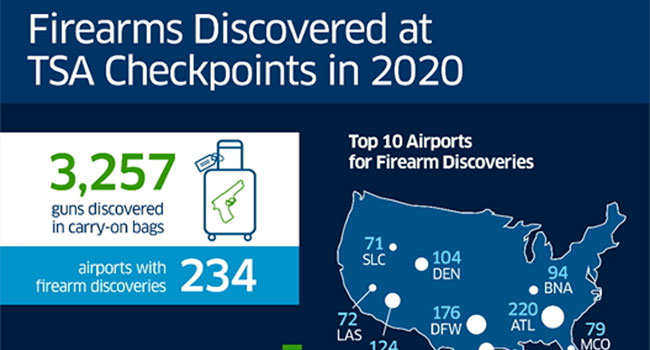
TSA officers discovered a total of 3,257 firearms on passengers or in their carry-on bags at checkpoints, although total passengers screened in 2020 fell by 500 million versus 2019 due to the pandemic. Of those firearms caught in 2020, about 83 percent were loaded. In 2019, TSA officers stopped a record 4,432 firearms, of which 87 percent were loaded.

“I commend our officers for their commitment to TSA’s security mission by identifying and stopping these weapons at the TSA checkpoints. Firearms are strictly prohibited onboard planes in the passenger cabin,” said Darby LaJoye, TSA Administrator, senior official performing the duties. “Bringing a firearm to a TSA security checkpoint poses a serious risk to TSA officer and passenger safety, and doing so may result in significant fines or arrest.”

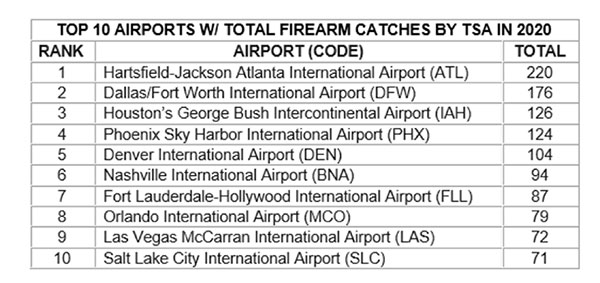
Passengers with firearms at checkpoints were stopped at 234 airports nationwide. The top ten airports where TSA officers detected guns at checkpoints in 2020 were:
Airport Firearm Detection more than Doubles in 2020

Airline passengers can fly with firearms in checked baggage if the firearms are properly packed and declared at check-in. However, firearm possession laws vary by state and locality. TSA advises travelers to familiarize themselves with state and local firearm laws for each point of travel prior to departure to ensure they transport guns in accordance with applicable laws.

Airlines may have additional requirements for traveling with firearms and ammunition, so travelers should also contact the airline regarding firearm and ammunition carriage policies prior to arriving at the airport.

In some cities, local law enforcement may file criminal charges against travelers who bring firearms to the TSA checkpoint. TSA will assess civil penalties that vary by number of previous offenses and whether the firearm was loaded at the time.

The complete list of penalties is posted on TSA.gov. Firearms are not permitted in the passenger cabin of an airplane; this includes travelers with a concealed weapon permit.

Where local firearm possession laws permit, passengers may travel with firearms in checked baggage if they are unloaded and packed in a locked hard-sided case. Ammunition must be in its original box and can be packed inside the hard-side case, next to the firearm. Even if the box of ammunition is not full, the bullets must be in their original case. The passenger must present the case with the firearm at the airline check-in counter and inform the airline representative of their intention to travel with the gun.

Firearms are transported with checked baggage and are placed in the cargo hold of the aircraft.

Data collected represents the number of firearms caught on passengers and in their carry-on bags at the nation’s TSA checkpoints. Excluded from the data are improperly packed guns at checked baggage stations, toys, replicas and BB guns. Visit the TSA website for details on how to properly travel with a firearm.

Featured

  • The Evolution of IP Camera Intelligence

    As the 30th anniversary of the IP camera approaches in 2026, it is worth reflecting on how far we have come. The first network camera, launched in 1996, delivered one frame every 17 seconds—not impressive by today’s standards, but groundbreaking at the time. It did something that no analog system could: transmit video over a standard IP network. Read Now

  • From Surveillance to Intelligence

    Years ago, it would have been significantly more expensive to run an analytic like that — requiring a custom-built solution with burdensome infrastructure demands — but modern edge devices have made it accessible to everyone. It also saves time, which is a critical factor if a missing child is involved. Video compression technology has played a critical role as well. Over the years, significant advancements have been made in video coding standards — including H.263, MPEG formats, and H.264—alongside compression optimization technologies developed by IP video manufacturers to improve efficiency without sacrificing quality. The open-source AV1 codec developed by the Alliance for Open Media—a consortium including Google, Netflix, Microsoft, Amazon and others — is already the preferred decoder for cloud-based applications, and is quickly becoming the standard for video compression of all types. Read Now

  • Cost: Reactive vs. Proactive Security

    Security breaches often happen despite the availability of tools to prevent them. To combat this problem, the industry is shifting from reactive correction to proactive protection. This article will examine why so many security leaders have realized they must “lead before the breach” – not after. Read Now

  • Achieving Clear Audio

    In today’s ever-changing world of security and risk management, effective communication via an intercom and door entry communication system is a critical communication tool to keep a facility’s staff, visitors and vendors safe. Read Now

  • Beyond Apps: Access Control for Today’s Residents

    The modern resident lives in an app-saturated world. From banking to grocery delivery, fitness tracking to ridesharing, nearly every service demands another download. But when it comes to accessing the place you live, most people do not want to clutter their phone with yet another app, especially if its only purpose is to open a door. Read Now

New Products

  • PE80 Series

    PE80 Series by SARGENT / ED4000/PED5000 Series by Corbin Russwin

    ASSA ABLOY, a global leader in access solutions, has announced the launch of two next generation exit devices from long-standing leaders in the premium exit device market: the PE80 Series by SARGENT and the PED4000/PED5000 Series by Corbin Russwin. These new exit devices boast industry-first features that are specifically designed to provide enhanced safety, security and convenience, setting new standards for exit solutions. The SARGENT PE80 and Corbin Russwin PED4000/PED5000 Series exit devices are engineered to meet the ever-evolving needs of modern buildings. Featuring the high strength, security and durability that ASSA ABLOY is known for, the new exit devices deliver several innovative, industry-first features in addition to elegant design finishes for every opening.

  • Camden CM-221 Series Switches

    Camden CM-221 Series Switches

    Camden Door Controls is pleased to announce that, in response to soaring customer demand, it has expanded its range of ValueWave™ no-touch switches to include a narrow (slimline) version with manual override. This override button is designed to provide additional assurance that the request to exit switch will open a door, even if the no-touch sensor fails to operate. This new slimline switch also features a heavy gauge stainless steel faceplate, a red/green illuminated light ring, and is IP65 rated, making it ideal for indoor or outdoor use as part of an automatic door or access control system. ValueWave™ no-touch switches are designed for easy installation and trouble-free service in high traffic applications. In addition to this narrow version, the CM-221 & CM-222 Series switches are available in a range of other models with single and double gang heavy-gauge stainless steel faceplates and include illuminated light rings.

  • Unified VMS

    AxxonSoft introduces version 2.0 of the Axxon One VMS. The new release features integrations with various physical security systems, making Axxon One a unified VMS. Other enhancements include new AI video analytics and intelligent search functions, hardened cybersecurity, usability and performance improvements, and expanded cloud capabilities