
Effective Governance is Key to Enterprise Cloud Security
Large organizations are prioritizing hybrid models and operational oversight to ensure long-term resilience and regulatory compliance.
- By Jesse Jacobs
- Apr 03, 2026
A growing gap exists between standard cloud adoption models and the complex governance requirements of large-scale enterprises. While the move to the cloud is often marketed as a simple transition, global organizations with hundreds of sites face unique regulatory and cybersecurity challenges that necessitate a more nuanced approach.
Recent data indicate that enterprise physical security rarely functions within a single deployment model. Instead, these organizations frequently maintain cloud, on-premises and hybrid environments simultaneously. Experts suggest that maintaining visibility and control across these diverse systems is essential for long-term operational stability.
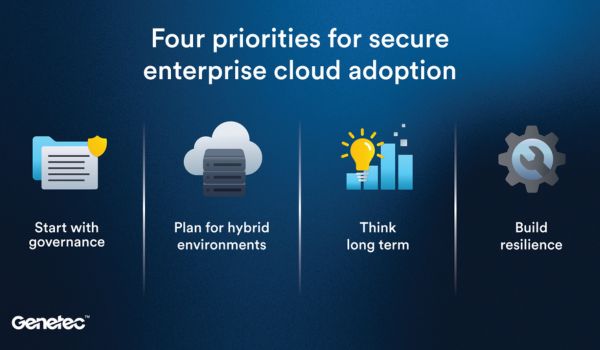
According to a 2026 industry survey of more than 7,300 respondents, hybrid-cloud adoption is increasingly viewed as a strategic necessity rather than a temporary phase. The study found that 39% of enterprises adopt hybrid environments for scalability, while 38% do so to ensure redundancy and business continuity.
Industry leaders argue that for the enterprise sector, the cloud should be viewed as an operating model rather than a final destination. This perspective emphasizes integrating cloud capabilities into existing infrastructure to strengthen oversight without compromising the ability to function during network disruptions or service outages.
To maintain security, organizations are encouraged to design systems that allow for autonomous operation. This ensures that physical security infrastructure remains functional even during outages or changing economic conditions. By focusing on accountability and graceful degradation across edge and cloud systems, enterprises can meet strict compliance standards while managing evolving risks.