Fraunhofer IPMS Advances High Density Chiplet Integration
Researchers develop a quasi-monolithic method to seamlessly fuse modular semiconductor components at the wafer level.
- By Jesse Jacobs
- May 19, 2026
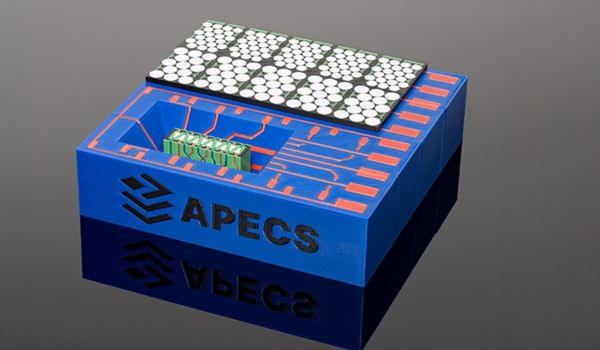
Microelectronics researchers have demonstrated a new manufacturing method that embeds separate chip components into silicon pockets to mimic the performance of a single, unified chip.
Developed by the Fraunhofer Institute for Photonic Microsystems IPMS as part of the European APECS pilot line, the quasi-monolithic integration (QMI) approach aims to bridge the gap between traditional chip packaging and advanced semiconductor fabrication. The process allows components like control electronics, sensors and microelectromechanical systems to be combined at the wafer level while maintaining a highly compact footprint.
To achieve this, researchers structured silicon wafers with precise recesses before inserting dummy chiplets into the pockets. The surface was then leveled with a passivation layer to prepare the system for subsequent back-end-of-line wiring.
"This creates a nearly monolithic system architecture that combines the highest integration density with modular scalability," said Dr. Lukas Lorenz, group leader at Fraunhofer IPMS.
By arranging the chiplets on a shared wafer substrate, the interconnects can be formed during the front-end fabrication process. This proximity achieves significantly higher connection densities than conventional packaging methods.
According to the research institute, the QMI architecture shortens signal paths to reduce latency and power losses. Eliminating traditional mechanical interfaces also improves system robustness, while the tight integration offers substantial space savings and cost-efficiencies for modular designs.
The integration method is primarily targeted for high-bandwidth smart transceivers and system-on-chip solutions utilized in artificial intelligence applications.
While the initial manufacturing run relied on dummy structures to prove the concept, the institute plans to transition the process chain to functional customer applications. Fraunhofer IPMS is currently seeking industrial partners to scale the technology into production-oriented manufacturing environments.