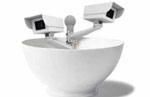
Cooking Up a Bowl of Security
When preparing to open Galileo III, a white-tablecloth Italian restaurant in Washington, D.C., within walking distance of the White House and the National Theater, Chef Roberto Donna let his imagination take hold, not only in the dishes he wanted to prepare for Washington’s movers and shakers, but also in how he could maximize the security surveillance system he knew he would need to protect his assets and help manage his business.
- By Courtney Pedersen
- Jul 01, 2011
Donna is an award-winning chef, having been twice named Chef of the Year by the Restaurant Association of Metropolitan Washington and receiving the James Beard Award as Best Chef/Mid-Atlantic Region in 1996. He also competed and won in the Iron Chef TV series and has made numerous appearances on other cooking and news shows.
Working with ICI Systems, a technology integrator and IT services provider in the nation’s capital, Donna and ICI consultant Nabih Bedewi deployed a solution that covered the three key areas in Donna’s vision: security, table management and cooking demonstrations.
“When he was talking about plans for the restaurant and was bringing up these ideas, we said we could do all of this in Milestone,” said Bedewi, adding that he hadn’t seen a situation before where a client wanted such diverse options within a system. ICI has been working with Milestone Systems since 2008.
The backbone of the solution is Milestone XProtect Professional—surveillance software used for advanced video management, flexible scheduling, fast searching and video analysis—and XProtect Smart Client, which is used for remote access.
“In order to do all the things Roberto wanted, you usually need different platforms,” Bedewi said. “But using Milestone, we are able to provide a single platform for all forms of camera management.”
Within and on the restaurant property there are 25 PoE IP network cameras: Panasonic WV-NS202A PTZ iPro and the Panasonic BB-HCM715 indoor PTZ. Five cameras are used for traditional security, focused on the front and back entrances, the wine room and the offices. An additional three are for use within the kitchen; the rest are spread throughout the 80-seat restaurant and the two private rooms that serve an additional 45 patrons.
With a wine inventory estimated at $300,000, Donna wanted a solution that would ensure the safety of this valuable asset. Through Milestone, a camera in the room tracks and records based on motion detection. The home position is the door, so when someone opens the door and enters the room, the system begins to track the person and records the entire time he or she is in the room, then automatically cuts off 20 seconds after the motion stops. On the other five doors being monitored, contact sensors are tied into Milestone.
More than Just Security
While the system’s security functions are a necessary part of doing business, both Donna and Bedewi were more excited about the non-traditional opportunities.
“Fine cuisine is all about timing and food preparation,” Donna said.
By having cameras in the dining room that can be viewed via a flat screen monitor within the kitchen, featuring up to 16 views at one time, the chef is better able to time when to begin the next course so customers feel neither rushed
nor neglected.
The cameras are not hidden from view, said Donna, so most customers are aware of their presence. But there is no audio associated with the system, nor is the video recorded within the dining room when it is occupied. The cameras are aimed at the tables, not the people themselves.
Via a touch-screen monitor in the kitchen, the chef can call up an individual table on the screen and make decisions on timing, service and meal preparation. Just tapping an image on the monitor brings it to full screen for the kitchen staff to view, Bedewi said.
The table management system uses the Milestone Smart Client Live View to monitor the tables. There is no recording or scheduling with this function, although Milestone is configured to use scheduling and motion detection for all cameras during non-service hours (midnight to 10 a.m.). Even the table management cameras are recording for surveillance purposes during the off hours.
Donna, who doesn’t cook at the restaurant every day, said he also uses the system on his laptop and office computer to monitor all the video from the security surveillance, dining room and kitchen. From home, he is able to view activity within the kitchen and check on deliveries and when the staff arrive. With 22x optical zoom, Donna is able to observe cutting techniques and other fine details. From a practical standpoint, Donna said he’s used the system remotely to look for keys he thought he had left on his desk. And yes, they were there.
A Class Act
In addition to monitoring dining room activity, Donna is eager to deploy the kitchen cameras for his cooking classes and special meals. He has been doing classes for about 11 years, he said, and in February 2011 he was planning to start again at his new restaurant.
Three kitchen cameras will provide live feeds as Donna prepares the eightto 10-course meals in the Laboratorio, which is open on certain evenings for these special tasting meals. They will provide access codes in advance to people at home who want to view the meal preparation so they can then log in to
see Donna at work.
“It’s a great tool to use,” he said.
The video from the cooking classes will be recorded and archived, Bedewi said. No DVRs are used, just a highend PC for the Milestone server.
Donna conceded his busy schedule has kept him from exploring all the options that the Milestone platform can provide.
“I’m not a computer scientist,” he said, “but the people from ICI explained everything well, provided training and were responsive to my needs.”
Other chefs visiting Donna in Washington have already checked out his system and have been impressed by what it can achieve. “I recommend it to all my friends,” Donna said.
This article originally appeared in the July 2011 issue of Security Today.